Annual Report Bonner Center for Character Education and Citizenship July 1, 2018 – June 30, 2019
Purpose of Ancillary Unit
The KSOEHD’s Bonner Center for Character Education and Citizenship was formed in 1997 to promote character education in the Central Valley through providing nationally recognized speakers for the Fresno area, forums on character education and professional ethics, materials and other professional resources for review, and coordination for a variety of character award programs.
Administrative Housing of the Ancillary Unit
The Bonner Center for Character Education and Citizenship is an authorized Ancillary Unit of the CSU Fresno and the KSOEHD. Dr. Jacques Benninga is its director. The Center’s activities are guided by an Advisory Board composed of KSOEHD faculty, local school districts, and personnel from Fresno, Kings and Madera County Offices of Education.
Major Accomplishments for 2017-2018
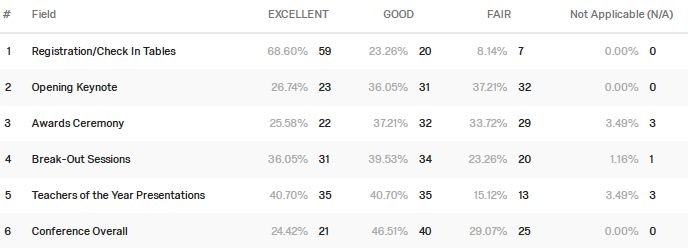
1. The 35th Annual Conference on Character and Civic Education was held on April 5, 2010. The conference was coordinated by KSOEHD faculty Dr. Susan Schlievert and Dr. Jacques Benninga. Fresno Pacific students and faculty joined our CSU Fresno students and faculty. We estimate that over 700 students attended, in addition to local educators. Justice Charles Poochigian of the 5th District Court of Appeal was the keynote speaker. He spoke about educating students for democratic participation. The conference day included the 32nd annual award programs for Valley schools, two general sessions, and 25 breakout sessions. The conference was positively received and received positive feedback from participants, with 63% favorable review of the keynote speaker, 76% favorable review of our breakout sessions, and 82% favorable review of the 2nd General Session speakers—Teachers of the Year from Fresno and Tulare counties. Some students had suggestions about the meals and others wanted additional sessions for special education. All responses/suggestions will be analyzed for next year.
2. The 32nd Annual Virtues and Character Recognition Program (2019) recognized 9 Valley middle schools and 3 Valley high schools for exemplary character education programs as part of the conference. This is a work-intensive process, initiated each year in October and culminating in March. Winning schools honored for 2019 included:
- Alpine Vista Elementary School, Tulare City School District
- Central High School, Central Unified School District
- Clovis East High School, Clovis Unified School District
- Clovis West High School, Clovis Unified School District
- Grant Middle School, Kings Canyon Unified School District
- J.F. Kennedy Jr. High School, Hanford Elementary School District
- Kings Canyon Middle School, Fresno Unified School District
- Los Tules Middle School, Tulare City School District
- Reyburn Intermediate School, Clovis Unified School District
- Scandinavian Middle School, Fresno Unified School District
- Sequoia Middle School, Fresno Unified School District
- Washington Academic Middle School, Sanger Unified School District
A small planning grant from the Kern Family Foundation (Waukesha, Wisconsin) to explore a statewide consortium for Character Education in California helped support the conference. That group met several times in San Diego, Santa Clara and Fresno. Members include representatives from Fresno Pacific University, University of San Diego, CSU Bakersfield, Fresno State, Santa Clara University, and San Jose State. The objective was to expand character education to a larger segment of California beyond the Central Valley. Conversations are ongoing with the Kern Family Foundation to expand character education in the Central Valley, and representatives from that foundation came to Fresno in May to meet with President Castro and various CSUF administrators.
3. Benninga serves as co-editor of the refereed Journal of Character Education and is a core member of Fresno State’s Ethics Committee, character.org’s Quality Assurance Task Force, and Santa Clara University’s Partnership for Educational Leadership Transformation. He presented a poster session on aspects of the awards criteria (described above) at the Society of Research in Child Development (SRCD) Special Conference: Promoting Character Development Among Diverse Children and Adolescents. Philadelphia, October 18-20, 2018 (with Steven Hart, Mariya Yukhymenko, Andrew Fiala).
Sources of Funding
The Bonner Center sells no services or products. Income for the center’s activities comes from donations provided by the following agencies:
- The Kremen School of Education and Human Development
- The Bonner Family Foundation
- The Kern Family Foundation
- Fresno County Office of Education
- Kings County Office of Education
- Madera County Office of Education
- Education Employees Credit Union
- Teaching Fellows Foundation
The Unit’s Financial Statement: See attached
Advisory Committee
The Bonner Center Advisory Committee is composed of KSOEHD faculty, representatives from local school districts, and public-school personnel from Fresno, Kings and Madera counties:
Dr. Jacques Benninga
Kremen School, CSUF
Ms. Dianna Young Marsh
Assistant Superintendent
Madera County Office of Education
Dr. Nancy Akhavan,
Kremen School, CSUF
Mr. Randy Mehrten
Fresno County Office of Education
Mr. Dan Bordona,
Fresno Unified School District
Dr. John Minkler
Bonner Center, CSUF
Dr. Kathryn Catania
Deputy Superintendent
Fresno County Office of Education
Ms. Jane Moosoolian
Kremen School, CSUF
Ms. Leanna Cantrell
Kings County Office of Education
Dr. Susan Schlievert
Kremen School, CSUF
Ms. Kaye Bonner Cummings
Bonner Family Foundation
Dr. Richard Sparks
Bonner Center, CSUF
Mr. Manuel Escandon
Fresno County Office of Education
Dr. Jennifer Moradian Watson
Kremen School, CSUF
Dr. Andrew Fiala
Department of Philosophy, CSUF
Dr. Don Wise
Kremen School, CSUF
Dr. Steve Hart
Kremen School, CSUF
Mr. Jim Yovino, Superintendent
Fresno County Office of Education
Ms. Erica Hasenbeck,
Fresno Unified School District
Dr. Mariya Yukhymenko
Kremen School, CSUF
Dr. Christina Luna
Kremen School, CSUF
Goals and Objectives for 2019-2020
Several areas will receive primary attention by the Bonner Center in 2019-20.
a. The Bonner Center is participating with Fresno State’s Ethics Center and the Fresno County Civic Education Task Force. The goal is to establish a consolidated Ethics Center on Fresno State’s campus. Thus far meetings have been held with university officials (i.e., Provost, respective deans, development officials, etc.) and local officials (e.g., Fresno Business Council). A planning proposal for part of this work was received from the Kern Family Foundation, and talks with the Foundation are ongoing.
b. The Bonner Center’s web site will be updated.
c. Dr. Benninga continues to serve as co-editor of the Journal of Character Education. He reviews manuscripts and coordinates special theme issues.
d. The 36th Annual Conference on Character and Civic Education is scheduled for April 3, 2020. The summer of 2019 will be spent raising the necessary funds for the conference and planning its events. We are searching for a keynote speaker.
e. Application for the 2020 Character and Civic Award Program will be revised. This will be the 33rd annual such program for the Bonner Center.
f. Other areas to receive attention in 2019-20 include the materials collection in the Bonner Center, consultation with schools, speaking engagements, and instructional programs, and planning for the upcoming year. A major project will be planning for the creation of the integrated Ethics Center and negotiating with the Kern Family Foundation.
Appendix
a. The unit’s financial statement prepared by the California State University, Fresno Foundation.
This HTML version was generated with AI assistance and may contain errors or omissions. The original approved PDF remains the official document of record. An alternative accessible format is available upon request from the document creator in accordance with Title II of the ADA.