Research-Based Character Education
Whereas character education is not new~scientific study of its efh~ctivenesshas been
only sporadically implemented during the past thirty—five years. Much of tile application
of character education is therefore not informed by a scientific knowledge base. This
article introduces a scientificperspective on character education and a summary ofthe
research base examining the student impact of school—based character education From
this research base, general pnnciples of effective practiceare denved, Thisin turn
is used to offer suggestions to practitioners and policy makers for the improvement
ofschoolbased character education.
Based Keywords: character education; research; best tree; character development; effective
Character scisools Education
C
haracter education is not new. In fact, we can probably date it back at least to Socrates.
Even in the United States, it goes backas far as the founding of the colonies (and
likely far—By ther in Native American culture) (McClellan MARVIN W. BERKOWITZ 1999).
But character education has historically and been a practice and not a science (Berkowitz
MELINDA C. BIER 2002). In otherwords, there has been an abundance of educational methods
and curricula generated i)Ilt comparatively little research on its effectiveness,There
was a flurry ofinterest in the first third of the twentieth century (e.g.,
Marvin W. Berkowitz, a developmental psychologist, is the Sanford N. McDonnell I’rofessor
of Character Mu— Cation at the Uoiversity of Missouri—St. Louis. J’rcvi— ously, he
was the Ambassador Holland Ii. Coors Professor of Character Development at the US.
Air I~orce Acadenuj and a professor of psijehologi,, at Marquette University.
Melinda C. Bier is an affiliate assistant professor ofedu— cation at the Uu~versityof
Missouri—St. Louis and the project director of “What Works in Character Educa— tion
(funded hij the John Templeton Foundation) and “National Character Education Clearinghouse
and Resource Center” (Funded by the U. S. Department of Education). Preciously, she
was Program Officer at the James S. McDonnell Foundation.
NOTE: Supported by a grant from the John Teulpietnll 1oundatinii.
DCI 0.1177/00(12710203260082
72 ANNALS, AAPSS, 591, january 2004
YOIJTI I AS PROP! .E
Steiner—Adair, C. I 989. Ilie body politic: Normal female adolescent tlevelopinent
and the th’velnpment of eating (lisorders. In Making connections: The re/ational worlds
of adolesceni girls at Loooa \l/illard School, edited by C. (4lligan. N. P Lyons.
and ‘P J . I laoinei; 162 82. l’roy NY: Ennna \Villard School.
S~~ll ivan, A. 1996. 1”ronimentor to loose. In Urban girls: Resisting stereo!ypes,
creating identi ies, editrsI by B. J. Leadheater and N. \\
T
ay, 226—49. New York: New York University Press.
latom, B. 1). 1997. “Why are all 1/ic black kids u/flog togetherin the cafeteriar’
and oilier con rersations’ about race. New York: Basi’ Books.
Tlinn , M. 2001 .Balancing thu’ equation: \Vlieri’are women and girlsin science, engineering
and technology? New York: National Cot mcii h)r Researelmu \W omen.
United States I )epartmnent of Education. 2003. When schools stat/ open late: I/ic
national (‘vahmtion of’time 2/st Century Coonnunitt,Lea rnmgCentersProgram: I iiSt
tjearJinding.’i. Washington, I)C: CovernI netit Printing Office.
Walker, K. E., J. B. Crossnian, amid R. Haley 2000. lestended service schools’: Putting
/)rogra?nlming in p/ace. With V. Fehleratli and C. I. Itolton. l’liiladelpliia: Pnblic/Private
‘A’otnres.
\Varcl, J. V 1996. Raisingresisters. In Urban girls: Resisting stereotypes, creating
u/cot Ote.s’, edited by B. J. Leadheater 111(1 N.Way, 85 99. Ness’ York: Ness’ York
University Press.
\VFD Inc., NIelpomoene Institnte for \Vomeo’s IIealth Research, Cirls Incorporated,
and National Assoeia— hon or Cirls and Womsien in Sport. 2001). Achieving gender (‘(/Uit~/in
the gym and on the platjingfiehl. Watertown, MA: \\ork/Fami!v Directions.
Wolfe, 1.. H. 2001 . “Does it have to belike thiis~”Teen women ask theirpeers about
violence, hate and (h.s’criio— maim: ‘I’he report of the ‘leen %V~nsietiLeaders/np
Development Initiativi’ Sort ey. Washington, I )( 3 :enter for Women Polic~Studies.
Retrues’ed from http://www.centem’svonienpo!icv.oi’g/reportdoss’oload. efm?BeportlD= 1.
~\T~nien’sSports Foondation. 1998. ‘The \Voomen ~s’Sports Foundation Report: Sport
011(1 teen pregnancy. East Meadow, NY: Author
Yonniss, J., J. A. Mc! .eI!am i, and B. Maser. 2001. \‘o!nntary service, peel’ groop
oriei tation, and civic engage— milent. Jomu rnal of Adolescent Research 16:4.56.
IIESEAIiCII BASEI) CIIAHAC]’ER EDUCATION 7:3
Denver Public Schools 1929; Dewey 1909; Griggs 1906; llaviland 1921; MacCuurt 1920)
antI evensome substantive research on the topic (Ilartshornc and May 1928 1930). Nonetheless,
interest in character education waned in the middle third of’ the twentieth century,
and little research was done. in the past thirty—five years, contemporaly researchers
have turned their expertise and attention to character education. Hence, a substantial
body ofinformation has begun to accrue concerning the effectiveness of character education.
Thisarticle will examine sonic of what we now know about effective practice.
What Is Character?
It is difficult to discuss the effectiveness of character education without first
considering its goals. The central goal ofcharacter education is the development of’
character in students. Therefore, before we address the research on effective ch~u’acter
education, we iieecl to consider what we mean by character and its (levelop— ment.
Character can be defined in vanous ways and is indeed used in clifft~rent ways in
common speec1~.\‘Ve consider someone “a character” ifthey act atypically. We also
commonly refer to “having character,” but sometimes that character is “good” or “bad.”
It is unlikely that a school that proposes a character—educationinitiative is interested
in either generating a “bunch of characters” or promoting the developiiient of “had
character” in students. What we really mean in this field whenwe invoke characterissociomoral
competency. Character is the complex set ofpsychological characteristics that enable
an individual to actas a moral agent. in otherwords, character is multiflhceted. It
is psychological. It relates to moral func— tionmg. In the Brst author’s moral anatonly,
seven psychological aspects of cliarac— ter are identified: moral action, moral values,
moral personality, moral emotions, moral reasoning, moral identity, and foundational
characteristics (Berkowitz 1.997).
Thisis likely nota complete taxonomy, butit helps to understandthat when one functions
(or fails to function) morally, it maybe due to any one or sotne set of these psychological
characteristics. For instance, if two equally well offpeople individually find a wallet
with money and identification in it, and one returns it intact while the other takes
the money and discards the wallet (perhaps even bragging to his or her kids about
how clever it was to take the money), we can imagine manyreasons for these different
responses to a moral situation. Person A may have more highly developedempathy and
feel for the person who lost the wallet. Or Person A may have a heightened sense of
moral sensitivityand be more likely to notice that this is a moral issue to begin
with. Or Person A may have more mature moral reasoning leading to a better understanding
of whatthe right action is. Or Person A may be better at perspective taking and is
ableto put himselfor herselfin the shoes ofthe wallet’s ossmer, Or Person A may have
been raised with a different set of values. Or Person A mayhave a more highlydevelopedconscience.
Or... Or... In fact, it may bP (Inc to ~onieset of these characteristics. The point
is that character is complex, multifaceted, and psychological and that it comprises
the moral side of’ a person.
Each ofthese characteristics develops over the life span and especially in child¬hood
and adolescence (Damon 1988). The predominant impact on this comes from family (Berkowitz
and Gmych 1998; Lickona 1983), but schools can also be a developmental force (Berkowitz
and Grych 2000; Liekona 1991; Gottfredson 2001). For families or schools to influence
character development optimally, they need to understand the complex nature of character
and to applyeffective principIesthat have been empirically shown to positively impact
the development ofthe many parts of the moral person.
Does Character Education Work?
This frequently asked question is s/ely difficult to answer, not because there is
not ample research on the topic but because, in a sense, it is the wrong question.
The term charactereducation is applied1 to such a wide array ofeducational initiatives
that it isdifficult to generically answerwhether such a mixed set of programs “works,”
Character education varies from a limited set ofstand-alone and homegrown lessons
to fully integrated, comprehensive school-reform models. Many teachers and/or schools
simply create some lessons or recognition programs forgood character. Others adopt
packaged curricula or programs that themselves mayvaryfrom a smallset oflessons to
a comprehensive school model. Others cobbletogether elements of other initiatives,
p~l’t~tpsadopting a packaged classroom—management program and overlaying another packagedpreventionprogram
with a homegrown integration of character issues into their literature or social studies
curriculum.
And so on.
Furthermore, much of what would count as character education is not even labeled as
such. Service learning, social-emotional learning, and prevention prograins all share
significant features withcharacter education and could be considered forms of character
education. For our purposes, if a school-based initiative targets character development,
as we have defined it above, in either its program design or its outcomes and goals,
then it is a form of character education. Indeed, the field would be well served by
a superordinate term that couldencompass all of these more parochial fields: something
like positive youth development as a rtil)ric for character education, service learning,
social—emotional learning, and so on. Unfortunately, the professional organizations
that represent each of’ these subfields have invested too heavily in their respective
names to make such an integrative move likely.
Thebest answer to the questionofwhether character education works is to simply statethat
quality character educationdoeswork. In otherwords, character editcation can work,
but its effectiveness hinges upon certain characteristics. This is what the rest ofthis
article will address: what are the features ofeffective character education?
Before we turn to that question, however, it isworthwhile to note tile wide array
of outcomes that have been demonstratedby effective character education. Character
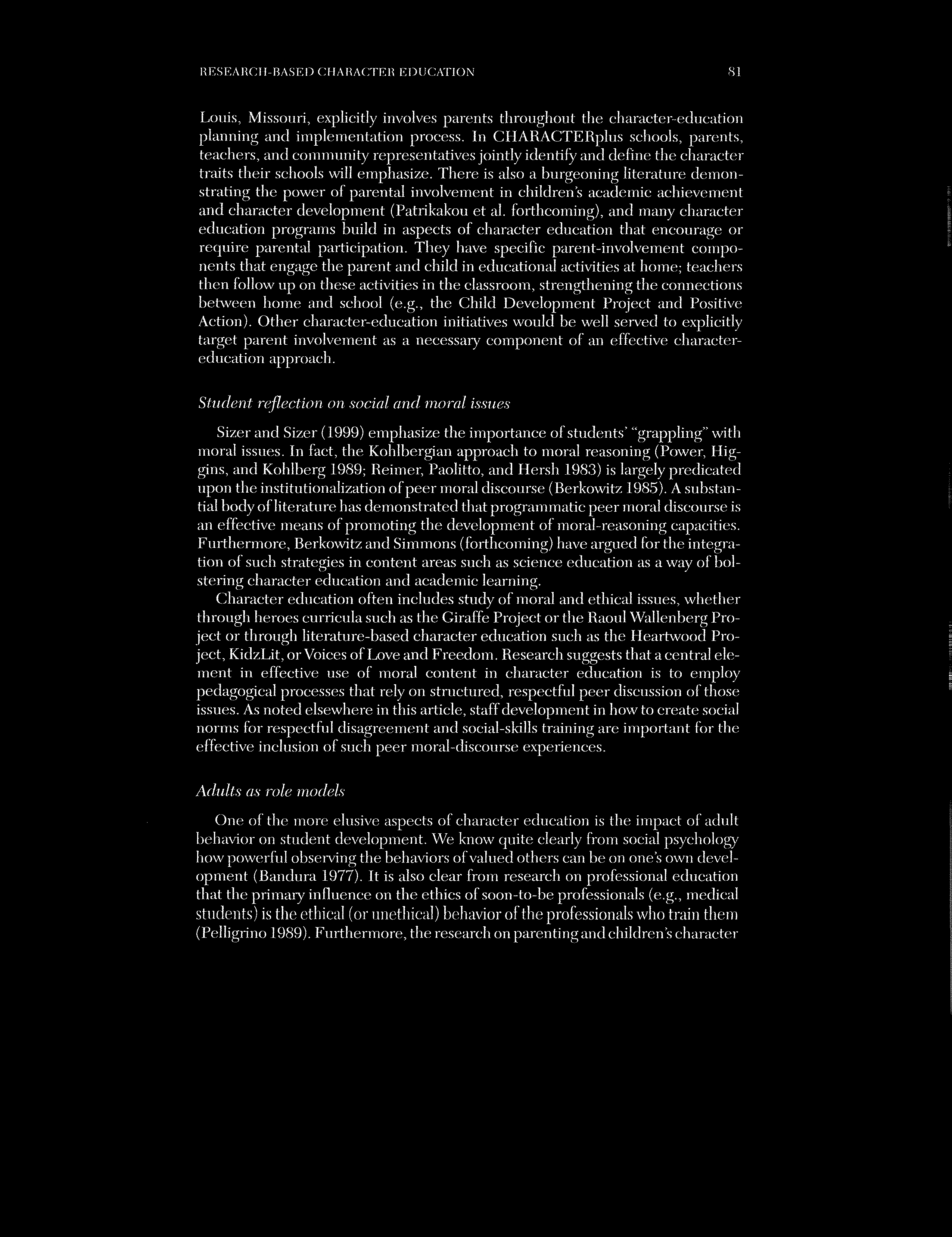
education has been demonstratedto he associated with academic motivation and aspirations,
academic achievement, prosocial behavior; bonding to school, prosocial and democratic
values, conflict—resolution skills, moral—reasoning maturity, responsibility, respect,
self-efficacy, self-control, self-esteem, social skills, and trust in and respect
for teachers. Furthermore, effective character education has been demonstratedlto
m’educe absenteeism, discipline referrals, pregnancy, school failure, suspensions,
school anxiety, and substance use. Clearly, whenit is effective, it svorks. \‘Vhat
we need to know is what makes a character—education initiative efh~ctiveor ineffective,
What Works in Character Education?
Most ofwhatfollows isthe productofa granmt fm’om the JoliniTempleton Founda— ti()ntitled
“What‘Works in CharacterEducation?”The results reported here, however; are preliminary
as that project has not been completed. The results are supplemeruted with work by
others, most notably an excellent review by Solomon, Watson, and Battistich (2001).
Quality ofimplementation
Itseemsself—apparent, but one ofthe most critical factors in the effectiveness of
character education is the faithfulness with which it is implemented. Typically, it
falls to classroom teachers to implement character education, and typically, they
are notade1
uately trained to implementit accurately or completely. Research ha.s consistently
demonstrated that fur character education (or any form ofinterven— tion for that matter)
to work, it must be fully and accurately delivered (Colby et al. 1977; Kam, Greenberg,
and Walls 2003; Solomon et al. 2000). Whereas this point may seem so obvious that
it is not worth repeating, the fact ofthe matter is that many programs and program
evaluations fail to monitor the level and quality of’ implementation and likewise
fail to build in adequate safeguards to mnaximize time likelihood offull imnplementation.
Effective character education requires fidelity in implementation, therefore implementers
riced to ensure such fidelity.
A subissue ofthis concern with implementation quality, arid one that has not been
adequately addressed in the researcii literature, is exposure. Given the high mobility
rates in manyschools, quality implementation may still not be effective if students
arenotpresent during implementation. Most researchers do notexamine the levels ofexposure
ofstudents in character-education initiatives. While it seems fur to assume that studentswithgreater
exposure will benefit more from character education than will students with low exposure
in the same schools, the relation¬ ship betweenexposure and outcomes maynot be straightforward
(Allen, Philliber, and lloggson 1990; Solomon, Watson, and Battistich 2001).
Comprehensive, inult’~facetedcharacter education
Many effective character-education initiatives represent comprehensive, often schoolwide
or districtwide, multifaceted approaches. Programs such as the Child Development Project
(and its derivative Caring School Community; http:// www.devstu.org; Solomon et al.
2000), Resolving Conflict Creatively Program (http://www.esrnational.org;Aber et al.
1998), and the Seattle Social Development Character is the complex set ofpsychological
characteristics that enable an individual to act as a moral agent. Project (Hawkins
et ah. 1992) are multicomponent models that include classroom management, curricular,
social—skill training, parent involvement, and/or school— reform elements. This is
notto say that monolithic initiatives cannot work;rather, that comprehensive initiatives
seem to be particularly effective, especially when character is broadly defined and
diverse outcome goals are targeted.
Student bonding to school
Under a vam’iety of dif’ferent names (bonding, attachment, belonging, relatedness,
connection, etc.),it has been demonstrated that from preschoolthrough high school,
the emotional attachment ofa student to his or her classroom and school is a critical
mediating factor in the effectiveness of character educatioim (Berkowitz and Bier
forthcoming; Osterman 2000) and of students’ general engagement in school (Furrer
and Skinner 2003). At the preschool level, 1-lowes and Ritchie (2002), through a series
ofstudies, have demonstrated that children with more positive interactions with and
more seetmre attachments to their teachers were more positive, more gregarious, engaged
inmore complex social play,had demonstrated more advanced cognitive activity, and
showed more ego resiliency. Research on the Child Developmnent Project (Solomon et
al. 2000) has revealed that the effectiveness of this elementary school program is
mediated by the degm’ee to which students come toperceive their classrooms and schools
as a “caring community.” Fimrthermore, in an earlierstudy, they report that students’
sense ofthe classroom as a comnnmnity is significantly related toteachers’ emuphasis
on cooperative strategies and focums on prosocial values (Solomon et al. 1997).
In middle school, when students perceive their teachers as supporting respectful 1 student interactions, having high expectations, being slmpportive and fair, and
avoiding a m’eliance on negative messages andl behavioral rules, the students show
increaseti self—efficacy, self—regumlation, character development, ammdl academid’
achievement (Ryan and Patrick 2001; Wentzel 2002). In a series ofstudies on a national
high school data set, it was demonstrated that attachment to parents and school were
the two mnanm predictors ofreduced risk beltavior (Resimick et al. 1997). Furthermore,
the school predictors ofstudent bonding to school were found to be positive classroomn
management, tolerant (nonliarsh) disciplinamy practices, involvementin extracurricular
activities, smaller schools, good pllysical health, and avoidance of cigarette smoking
(Bonny et al. 2000; MeNeely, Nonnemaker; and Blum 2002).
Clearly then, when designing and implementing a character—education initiative, it
is of great importance to intentionally target strmdents’ phenomnenohogical perspective
ofthe school (amid classroom) as a caringcommunity and their subsequent einoliomial
bonding to the school and classroom, as 1)0th a goal and a mea—
surecl ni mtcome or mediating variable.
Leadership is key
One of tile fictors that practitioners will repeatedly affirmsi is that the school
leader is the most critical individimal in the success or failum’e of a character—education
initiative. Certainly,it is possible tocreate an islandofsanitywithin a classroom
in a school that does not meaningfully embrace character education (Urban 2003), but
that serves only the stumderits who pass through that classroom. To positively impact
an entire school, the school pm icipaLs role is essential (l)efloehie and Williams
2001; Lickona 1991).
The Character Education Partnership identifies three imuiportant aspects of character:
imniderstanding, commitment, action.While these are intended toapply to the student
developmental outcomes of character e(lucatiOfl, tlley can apply to staffdevelopment
as well, An effectiveprincipal needs to (1) “getit,” (2) “buy into it,” and (3) “live
it.” In other words, leadimug a school of character requires that the principal first
hilly understands what qualitycharacter education entails (mnost do not). Then the
principal must really connmnitto this vision and trulywant to make it happen under
his or her watch. Finally, the principal must have the requisite skills to enact quality
character education amid then to live it out both personally and programmatically.
PATHS (Greenberg et al. 1995), a well-researched character-education program, recently
reported that principal “buy-in” (interestlcommitmnent) was one of two critical factors
necessary for effective implementation (Kam, Greenberg, and Walls 2003). But buy-in
is only part of this triumvirate of leadership attributes. Whereas some identify the
task of character—education leadership to be largely exhortation (Mumrphy 2002), others
argue that the core function ofschool leader— ship goes much deeper. Valentine, Triunble,
and Whitaker (1997) argue fur leader competency. Jackson and Davis (2000), in a blueprint
for middle school reform, argime for the principal to be a “principal change agent”
who relieson staffempow—
ernmemit and dc’mnocm’atic governance as the path to school impm’ovemilent amid stimdent
flourishing.
This is pm’ly wilygm’ommps like the Character Education Partmiem’ship (huttp://www.cluaracter.org)
amid the Collaborative for Academniic, Social and Emotional I ~earnmg (http://www.casel.org)
have tam’geted imiitiatives for school—header training. imi St. Loumis, a collaborative
of the University of Missouri—St. Louis and the Cooperating School Distm’icts has
been offering yearlong academies imi chau’acter d’dll education fur five years (Nance
et al. 2003). It is clear to us rilmunimig these acacle— imiies that school leaders
need to learn the why (“head”) amid the how (“hamid”) but also often need to dievelop
the comntitmmiemit and motivation (“heam’t”) to lead a d’haracter—edlmmd’atioml initiative
effectiveh~
C/iaracter education is good editcation
In the current climate of high—stakes standardized testing in schools, (hlflhlit)~
edumeation is takiumg quite a beating. Schools are skewing their curricula toward
the nam’row content of’ tests, in some cases actually dropping entire subject areas
that are not being tested that year. Schools am’e heconting pressure cookers where
adults amid studlc’mIts feel oppressed. Teaching is moving toward rote nieniorizationu
of’ whatever is expected to be on the test.
Character education, on the other hand, entails many of’ the central tenets of (~ualityc’hmcation.
The Hope Foummidation (hittp://wwss~eounimnmsmuitiesofliope.org) has iclemitifIecl
six characteristics of liigh—perf’orniing schools, which include having a shared vision
and goals, imsing collaborative teams, and developmg leadem’ship capacity at all levels,
A recent study ofthree at—risk schools that excel academically (Ancc’ss 2003) identifies
the characteristics of’success, which imichudle shared govem’— nanee, strong leaclem’s
who empower others, norms ofinterpersonal respect, close carimtg relationships among
staf’f and between staff and stumdents, and maximal opportunities for success f’or
all students. The characteristics identified by both of these reviews align stromigly
with many of the characteristics of comprehensive charactc’r education: student empowerment,
constructivist principles, collal)ora— tive learning, opportunities for student reflection,
a foc’mms on the deep and power— fiml truths of himman expc’m’iemice, and applications
of course eomitent to real—life projects (e.g., serviec’ lc’arning). It is them’efore
not slmrpnsing that quality character education turns omit to be good ediumeation
imi genem’al and that educational reforms like service learning and constrimctivist
edmmcation am’e found not only to promote academic achievement but also to foster
student character dievelopulent as well.
Likewise, it is not sumrprising that quality character education results in ac’ademnie
gains for students, sonmething that has beeii demuonstrated repeatedily in research
(e.g., Aber, Brosvn, andl I lemirich 1999; Allenet al. 1997; Battistieh amid I long
2003; Character Education Partnership 2000; Elliott I 993; Flay, Allred, and Ordway’
2001; Kiger 2000; Twemlowet al. 2001). All of these studies focus on the academic
effects ofparticimlar character—edtmcation pm’ogranis; however, a recent stimcly of
1 20 elementary schools iii California used a more genem’id’ definition of (‘hal’ac’tc’r
cdii—
cation and f’ormmd that qualityof character education is significantly related td)
stan— dlam’dizedl test scom’es (Bcnninga et al. forthcoming).
Character education OS primary prevention
In both the scholarly and the practical literatures, a strong distinction is made
between school-based prevention and charactereducation. I-Id)wever, this appears to
be a false dichotonny for two reasons (Berkowitz 2000). First, the two tend to share
many features. Second, character educationhas been systematically demon strated to
be an effective form of prevemition, especiallyprimary prevention.
Character—education programs like the Child Development Project have repom’ted significant
reductions in violence amid substance use (Battistich et al. 2000). Effective prevention
programs such as Life-skills Trainimig (Botvin et a!. 1997) an~IAll Stam’s (Harrington
et al. 2001) incorporate character—education dc¬ niemìts. Other prevention programs
have been demonstrated to both redluee risky behaviors and promote positive character
clevelopntiemmt (e.g., Allen et al. 1994; Kam, Greenberg, and Walls 2003; Taylor et
al.1999). Clearly, the distinction between preventioni and character education is
murky and character education is an effective form of primnary preventiomi.
Staff development
Staffinvolvement and comnmitment tocharacter education is criticaltoeffective implementation,
just as itis to all instructional innovations or edumcational reforms (Ilimide 2003).
Kamn, Greenberg, and \Valls (2003) report that immmplememitation of PATI-IS depended
heavily on teacher commitment.
Omie of the vastly underutilized components of quality character education is staffdlevelopmiient.
Typically, this is so either because the delivery systems were never builtinto the
character educationmodel or because itisjusttooexpensive (in terms of 1)0th money
and time). Many effective character-edimeation models either require or strongly recommend
staff development or offer it as an option (e.g., Child Development Project, Responsive
Classroom, Community ofCaring, Facing Ilistory and Ourselves, Learning for Life, Life
Skills Training, Reach Out to Schools).
As withprincipals, ifstaffdo not understand the imlitiative, they will likely implementitineffectively
or reject it for the wrong reasons. Ifthey do not value it, then they will notimplement
it effectively (if at all). If they do not know how to imiiple— ment it, then again
they will likely imuplement it ineffectively.
Direct skill building
Fronn a variety of theoretical perspectives, the trainimig of interpersonal, emo—
tional, and moral skills is critical toeffective school-based character development.
The traditional approach tocharacter education (Benninga 1991; Wynneamid Ryan
1993) has long relied upon aim Aristotehiami principle that character is f’om’mned
in large pam’t through habitual behaviorthat eventually becomiies internalizedi into
virtues (charactem’). Traditional social—emotional learning (Greenbem’g et al. 1995)
has m’eliecl upon niom’e behavioral models of’ learning audI dcvelopimiemmt and tlieref’om’e
dlependled heavily omi chassroomii lessons that clim’ectly tc’ach social and emttotional
skills. This same ~ipproachhas beemi clominamit in mitch of’the school—based pr~’v~’mi—
tiomi literature (Tappe, Galer—Unti, amid Baily 1995).
Character education ha,s’ been cleinonstrate(l to be associated with academic motivation
and aspirations, academic achievement, prosocial behavior, bonding to school, prosocial
and democratic values, conflict-resolution skills, moral—reasoning maturity, responsibility,
respect, self-efficacy, self-control, self—esteem, social skills, and trust in and
respectft r teachers.
Fimm’thc’rmom’e, it is clear that many of the initiatives amid milodlels that imicom’pom’ate
clirc’t skill training are quite effective. In many cases, directskill tm’ainimig
is a mod— umle iii a mnord’ comprehemisivc appm’oach to character education (Ilawkimis
et al. 2001; Weissberg, Barton, and Shriver 1997). This works particularly well when
trainimmg those skills import which the eomiiprehemisive approach relies, for example,
teaching listemlimtg skills so that coopem’ativc’ learning can be effed’tive, or teaching
peer comiflict—m’esolutiomi skills so that class mileetings can be effective.
Parent involvement
More amid more schools are recognizing that they mieed to he proactivc’ about incorporating
p~trentsinto the life of the school and imito their chilciren’s learmiimig iii gemmeral.
Primiciple 10 of the Character Eclimcation Pam’tmiership’s 11 Principlc’s of Fffective
Character Edmmcatiomt (Lic’kona, Schiaps, amid I~ewis2003) assem’ts tI tat “schools
miiust recruit pam’ents and commmmnity niemiibers asfull partners inthe c’har— ac’ter—building
effort.” CIIARACTERpIus (http://www.csd.org), baSed imi St.
Louis, Missouri, explicitly imivolves pitm’cmits thrommghoimt the cham’acter edlimcatiomi
planning amid implementation process. in CI1ARACTERp1us schools, paremmts, teac’hers,
amid eomimiunity represemitativesjointly identify and defmne the cham’acter tm’aits
their schools will emphasize. There is alsd) a hurgeonunig literatumre demsiomi— stratimig
the power of pam’ental involvement in childremi’s acadeittic achieveimient and cli
aracter developmnent (Patrikakou ct al. f’orthcoinm g), amid nnamiy character education
programiis bimild in aspects of character education that encourage or require parental
participation. They have specific parent—involvemiient comnpd) nents that engage the
p~mrem1tand child in educational activities at home; teachem’s then follow up omi
these activities in the classroom, strengthening the comneetiomis between home anti
school (e.g., the Child Developmentt Pm’oject and Positive Action). Other character—education
initiatives would be well served to explicitly target parent involvement as a necessam’y
comiiponent of aii effective ch aractem’—education approach.
Student reflection oTt social and innral i.s.sue.s
Sizer amid Sizer (1999) emphasize the importamice ofstudents’ “grappling” with moral
issues. In fact, the Kohlhergian approach to moral reasoning (Power, IIiggins, and
Kohlberg 1989; Reimer, Paohitto, amid I-Iersh 1983) is largely predicated upon the
institutionalization ofpeer moral discourse (Berkowitz 1985). A sumbstamitialhotly
ofliterature has demonstrated that progranlmatic peer immoral discourse is an effective
mneans of promoting the development of morah—reasomuing capacities. Furtherniore,
Berkowitz and Simuniomis (forthcomiiing) have argued for the integrati()n ofsuch strategies
in content areas such as sciemice education as a way oflid)1—stering character education
amid academic learmiing.
Character education often includes study of moral anti ethical issues, whether through
heroes curricula such as the Giraffe Project orthe Raoul WallenhergProject or thrommgh
literature—based character education such as the Ileartwd)odi Project, KidzLit, or
Voices of Love and Freedom. Research srmggests that a central dc¬ mnent in effective
use of mntoral content in character education is to employ 1
echtgogical pm’ocesses that rely on structured, respectful peer dliscumssiomi ofthose
issues. As noted elsewhere inthis article, staffdevelopmentin how tocreate social
nouns for respectful disagreemmmemit amid social—skills training are imiiportant fur
the effective inclusion ofsimch peer moral—discourse experiences.
Adults as role models
One of the mnore elusive aspects of character ediumcatiomi is the impact of’ adult
l)ehavic)r on student dlevelopmiieflt. We kmiow quite clearly fm’ont social psycholc~i
how pd)Wd’m’fnl observing the behaviors ofvahumecl others can lid’ Ort one~iowmi clevel—opmiient
(Bamidura 1977). It is also clear fromut m’esearch on professional education that
the primi1~uryinfluence tin the ethics ofsoon—to-be 1 )rofessionals (c’.g., mneclical
studeiits) is the ethical (or tinetltical) behavior of thie professiomials Wild) train
theiii (Pelligrino 1989). Fumrthiermuiore,the research on parenting amid childremi’s
character
development frequently dlemnomistrates the power of parental role modlehng diii chiidren~scliam’acter,
for example, on their altruism (Eiseriberg and Mumssen 1989) and self—eontm’ol (Maccoby
1980). Bumt there is little research on this powerful factor imi schools. One exception
is the work by Ryan amid Patrick (2001) whit) report that teachers who are perceived
by students a~expecting respectful relations in the classroom had students with increased
self—m’egumlatory skills. Anecdotal evidence about such a relationship betweemi teacher
behavior amid1 student character aboimnds. Pm’incipals repeatedly report that the
easiest wayto get students to clean up the debris in the school yardis for the principal
to begin to do it daily. Students soon follow suitwithout being asked or told to dd)
so. Elennemitam’y school teachers, especially at the primniary grades, frequently
m’eport that the easiest way to know what kind d)f teacher you are is to eitherwatch
youmr stumdents playing sc 1 ioooi or ask one of them to lead a lesson.
Closing Thoughts
It is clear that character education is’ means of promoting both stim— dent sociah/mnoral/emotional
dievelopment anti academic achievememit. As one scrutinizes simceessful character
education imiitiatives, it is also clear that (1) character edhmcation is goodl education
and that (2) character education comes in a wide variety of forums. Some of those
forms are effective and others are not; however, there is great variety in the formnms
of character education that do sumcceed. Nevertheless, it is important to examine
those characteristics ol’efiective character cdii— cation to identify the “activeingredliemits”
that miiake them work. This discussion has attempted to highlight sortie of those
ingredients: comprehensive, multifaceted approaches; approaches that target amid succeed
at pm’omoting student bondimig to school; committedand informed school leadership;
integrating character and aca— demic education; integrating character education and
prevention edmmcation; annple and appropriate staffdevelopment; direct teaching ofrelevant
personal and social skills; parent involvement; and studemit reflectiomi anti grappling
with moral issues; adumlts’ modeling good character.
Clearly, more research is mieeded to umndem’stand better how and when cham’acter educatiomi
is most effective. Nomiethehies, enough is ahm’eaciy known to help edumca— tot’s design
effective initiatives that will foster the development of character iii students.
References
i~her,J. L., J. I,. Brown, and C. C. Ilenrich. 1999. ‘reaching conflict exolutfon:
An eJj’eclicc .school—ba.sed approach to rioleoce prevention. New York: National Center
Ibr Children in Poverty
Aher, 1.. J., S. NI. Jones, J. L. Brown, N.ChaudiT and F. Samples. 1998. Resolvingcorillict
creatively: Evaluatingthe developmental effects ola school—based violence prevention
program in neighborhood and class—room context. Dem:elopmnenl and Psmjchopaihologi1
10:187—213.
84 ‘rITE ANNAI.S (‘IF ‘I’lIE AMERICAN ACADEMY
Dewey J. NV 1909. I’rincipbe.s of mmmoral edocam’iomm. Boston: ilommghton Mifilin.
Eiseimberg, N., and P. Fl. Mmmssemi. 1989. The r-oot,s of prosocial be/mac/or imm
c:lnldremm. New Yorh: Cammibridge University Press.
Elliott, S. N. 1993. Garimmg to /eai—mm: A m—eport on timep0.5//ire immm pact 0/a
social curricmmimi,mm. (‘.reenfield, MA:
Nmmm5hieast I”oimndation bir d’.hmihdren -
Flay, 13. 13., C. C. Ahlrech, and N. Ordway. 200] - Effects oftime Positive Action
Progranm on achnevemmiemit and discipline: Iwo matcbed—comitroh comnpmmrisons. Prevemmtiomi
Science 2:71—89.
Fm,rer, C’.., amid E. Skimmer. 2003. Sense of reh,mtedmmess as a fimctor in chmildremmN
acadeimiic engagement and per— forniance. Jommrmmal ofI.’ducatiommal P.sycimology
95:1 ‘18—62.
Cottfrcdsomi, I). C. 2001. Sc/mool.s amid dc/in quemmcy. New York: Cambridge University
Press.
Greenberg, M. ‘I’., C. A. Kmmschie, 13. T. Cook, and J. 1’. Quamma, 1995. I’rouioting
emotional comsipeteimce ill school_aged chmilclrerm: ‘I’he effects ofthe PA’I’I-IS
curriculum. Demelopmemmt cud P.st
1
c/iopatimology 7:117—
36.
Criggs. E. II. 1906. Moral cdmmcatiomi. New York: 13. NV Uuehmschm.
I Imrrington, N. C., S. NI. Giles, B. H. Doyle, C. J. Feemmey, and S. C. Ymmrmghlntb.
2(1(11 . Evalumatioum ofthe All
Stars Clmaracter Educatiomi amid Problemmi Ilehsavior Prevention Prograimm: I’retest—posttest
c’ffects on niedi— ator amid ommtcommie varmables for middle schìool stmmdemits. !leal//m
Educatiomm amid Beimam3om 29:533—46.
(1artshmcrne, H., and ].I.A. .May. 1928—1930. Studies iv. the matmmi-c of dma rae/cr.
\‘OiS. 1_S. New Yom’k:
MacMillan.
hIavihand, M. S. 1921. Character tmiumimmg in chili/hood. I3ostomm: Small, Maynard,
and Co.
Ilawkins,J. I)., 13. F. Cmmtalano, D. M. Morrison,J. O’Dommnell, 11. 1). Abbott, and
L. E. Day. 1992. The Seattle
Social Development Project: Effects ofthe first four years on protective factors and
problem behaviors.
Jim ‘I’imeprevcmm/iomm ofantm.soeiai he/mar/or in cbnidm-eu, edited byJ. McCord and
R. Trerumbly, 139—61. New
York: Gnilford.
I I,mwkins, J. I)., J -Cmmo, K. C. Full, 5. Battin—Pearson, and II. D. Abbott. 2001
. l.omig—termo effects of tIme Seattle
Smcial Development Intervemmtion on school bonding trajectories.Applied I)em:ebopmmmerm/a/
Sciemmce5:225—
36.
Ilimde, E. 2003,August 3. Reflections on reformn: A formiierteacher hooks at school
changeand the hictorsthat
shape it. 1mm leacimer.s CollegeRecord. Retrieved from http://www.tcrecom’d.org/Conteiut.mmsp3k’.omitemmtl D=
11183
I lowes, C., arid S. Ritchie. 2002. A moat/er o/trn.O: Coummec/immg tcaciicrs rimid
learmiei:s ui the earl,
1
c/mild/mood
cla.s.roommm. New York: Thacber~College Press.
Jacksomm, A. NV., amrd C. A. Davis. 2000. l’unmimig Pm4mm/.s 2000: I’.dueatimmg adolescents
imi f/me 21st cen/mmrm/. Ness’
\‘om’k: ‘I’eachers College Press.
Kani, C. NI., lvi. ~11Greenberg, and C. ‘I’. N%’aIls. 2003. Exammmimming this’ role
of i nplenuemitatiomi quality imi schimmol—
based prevelmtiomm using 11mm’ I’ATl—IS Cumrricmilmmmmm. l’cm,cmemm/ion Sciemmcm:
4:55—62.
Kiger, F). 2000. TheTriiies Process TIC: A prehiminamy evaluation ofcla.ssrooni inmipleimieumtatiomm
and iimmpact
student achievenment. Edocatiomm 120:586—92.
Lickmmna, ‘F’. 1983. Rai.simmg good children. New York: I3antam.
- 1991. Educatingfor clmam’acter. New York: Bantam.
Lickona, ‘P., F’.. Schaps, and C. Lewis. 2003. CEP’.s Eleremm Primmcip/es of1’~ffectiveC/maractcrEdmmca/iomm.
\,Vaslm— ioogtomi, DC: Character Education Partnership.
Maccohy F’.. F’.. 1980. Social dece/opummcmmt: P.sijc/molmigicalgrowtim ammd time
parerm/—cimild re/a/iomm.s/mip. Ness’York:
Flarcmmm miS l3race Jma’anovich.
MacCmmnms, 3. 1920. ‘I’lmc mmmakimmg ofc/iaractec New Ymmm’k: Macmillami.
McClellamm, 13. F. 1999. Mom-aleducation imm Ammmem’ica: Sm—/mool.s ammd f/me .s/mapmmigo[c/iam’acterfrommm
cm,lommial /immme.s
to time prcsemmf. New York: Teachers College Prcss.
McNeely, C. A., J. NI. Nnnmiemimakem; and B.N’. lllmmmim. 2002. I’romootiimg school
coumrmc:tedness: Evimlemice from
the National 1.ongitudimiml Study of’ Adolescemit Fiealthm.Jounia/ of Scimooi Ilealtim
72:138—46.
Mmmrphmy, NI. NI. 2002. Character educa/iomm in Am,merica’s Blmme Ribbomiscimoofs:
B~.stpracticesJoe mmmcetimmg time
c/ma//emmge. 2mmd ccl. i,armhiamum, MI): Scarecrow Press.
Namice, B., NI. NV. hlerkowitz, I,. McKmsy, P.., amid ‘1’. Proffitt. 2003. A ieadem.’shipprogm-amiiforc/iarac/em’edmmca—
tion. NVaslmingtomi, DC’.: Character Edmmcation Partnership.
Ostermnamm, K. 2000. Stuudemmts’ mmcccl hir belommgmmmg in tIme school c’ommmmnmmlmity.
Recteuc ofEducatiommal Re.seameim
70:323-67.
Patm’ikmmkomu, E.N., B. I’. Weissherg, J. 13. Mamining, S. Reddimig, amid II. J. amid
NValbei-g, eds. F’ortlucommmimmg.
Scboob_flmmnily partumerships: Promnotimug the social, emmiotiommal, moms
1
mmcmmclemnic growth of’c’hildrcmi. Time LSS
Reeicuc 2.
Pelhigrino, E. 1). 1989. ‘reaching nmechical ethuics: Somne persistent qmlestions
mud smmmnc’ respomuses. Acadeu,mie
Mcdicimme 64:7(11-03.
Powem; F’. C., A. H. Fliggins, ansi L. Koblbei’g. 1989. Lamvm-encc K.smimlberg.s appioach
to miioralcdneatiomm. New
York: (‘.ohunibfa University Press.
Reimsier, J., 1). P. Paolitto, and 13. Il. Ilersim. 1983. Prommmotimmg mmmora/gromvt/m:
Froumm Piaget to Ko/mihcmg. 2mid ed.
New York: I ~ongmams.
Resnick, XLI)., P. S. Ilearmnan, R.W. Blummmm, K. E. l3amimsmmmnm, K. NI. ITarris,J.Jonmes,J.
Tabor,T. Beuuhirirmg, B. F’..
Sieviumg, NI. Shiess’. M. Irehmrmd, L. II. Ilearirmgcr, anml J. H. Udry. 1997. Protectimig
adolescemits from himmrirm:
Findiuugs fm’omim thus, National Longitmmdinal Studyon Adolescent Health .Jominmal
oft/me Auncu4cami Medical
Associafiomm 278:823-32.
Ryan, A. M., amid II. f’mmtrick. 2001. The clmmssroommm social emivironmnmeimt arid
chamiges in adolesceimts’ mnotivatimiui
amud eimgagemnent during middle school. Ammmcu’icauu Edumca/iommal Rcscarc/m Joum’mmal
‘.38:437—6t).
Sizer, ‘1’. H., and N. F. Sizer. 1999. limestuu/cumt.s (lu-c ucatcimimmg: Sc/moo/.sand
flue immoralcomerac/. l3ostonu: Beacomu.
Solomnomi,Ii, V l3attisticlm, I). Kim, and NI. Wmmtson. 1997. Tcmmcherpracticesassociated
with stumdemits’senseof
the cla.ssi’oom as’”,m comiummmlmnity. Social P.syc/mologt~of Educatioui 1:235—67.
Solomoim, I)., V l3attisticb, NI. Watson, E. Schaps, amid (‘.. Lewis. 2000. A six—district
study of educatiomimml
chmamige: Direct and niediated effects oftIme C’.hiild Devs’lopmemmt Project. Social
P.sycluology oflsdueam’ioim
4:3-51.
Solmmmiioim,D., NI. S. Watsomm, amid V. Battistich. 2001. Temmchimug and school el’fects
onm mumm)rah/prosocial develop—
macmit. 1mm l!amudhookofre.searcbm omm teac/mumug, 4th ed., edited by N’. Riehmardsomi,
566—603. \ka.sliimmgtomm, DC:
Aumiericami Edmicational Research Association,
rm11
)1X’, NI. K., B. A. Gaher—Urmli, amid K. C’.. llaily. 1995. 1~oiug—termsminuiplemnuentation
of the teenage health
temmchiing rmnmdumles by trmuined teachers: A cisc stumdyJomirmia/ of Sc/uool heal//i
65:411—15.
Taylom; A. S., P.. i,cmSciuito, NI. Fox, S. NI. Hubert, and M. Sonkowsky 1999. The
ummcmmtou’immgfiictor: Eu:a/uafion
acm-os.s ages’ immicrgcuicratiomual appuoach to drng abumse preccumtiou. New You-k:
Flaxvorth.
T’,venmlow, S. NV,, P. F’onmmmgy, F. Sacco, NI. I,. Gies, H. Evamus, and H. Ewbank.
2001. (‘.reatimiga peacefmul school
lemurnmingciiviroiimuent: A controlled stuidyofan elennental’y school intervemitiomi
to reduce violermce. fumier—
icaum Jomsrmma/ ofPsychiatry 158:808—1(1.
Urbmumi, Fl. 2003. LmJi.’N greatest /es,somi.s: 20 t/limugs t/mat oiatfcr. 4thm ed.
New You-Ic: Siuiiomm ammud Selmumster.
Valentiimc, J -NV., S. Trinible, amid ‘F. Whitaker. 1997. The middle level prinmcipalshup.
In ‘mV/mat cmirm-emm/ re.seareii
.sa,/.s to f/me uiodd/m’iem;elpracfitiommem;’dited bs’J. P.. Irviui,337—47. (‘.olmmmmmbus,
OH: Ncmtiommal Middle Sclimmmml
Assmiciatioui.
Weisslmei-g, B. P., II. A. Bartoim, mmmd ‘P. P. Shmi-iver. 1997. Thu., Socimd—Conmpetence
Prommiotioim Progu-mumim for
Ymmmmmmg Adolesceumts. 1mm Pu—iumuanj prem.’eumfiomu ux)rk.s: The LelaRoueiauudfmmxm
rd.s, editeuih by C. NV. Ahhmem, mumd
‘1’. P. dSmllotta, 268—90. Newbnumy l’ark, (‘.A: Sage.
NVeotzel, K. 11. 2002. Are effective teacluers like good pareults? ‘I’eam’luimmg styles
aumml stmmdemit adjumstmumemit mm
early mclolescemuce. C/i/id I)eceiopumiemif 73:287—3(11
\\‘ymumie, F’.. A., amid K. Ryami. 1993. Ileclaimmmimmg omir.seimool.s:A iiammdhookomm
/eaciiimmge/iarac/cr. aeademmmie.s, amid
di.scipiumme. New Yom’k: Merrill.
Iwo chmalhc:~ngesfor researc’hiem-s of sclmool—based action
toidentify effective approaches to preverut probiemum
behavmm’s and promote positive yommth development and
to support the w’idespread imnuplemnemitation arid
suistainability of evidence—based preschool throu.mgh high
school pm’actiee In this article, the authors describe mute—
grated social, emotional, and acadlemie education as a
usefulframework for comuceptuahizing school—based positive youth clevehopniemut pi-Og
liming. We then m’eview
findlings fronu selected exemmuplauy studies and research
\~\7li.at\~\7orksjp~ syntheses to support this perspective. We comuchnude with
gtmidehmnes br implementing imutegrmmted social,
Sclix~l—I1I3aseI emotional, amid academic leam-numig progi-aumis.
1 1 Kc,jword,s: social and emotional learning; school; c’imiI—
Sociai anci. siren; prevention
Emotional
L
ducators and pai’eiits want children to eai ning attend safe, supportive Schools that
use
-p f sound methodis to enhance students’ academic, rograms or social, emotional, and
ethical growth (Learning
~it~ T
J~kJ~) .~ve Y~th students First Alliance who 2001). are intellectually In additionreflective
and to producmg 1 f committed to lifelong learning, they want qual—
~ eve opmenL ity education that results in students Whdi relate
in socially skilled, respectfrd, and constructive
ways with other young people and adlults;
engage in positive and sale health practices; contribute ethically and responsibly
to their peer
By
ROGER P. WEISSBERG Rugem-P Wezssberg is a pr(?fessor ofpsychologuj arid edo—
ann ca/tort at the Uuuivcrsity ofIliiruof,c at C/i/cago (UIC) and
MARY UTNE O’BRIEN aLso executive director of the Collaborative for Academic, Social,
and Euiuotional Learning (CASEL). lie
directs a Natiouual Institute of Mental Iicalth__funded
Prevent jon Reseau-ch Tu-aiuting Program in Urban Gb/i—
dren’s Mental Health andAlDS Prevention at UIC. Represcuu tat/ye books include Enhammci
mig C’.hi Idren ‘s
Weliness (19,97), Establishimig Preventive Services
(1997,), l’roniotcng Social and Emotiommai Learning:
Guidelimmes for Educators (1997~,Long—term Trends in
theWell-Being ofChilclren and Adolescents(2003), and
Safe mmn~lSoummicl: Aim Educational Leader’s Guide to Evi—
dence—Based Social and Fmotionmsl I ~earnimig I’rograuuis
(2003). He has received flue NV/hoot V. Grauut Fommnda—
tion’s fice—~jeai’Facmilt,j Scholars Award imu Children N
Menutai Hcult/u, tlue National Meuutai Health Association’.s
DOI: 10.1177/0002716203261(093
86 ANNALS, AAPSS, 591, January 2004
This HTML version was generated with AI assistance and may contain errors or omissions. The original approved PDF remains the official document of record. An alternative accessible format is available upon request from the document creator in accordance with Title II of the ADA.