AAQEP Annual Report for 2024
Provider/Program Name: California State University, Fresno / Fresno State
End Date of Current AAQEP Accreditation Term (or “n/a” if not yet accredited): June 2030
PART I: Publicly Available Program Performance and Candidate Achievement Data
1. Overview and Context
This overview describes the mission and context of the educator preparation provider and the programs included in its AAQEP review.
Land Acknowledgement:
The Fresno State campus sits in the midst of the San Joaquin Valley, a valley rich
in the traditions and representation of Native American peoples and cultures. We are
grateful to be in the traditional homelands of the Yokuts and Mono peoples, whose
diverse tribal communities share stewardship over this land.
Overview: Fresno State
California State University, Fresno (Fresno State), now a public, comprehensive university,
was founded as Fresno Normal School in 1911 with the goal of developing teachers.
It joined the California State University system in 1961 and was granted university
status in 1972. Its 1,410-acre campus, including the university farm, is located several
miles northeast of downtown Fresno. Fresno is located in California’s Central Valley,
an agricultural region that produces many of the fruits, vegetables, nuts, and other
food eaten across the globe. The area’s strengths are evident in its world famous
national parks, fertile literary landscape (including two former poet laureates of
the United States), linguistic diversity, and rich cultural traditions and history.
With an enrollment of over 24,000 students (89% of whom are from the Central Valley),
Fresno State offers 59 undergraduate degree programs, 44 master’s degree programs,
three doctoral programs, 12 certificates of advanced study, and various credentials.
Our alumni become successful teachers, writers, politicians, entertainers, academics,
and even the chancellor of the California State University (CSU) system. Fresno State
is one of 23 California State University (CSU) campuses. It is designated as a Hispanic
Serving Institution (HSI) and as an Asian American Native American Pacific Islander-Serving
Institution (AANAPISI).
We are proud to support our large population of first-generation students: Fresno State now boasts more than 14,000 undergraduates (nearly 2 out of 3 undergraduates) who are first-generation college students, drawing from a local demographic where less than 21% of the citizens hold college degrees of any kind.
Within the CSU system, Fresno State continues to be among the universities graduating the largest cohort of K-12 educators each year. More than 60% of school leaders in our region have roots in Kremen School of Education and Human Development programs.
Educator Preparation Programs at Fresno State
Educator preparation programs are housed in several colleges at the university, though
all programs are affiliated with the Kremen School of Education and Human Development
(Kremen). Kremen’s mission is the recruitment and development of ethically informed
leaders for classroom teaching, education administration, counseling, and higher education.
We foster the candidate dispositions of collaboration, valuing diversity, critical
thinking, ethical judgments, reflection, and life-long learning. The Kremen School
theme, “Leadership for Diverse Communities,” places considerable emphasis on developing
educators who can function effectively as leaders in a culturally and linguistically
diverse society. With more than 100 languages spoken in the region, our programs offer
diverse field experiences, and our students learn strategies to optimize the education
of emergent bilinguals while valuing what all students bring to their educational
experiences. Additionally, integration of educational technology and performance assessment
is essential to all programs.
Programs Included in this Annual Report:
This Annual Report is one of two we are submitting and focuses on programs that are
considered to be Advanced (as opposed to basic/initial) Credentials by the California
Commission on Teacher Credentialing. While Basic Credential programs prepare teacher
candidates, the Advanced Credentials prepare personnel for work in administrative
and support roles. The programs included within this Annual Report are the Preliminary
Administrative Services Credential, the Reading/Literacy Specialist Credential, the
School Counseling Credential, and the School Nursing Credential.
Public Posting URL
Part I of this report is posted at the following web address (accredited members filing
this report must post at least Part I):
https://kremen.fresnostate.edu/about/aaqep/index.html
2. Enrollment and Completion Data
Table 1 shows current enrollment and recent completion data for each program included in the AAQEP review.
| Degree or Certificate granted by the institution or organization | State Certificate, License, Endorsement, or Other Credential | Number of Candidates enrolled in most recently completed academic year (12 months ending 06/24) | Number of Completers in most recently completed academic year (12 months ending 06/24) |
|---|---|---|---|
| Programs that lead to initial teaching credentials | |||
| N/A | N/A | ||
| Total for programs that lead to initial credentials | |||
| Programs that lead to additional or advanced credentials for already-licensed educators | |||
| Preliminary Administrative Service–Total | 105 | 62 | |
| Reading/Language Arts Added Authorization & Reading/Literacy Leadership Specialist Credential | 9 | 9 | |
| Total for programs that lead to additional/advanced credentials | 114 | 71 | |
| Programs that lead to credentials for other school professionals or to no specific credential | |||
| School Counseling | 26 | 24 | |
| School Nursing | 50 | 46 | |
| Total for additional programs | 76 | 70 | |
| TOTAL enrollment and productivity for all programs | 190 | 141 | |
| Unduplicated total of all program candidates and completers | 190 | 141 | |
Added or Discontinued Programs
Any programs within the AAQEP review that have been added or discontinued within the
past year are listed below. (This list is required only from providers with accredited
programs.)
N/A
3. Program Performance Indicators
The program performance information in Table 2 applies to the academic year indicated in Table 1.
Table 2. Program Performance Indicators
A. Total enrollment in the educator preparation programs shown in Table 1. This figure
is an unduplicated count, i.e., individuals earning more than one credential may be
counted in more than one line above but only once here.
190
B. Total number of unique completers (across all programs) included in Table 1. This
figure is an unduplicated count, i.e., individuals who earned more than one credential
may be counted in more than one line above but only once here.
141
C. Number of recommendations for certificate, license, or endorsement included in Table
1.
141
D. Cohort completion rates for candidates who completed the various programs within their respective program’s expected timeframe and in 1.5 times the expected timeframe.
Preliminary Administrative Services (3-semester program)
| Admitted Semesters | Enrolled Cohort | Graduated 100% (2 years time) | Graduation Rate % (2 years) |
|---|---|---|---|
| Fall 2020-Spring 2021 | 43 | 43 | 100% |
| Fall 2021-Spring 2022 | 89 | 89 | 100% |
| Fall 2022 | 21 | In progress | N/A |
| Spring 2023 | 25 | In progress | N/A |
Reading/Language Arts Added Authorization & Reading/Literacy Leadership Specialist
Credential
(5-semester program)*
| Enrolled Cohort | Graduated 100% (5 semesters) | Graduated 150% (3 years) | |
|---|---|---|---|
| Fall 2020 | 1 | 1 | |
| Fall 2021 | 18 | 6 | |
| Fall 2022 | 17 | In progress | |
| Fall 2023 | 9 | 9 | 0 |
*Prior to Fall 2023, candidates enrolled in the Reading MA program and then chose whether or not to also pursue the RLAA and/or the RLLSC. For all candidates who enrolled in Fall 2022 or before, we report all who enrolled in the MA program.
School Counseling (5-semester program)
| Enrolled Cohort | Graduated 100% (2 years time) | Graduated 150% (3 years time) | |
|---|---|---|---|
| Fall 2022 Masters Cohort | 20 | 19 | 1 |
| Fall 2022 PPS-only cohort | 5 | 5 | 0 |
| Fall 2023 Masters Cohort | 22 | In progress | N/A |
| Fall 2023 PPS-only cohort | 4 | 4 | 0 |
School Nursing Services (3-semester program; summer-fall-spring)
| Summer-Fall-Spring Enrolled Cohort | Graduated 100% (1 year time) | Graduated 150% (2 years time) | |
|---|---|---|---|
| 2021-2022 | 45 | 42 | 3 |
| 2022-2023 | 54 | 52 | N/A |
| 2023-2024 | 50 | 44 | 2 |
E. Summary of state license examination results, including teacher performance assessments,
and specification of any examinations on which the pass rate (cumulative at time of
reporting) was below 80%.
The only advanced credential that requires a state license exam is the Preliminary
Administrative Services credential, which requires candidates to pass the California
Administrator Performance Assessment, which consists of three cycles.
All candidates who attempted one or more cycles in 2023-2024 passed, meaning the pass
rate was 100%.
F. Narrative explanation of evidence available from program completers, with a characterization
of findings.
Because of the unique nature of the Advanced Credential Programs, each program engages
in its own system of data collection and analysis. Doing so allows programs to select
data sources that will be meaningful to them and will best support their ongoing programmatic
improvements.
Preliminary Administrative Services: Candidates in the Preliminary Administrative
Services Credential must pass a performance assessment in order to earn the credential.
The program chose to use candidates’ scores as a way to evaluate completer performance.
Additionally, the program chose to use its own self-assessment that candidates complete
at the end of program. Both measures indicated that candidates are well-prepared to
enter the profession.
Reading Literacy Leadership Specialist Credential: The Reading Literacy Leadership
Specialist Credential made significant programmatic revisions in 2023-2024 in order
to better align the program with the needs of candidates and local districts and to
incorporate more recent and relevant research. As such, the program selected both
key assignments and the unit’s common exit survey to investigate completer performance
and completers’ perceptions of their level of preparation. All measures demonstrated
that the implemented changes have been overwhelmingly positive.
School Counseling Credential: Within the School Counseling Credential program, faculty
chose to examine items from the Site Supervisor Program Evaluation, the Field Placement
Evaluation, and the Counselor Disposition Assessment. The first of these measures
are used to evaluate School Counseling candidates’ performance in their clinical experience,
determining how well they are able to put into practice what they learn in their courses.
The final measure examines changes in candidates’ overall dispositions through their
time in the program, ensuring they demonstrate the dispositions needed by school counselors.
On all measures, candidates met the program criteria for success.
School Nurse Services Credential: Similar to the School Counseling Program, the School
Nurse Services credential program selected items from two measures that focus on candidates’
work in their clinical practice and items from the tool the program uses to evaluate
candidates’ dispositions. Again, the analysis of the data demonstrated that candidates’
performance met the program’s criteria for success.
G. Narrative explanation of evidence available from employers of program completers,
with a characterization of findings.
The Fresno State Advanced Credential Programs have had limited access to evidence
from employers of program completers. The California Commission on Teacher Credentialing
administers a survey to employers of completers of all educator preparation programs
throughout the state, but the response rate is quite low. In 2021-2022, the most recent
year for which data are available, only 851 individuals responded in the state. Of
these, 46 indicated they employed completers of Fresno State’s preliminary and advanced
credential programs. Unfortunately, responses cannot be disaggregated by program.
Still, 45 of the 46 employers who responded to the CCTC survey indicated completers
were at least adequately prepared, and 22 indicated completers were well or very well
prepared. The survey includes items that align with each of the six domains of the
California Standards for the Teaching Profession: 1 - Engaging and Supporting All
Students in Learning; 2 - Creating and Maintaining Effective Environments for Student
Learning; 3 - Understanding and Organizing Subject Matter for Student Learning; 4
- Planning Instruction and Designing Learning Experiences for All Students; 5 - Assessing
Students for Learning; and 6 - Developing as a Professional Educator. Based on the
responses, Fresno State’s programs need to work with candidates more on Engaging and
Supporting All Students in Learning and Assessing Students for Learning.
Programs also gather feedback from employers at the President’s Commission on Teacher Education (PCTE), an event held twice a year and attended by local site, district, and county leaders; program-specific advisory board meetings; and the Teacher Education Summit. Overall, feedback on the educators prepared by Fresno State is favorable, as evidenced by districts reaching out to hire our completers and multiple districts reaching out to partner with the university on cohorted administrative credential programs.
In Spring 2024, we did attempt to administer a Fresno State-specific employer survey in hopes of gathering more specific data about our completers, both in general and by program. Unfortunately, the response was incredibly low, with only 17 individuals responding. Clearly, we need to identify a better way to collect data from employers of our program completers.
H. Narrative explanation of how the program investigates employment rates for program
completers, with a characterization of findings. This section may also indicate rates
of completers’ ongoing education, e.g., graduate study.
To date, the Advanced Credential Programs do not have a reliable means of tracking
employment rates for program completers.
Anecdotally, we know that the vast majority of our program completers get jobs within
the region.
In early Spring 2024, we attempted to reach out to individuals who completed a program in 2022-2023 to provide (a) their current employment status; (b) their current employer; and c) the name and contact information for their supervisor. Unfortunately, of the over 600 program completers we had in 2022-2023 across all programs, only 54 responded. Again, this is an area we need to continue to revisit so that we can better learn about the work our program completers are doing and how well, in their opinion, they were prepared to engage in this work.
4. Candidate Academic Performance Indicators
Tables 3 and 4 report on select measures of candidate/completer performance related to AAQEP Standards 1 and 2, including the program’s expectations for successful performance and indicators of the degree to which those expectations are met.
| Preliminary Administrative Services Credential | Provider-Selected Measures | Explanation of Performance Expectation | Level or Extent of Success in Meeting the Expectation |
|---|---|---|---|
| CalAPA Leadership Cycle 2 (Rubric 2.3) | Candidate success would be measured at Level 2 or Level 3, as proficiency with the CTC is currently at a Level 2; however, Fresno State faculty instruct toward all 5 levels with an emphasis on Level 3 or 4. In addition, maintaining mean scores above the state average by rubric will be considered as an element of success criteria. | Submission year: 2021-2022 (Academic year) Program: 2.5 (>2 = yes) State-wide: 2.3 Program Comparison: +.2 (above state = yes) n=22 (State n=1516) Submission year: 2022-2023 (Academic year) Program: 2.0 (at 2.0) State-wide: 2.3 Program Comparison: -.3 (above state = no) n=59 (State n=1882) Submission year: 2023-2024 (Academic year) Program: 2.0 (at 2.0) State-wide: 2.0 Program Comparison: +/-0 (even w/ state) n=54 (State n=2118) Submission year: 2019-YTD Program: 2.2 (>2 = yes) State-wide: 2.2 Program Comparison: +/-0 (even w/ state) n=201 (State n=8979) |
|
| CalAPA Leadership Cycle 1 (Rubric 1.1) | Candidate success would be measured at Level 2 or Level 3 as proficiency with the CTC is currently at a Level 2; however, Fresno State faculty instruct toward all 5 levels with an emphasis on Level 3 or 4. In addition, maintaining mean scores above the state average by rubric will be considered as an element of success criteria. | Submission year: 2021-2022 (Academic year) Program: 3.0 (>3 = yes) State-wide: 3.1 Program Comparison: -.1 (above state = no) n= 61 (State n=1715) Submission year: 2022-2023 (Academic year) Program: 2.9 (>2 = yes) State-wide: 2.9 Program Comparison: +/-0 (even w/ state) n=68 (State n=2170) Submission year: 2023-2024 (Academic year) Program: 3.0 (>3 = yes) State-wide: 2.9 Program Comparison: +.1 (above state = yes) n=42 (State n=2141) Submission year: 2019-YTD Program: 3.0 (>3 = yes) State-wide: 3.0 Program Comparison: +.1 (above state = yes) n=236 (State n=9849) |
|
| CalAPA Leadership Cycle 3 (Rubric 3.4) | Candidate success would be measured at Level 2 or Level 3 as proficiency with the CTC is currently at a Level 2; however, Fresno State faculty instruct toward all 5 levels with an emphasis on Level 3 or 4. In addition, maintaining mean scores above the state average by rubric will be considered as an element of success criteria. | Submission year: 2021-2022 (Academic year) Program: 2.7 (>2 = yes) State-wide: 2.7 Program Comparison: +/-0 (even w/ state) n= 36 (State n=1590) Submission year: 2022-2023 (Academic year) Program: 2.7 (>2 = yes) State-wide: 2.6 Program Comparison: +.1 (above state = yes) n= 47 (State n=1993) Submission year: 2023-2024 (Academic year) Program: 2.6 (>2 = yes) State-wide: 2.4 Program Comparison: +.2 (above state = yes) n=60 (State n=2154) Submission year: 2019-YTD Program: 2.6 (>2 = yes) State-wide: 2.6 Program Comparison: +/-0 (even w/ state) n=214 (State n=9024) |
|
| P12 PASC Program AAQEP Candidate Self-Assessment | Candidate success would be measured by 1) average of 3 or higher for each semester and 2) evidence of mean growth from semester 1 to semester 3. | AAQEP Standard 1 Through academic year: 2022-2023 Semester 1: Overall M=4.30 (n=154) Semester 2: Overall M=4.29 (n=90) Semester 3: Overall M=4.61 (n=49) Mean growth SEM 1 - SEM 3 = +.31 (yes) Through academic year: 2023-2024 Semester 1: Overall M=4.27 (n=171) Semester 2: Overall M=4.34 (n=155) Semester 3: Overall M=4.67 (n=111) Mean growth SEM 1 - SEM 3 = +.40 (yes) |
Reading and Literacy Added Authorization / Reading and Literacy Leadership Specialist Credential (RLAA/RLLSC)
| Provider-Selected Measures | Explanation of Performance Expectation | Level or Extent of Success in Meeting the Expectation |
|---|---|---|
| LEE 224-Case Study Rubric | Students administer a variety of literacy assessments to an individual struggling
reader in K-12, analyze the assessment results, and use the results to develop an
individualized instructional plan. The students prepare a case study report that details
the assessment tools and results, provides an analysis of the results, and provides
instructional recommendations. Reports are evaluated and scored using a rubric (Case Study Rubric) ranging Exemplary (90-100), Accomplished (80-89), Developing (70-79), and Beginning (below 70) based on the ability to administer, score, and analyze assessment tools and to use assessment results and literacy research to guide the design of differentiated instruction for struggling readers. A score of ≥ 80 is considered to have met the learning outcome. 75% of students are expected to meet the learning outcome. |
Nine candidates’ Case Study Reports were evaluated in Spring 2023. 100% were designated proficient and met the benchmark. |
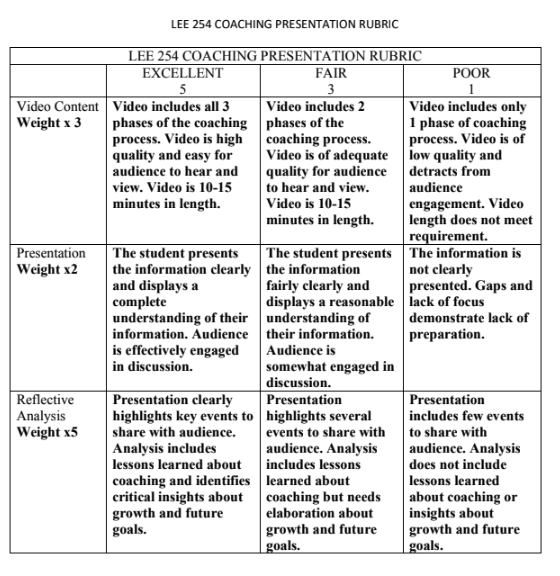
| LEE 254- Coaching Videos Rubric | Students conduct a coaching session with a colleague that includes a pre-coaching
discussion to focus the coaching, the coaching event, and a debriefing to assess the
outcome. The student then created a coaching video that highlights their use of effective
coaching practices. As a program, our goal is for candidates to holistically score a minimum of 12 out of a total of 15 while scoring 3 or above in each category (video content, presentation, reflective Analysis) This demonstrates that candidates exhibit an ability to provide effective coaching. |
Nine candidates’ Coaching Videos were evaluated in Spring 2024. 100% met the benchmark with scores of 12 -15. |
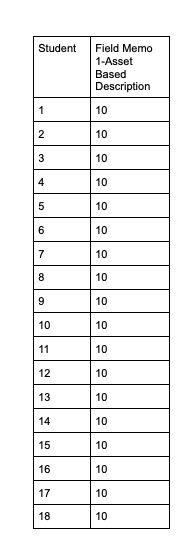
| LEE 213-Asset Based Description of Learner | Students collect information about their focal learner and present it an asset based
description which allows them to build on student strengths and interests without
a deficit lens toward the learner. This is submitted in a field memo that is worth
10 points. As a program the goal is for students to earn a minimum of 8 out of 10 points and for 80% of students to meet the goal. |
9 students’ Asset Based descriptions were assessed with 100% earning 10/10. |
School Counseling
| Provider-Selected Measures | Explanation of Performance Expectation | Level or Extent of Success in Meeting the Expectation |
|---|---|---|
| Site Supervisor Program Evaluation Survey (Aspect A) | Site supervisors evaluated students on a 5-point Likert scale (0 = Not Observed, 1
= Doesn’t Meet Expectations, 2 = Progressing, 3 = Meets Expectations, 4 = Exceeds
Expectations). Success for this data source will be indicated by achieving an average
of 3.0 or higher. Items indicated as “Not Observed” were not included as part of the analysis. (Note: “Not Observed” signifies that the site supervisor did not have the chance to witness students’ capabilities in the specified area.) |
The site supervisors have evaluated a total of 97 students’ knowledge of services around crises and trauma and their ability to apply ethical and legal considerations. The means from the selected survey items from the Fall 2023/ Spring 2024 Site Supervisor Program Evaluation Survey were calculated. The computed means ranged from 3.08 to 3.54, all surpassing the threshold of 3.0. This implies that site supervisors consistently rated students within the bracket of "meets expectations" to "exceeds expectations." The |
| Items from the Crises & Trauma and Ethical & Legal knowledge scales on the Site Supervisor Program Evaluation Survey | a) Understand and use appropriate measures pertaining to students with suicide and
homicide risks. b) Have knowledge and ability to assess and provide prevention and intervention for other crisis and trauma situations that may occur on school campus, such as school shootings. c) Understand and apply ethical and the legal obligations to students, parents, administrators, and teachers. d) Maintaining professional and ethical boundaries in school counseling relationships per professional association ethical guidelines created by the American School Counselor Association. e) Understand and articulate the state laws and obligations regarding mandated reporting for child, elder, and dependent adults. f) Display professional disposition related to conduct, communication, demeanor, and presentation (appearance/written/oral) within the school counseling program, internship site, and profession. |
Survey Item Mean (a) Understand and use appropriate measures pertaining to students with suicide and homicide risks. 3.15 (b) Have knowledge and ability to assess and provide prevention and intervention for other crisis and trauma situations that may occur on school campus, such as school shootings. 3.08 (c) Understand and apply ethical and the legal obligations to students, parents, administrators, and teachers. 3.41 (d) Maintaining professional and ethical boundaries in school counseling relationships per professional association ethical guidelines created by the American School Counselor Association. 3.51 (e) Understand and articulate the state laws and obligations 3.44 |
| (f) Display professional disposition related to conduct, communication, demeanor, and presentation (appearance/written/oral) within the school counseling program, internship site, and profession. | 3.54 | |
| Site Supervisor Program Evaluation Survey (Aspect C) | Site supervisors evaluated students on a 5-point Likert scale (0 = Not Observed, 1
= Doesn’t Meet Expectations, 2 = Progressing, 3 = Meets Expectations, 4 = Exceeds
Expectations). Success for this data source will be indicated by achieving an average
of 3.0 or higher. Items indicated as “Not Observed” were not included as part of the analysis. (Note: “Not Observed” signifies that the site supervisor did not have the chance to witness students’ capabilities in the specified area.) Working with Students of Diverse Background Scale Items on the Site Supervisor Program Evaluation Survey. (a) Have knowledge and ability to work with students of diverse backgrounds, including socioeconomic disadvantages, English learners, homeless youth, foster youths, sexual minority youths, and racial and ethnic minorities. (b) Have knowledge and ability to work with students with disabilities and other educational/socioemotional needs that impact learning (including knowledge of IEP and Section 504 plans). (c) Understand information on school, district, State, and Federal policies and the impact of resulting practices. |
A total of 97 students’ ability to work with diverse students was rated by site supervisors
on three survey items. The means for these survey items from the Fall 2022/ Spring
2023 Site Supervisor Program Evaluation Survey were calculated. The computed means
ranged from 3.10 to 3.48, all surpassing the threshold of 3.0. This implies that site
supervisors consistently rated students within the bracket of "meets expectations"
to "exceeds expectations." The data suggests that site supervisors generally perceived
students to demonstrate adequate knowledge, skills, and abilities associated with
culturally responsive practice. Survey Item Mean (a) Have knowledge and ability to work with students of diverse backgrounds, including socioeconomic disadvantages, English learners, homeless youth, foster youths, sexual minority youths, and racial and ethnic minorities. 3.48 |
| (b) Have knowledge and ability to work with students with disabilities and other educational/socioemotional needs that impact learning (including knowledge of IEP and Section 504 plans). | 3.27 | |
| (c) Understand information on school, district, State, and Federal policies and the impact of resulting practices. | 3.10 | |
| Counseling Disposition Assessment | Site supervisors evaluated students on a 5-point Likert scale (0 = Not Observed, 1
= Doesn’t Meet Expectations, 2 = Progressing, 3 = Meets Expectations, 4 = Exceeds
Expectations). Success for this data source will be indicated by achieving an average
of 3.0 or higher. Items indicated as “Not Observed” were not included as part of the analysis. (Note: “Not Observed” signifies that the site supervisor did not have the chance to witness students’ capabilities in the specified area.) Collaboration Scale Items on the assessment: |
A total of 84 counselor dispositions were analyzed from Fall 2022 and Spring 2023
assessments. The means for six survey items were computed and analyzed. The calculated
means ranged from 3.32 to 3.44. Notably, all means were above the 3.0 threshold. This
suggests a perception among site supervisors that all interns during the 2022-2023
academic year consistently demonstrated the knowledge, skills, and abilities essential
for fostering positive learning and work environments. Please see below for the means
of each item. Survey Item Mean |
| (a) Demonstrates the ability to work creatively and collaboratively with colleagues, clients, families, and the community; | 3.44 | |
| (b) Values clients as full partners in the counseling/educational process; | 3.38 | |
| (c) Collaborates with community partners and agencies in all phases of intervention when possible; | 3.42 | |
| (d) Communicates on a regular basis the progress of students to parents and involved parties with proper consent. | 3.32 | |
| (e) Works well with others to develop opportunities for peer and student learning; | 3.40 | |
| (f) Plans and collaborates to ensure that appropriate supports for smooth transitions are in place. | 3.36 |
School Nursing
| Provider-Selected Measures | Explanation of Performance Expectation | Level or Extent of Success in Meeting the Expectation |
|---|---|---|
| Site Supervisor’s (Preceptor) evaluation of students’ skills and knowledge essential to perform as successful school nurses. (Preceptors). The rating scale is as follows: 5 = Excellent; 4= Very Good; 3= Good; 2 = Fair; 1 = Poor. Success is defined as 3 or above. | Likert rating scales measuring students’ knowledge of essential components are completed by Site Supervisors | Preceptor evaluation of Student: All practicum activities and overall student performance were considered: |
 |
 |
Fall 2023 Spring 2024 No scores below 4 |
| Professional Dispositions and behaviors: Preceptors evaluated students’ knowledge, skills, and abilities. Six dispositions and behaviors were measured |
Likert rating scales measuring students’ professional dispositions and behaviors were completed via a survey. The rating scale is as follows: 5 = Excellent; 4= Very Good; 3= Good; 2 = Fair; 1 = Poor. Success is defined as 3 or above | Student Dispositions and Behaviors Fall 2023 N=46 5 4 3 Measure 1 42 8 0 Measure 2 42 4 0 Measure 3 41 5 0 Measure 4 43 3 0 Measure 5 39 7 0 Measure 6 40 6 0 Spring 2024 N=44 5 4 3 Measure 1 42 2 0 Measure 2 40 3 1 Measure 3 43 1 0 Measure 4 43 1 0 Measure 5 40 4 0 Measure 6 42 2 0 No scores below 3. Goal met. |
| Students evaluate the support and mentoring provided by site supervisors in completing learning objectives and school nurse competencies. 5 key areas (measures) were evaluated. | Likert rating scales measuring students’ knowledge of essential components are completed by Site Supervisors (Preceptors). The rating scale is as follows: 5 = Excellent; 4= Very Good; 3= Good; 2 = Fair; 1 = Poor. Success is defined as 3 or above. | Student evaluation of Preceptor: Fall 2023 N =46 5 4 3 Measure 1 31 3 0 Measure 2 31 3 0 Measure 3 32 2 0 Measure 4 33 1 0 Measure 5 32 2 0 Student evaluation of Preceptor: Spring 2024 N = 44 5 4 3 Measure 1 42 1 1 Measure 2 43 1 0 Measure 3 42 1 1 Measure 4 43 1 0 Measure 5 43 1 0 No scores below 3. Goal met |
Table 4. Expectations and Performance on Standard 2: Completer Professional Competence and Growth
| Preliminary Administrative Services Credential | Provider-Selected Measures | Explanation of Performance Expectation | Level or Extent of Success in Meeting the Expectation |
|---|---|---|---|
| CalAPA Leadership Cycle 2 (Rubric 2.2) | Candidate success would be measured at Level 2 or Level 3, as proficiency with the CTC is currently at a Level 2; however, Fresno State faculty instruct toward all 5 levels with an emphasis on Level 3 or 4. In addition, maintaining mean scores above the state average by rubric will be considered as an element of success criteria. | Submission year: 2021-2022 (Academic year) Program: 3.0 (>3 = yes) State-wide: 2.8 Program Comparison: +.2 (above) n=22 (State n=1516) Submission year: 2022-2023 (Academic year) Program: 2.9 (>2 = yes) State-wide: 2.7 Program Comparison: +.2 (above state = yes) n=59 (State n=1882) Submission year: 2023-2024 (Academic year) Program: 2.8 (>2 = yes) State-wide: 2.6 Program Comparison: +.2 (above state = yes) n=54 (State n=2118) Submission year: 2019-YTD Program: 2.9 (>2 = yes) State-wide: 2.6 Program Comparison: +.3 (above state = yes) n=201 (State n=8979) |
|
| CalAPA Leadership Cycle 1 (Rubric 1.7) | Candidate success would be measured at Level 2 or Level 3, as proficiency with the CTC is currently at a Level 2; however, Fresno State faculty instruct toward all 5 levels with an emphasis on Level 3 or 4. In addition, maintaining mean scores above the state average by rubric will be considered as an element of success criteria. | Submission year: 2021-2022 (Academic year) Program: 2.5 (>2 = yes) State-wide: 2.4 Program Comparison: +.1 (above state = yes) n= 61 (State n=1715) Submission year: 2022-2023 (Academic year) Program: 2.3 (>2 = yes) State-wide: 2.3 Program Comparison: +/-0 (even w/ state) n=68 (State n=2170) Submission year: 2023-2024 (Academic year) Program: 2.4 (>2 = yes) State-wide: 2.3 Program Comparison: +.1 (above state = yes) n=42 (State n=2143) Submission year: 2019-YTD Program: 2.4 (>2 = yes) State-wide: 2.4 Program Comparison: +/-0 (even w/ state) n=236 (State n=9849) |
|
| CCTC Completer Survey (Q4) | Candidate success would be measured by 1) mean rating of 3 (adequately) or higher, and; 2) maintaining mean ratings above the State-wide average. | Academic year: 2021-2022 Program: 4.46 (>3 = yes) State-wide: 4.56 Program Comparison: -.10 (no) n=13 (State n=274) |
|
| P12 PASC Program CAPEs Candidate Self-Assessment Overall Visionary Leadership, (Q1-3) | Added aligned internal metric: Candidate success would be measured by 1) average of 3 or higher for each semester and 2) evidence of mean growth from semester 1 to semester 3 in Overall Visionary Leadership (CAPEs A, B, C) | Academic year: 2022-2023 Program: 4.54 (>3 = yes) State-wide: 4.69 Program Comparison: -.15 (no) n=24 (State n=909) Academic year: 2023-2024 Program: 4.52 (>3 = yes) State-wide: 4.56 Program Comparison: -.04 (no, margin nearing even) n=46 (State n=1433) CAPEs Standard 1, Visionary Leadership (Q1-3) Through academic year: 2023-2024 Semester 1: Overall M=3.71 (n=168) Semester 2: Overall M=4.04 (n=152) Semester 3: Overall M=4.48 (n=110) Mean growth SEM 1 - SEM 3 = +.77 (yes) |
|
| P12 PASC Program AAQEP Candidate Self-Assessment | Candidate success would be measured by 1) average of 3 or higher for each semester and 2) evidence of mean growth from semester 1 to semester 3. | AAQEP Standard 2 Through academic year: 2022-2023 Semester 1: Overall M=4.19 (n=154) Semester 2: Overall M=4.24 (n=90) Semester 3: Overall M=4.56 (n=49) Mean growth SEM 1 - SEM 3 = +.37 (yes) Through academic year: 2023-2024 Semester 1: Overall M=4.17 (n=171) Semester 2: Overall M=4.29 (n=155) Semester 3: Overall M=4.63 (n=111) Mean growth SEM 1 - SEM 3 = +.46 (yes) |
Reading and Literacy Added Authorization / Reading and Literacy Leadership Specialist Credential (RLAA/RLLSC)
| Provider-Selected Measures | Explanation of Performance Expectation | Level or Extent of Success in Meeting the Expectation |
|---|---|---|
| Reading/Literacy Program Master’s Degree Completion EXIT Survey Item 5: Fresno State's Reading/Literacy program prepares completers to understand and implement culturally responsive practices. | Review of this item enables us to determine if we have met Candidate Academic Performance
Indicators–Standard 2b: Engage in culturally responsive educational practices with
diverse learners and do so in diverse cultural and socioeconomic community contexts Programmatically, our goal is for candidates to rate the item at a 5 or a 6 out of 6 within each area with a minimum response rate of 80%. |
6 = Strongly agree 5 = Agree 4 = Somewhat agree 3 = Somewhat disagree 2 = Disagree 1 = Strongly disagree Of 8 respondents (out of 9): 7 rated it as 6 1 rated it as 5 We met our goal w/ a robust response rate. |
| Unit Wide Credential Exit Survey item 14: I have learned to establish goals for my own professional growth and engage in self-assessment, goal setting, and reflection. | Review of this item enables us to determine if we have met Candidate Academic Performance
Indicators–Standard 2e: Establish goals for their own professional growth and engage
in self-assessment, goal setting, and reflection Programatically, our goal is for candidates to score the item at a 5 or 6 out of 6 with a minimum response rotate of 80% |
6 = Strongly agree 5 = Agree 4 = Somewhat agree 3 = Somewhat disagree 2 = Disagree 1 = Strongly disagree Of 8 respondents (out of 9) 6 rated it a 6 2 rated it a 5 We met our goal and w/ a robust response rate. |
| LEE 254 Program Evaluation Report Rubric Item: Professional Development- Clearly identifies areas of need for future PD. | Content of PD is strongly supported by evidence in the report and formats for PD are
supported by at least 2 research references from PD literature and Adult Learning
Theory literature. As a program, our goal is for candidates to score at least to a score of 8 out of 10, as this demonstrates that candidates exhibit at least general ability to identify areas of need for future professional development based on the findings from the program evaluation. 75% of students are expected to meet the learning outcome. |
9 students scored 10/10 on this item |
School Counseling
| Provider-Selected Measures | Explanation of Performance Expectation | Level or Extent of Success in Meeting the Expectation |
|---|---|---|
| Evaluation of Field Placement Student | Site supervisors evaluated students on a 5-point Likert scale (0 = Not Observed, 1
= Doesn’t Meet Expectations, 2 = Progressing, 3 = Meets Expectations, 4 = Exceeds
Expectations). Success for this data source will be indicated by achieving an average
of 3.0 or higher. Items indicated as “Not Observed” were not included as part of the analysis. (Note: “Not Observed” signifies that the site supervisor did not have the chance to witness students’ capabilities in the specified area.) Six items relevant to Standard 2a were selected. These items below ask for knowledge and abilities to work in local schools and cultural communities. |
Site supervisors assessed the competence of 84 students in working with local schools and cultural communities. Mean values for specific survey items from the Fall 2022/Spring 2023 Site Supervisor Program Evaluation Survey were computed, ranging from 3.15 to 3.48. All computed means exceeded the 3.0 threshold, indicating consistent ratings by site supervisors in the "meets expectations" to "exceeds expectations" range. The data suggests that, overall, site supervisors perceived students to possess satisfactory knowledge, skills, and abilities relevant to working in local schools and cultural communities. |
| a) Understand and use tests and measures used in assessing student learning and achievement, development of school, family, and community partnerships. | 3.24 | |
| b) Have knowledge and ability to work with students of diverse backgrounds. | 3.48 | |
| c) Able to learn about the duties that a school counselor will perform; adapted well to conditions. | 3.47 | |
| d) Have knowledge of relevant resources and connects with students to resources needed to assist in academic achievement; | 3.36 | |
| e) Have knowledge and abide by policies and processes relating to academic development at the school, district, state, and federal levels; | 3.15 | |
| f) Demonstrate knowledge of and skills in consulting with and educating school staff on social emotional needs of students. | 3.35 | |
| Counselor Disposition Assessment | Site supervisors evaluated students on a 5-point Likert scale (0 = Not Observed, 1
= Doesn’t Meet Expectations, 2 = Progressing, 3 = Meets Expectations, 4 = Exceeds
Expectations). Success for this data source will be indicated by achieving an average
of 3.0 or higher. Items indicated as “Not Observed” were not included as part of the analysis. (Note: “Not Observed” signifies that the site supervisor did not have the chance to witness students’ capabilities in the specified area.) The following items demonstrate candidates’ commitment to engage in culturally responsive educational practices: |
A comprehensive review of 84 counselor disposition assessments from the Fall 2022 and Spring 2023 semesters was analyzed. The means for four survey items assessing candidates’ commitment to engage in culturally responsive educational practices were computed. The means ranged from 3.18 to 3.48, surpassing the 3.0 threshold. This indicates a consistent perception among site supervisors that interns throughout the 2022-2023 academic year consistently exhibited the necessary knowledge, skills, and abilities to commit to engagement in culturally responsive educational practices. |
| a) Diagnose clients/students’ needs by interpreting data from various sources. | 3.26 | |
| b) Develop intervention plans compatible with diverse students | 3.18 | |
| c) Accommodates all clients, including those from diverse backgrounds | 3.44 | |
| d) Respects clients as individuals with differing personal backgrounds | 3.48 | |
| Counselor Disposition Assessment | Site supervisors evaluated students on a 5-point Likert scale (0 = Not Observed, 1
= Doesn’t Meet Expectations, 2 = Progressing, 3 = Meets Expectations, 4 = Exceeds
Expectations). Success for this data source will be indicated by achieving an average
of 3.0 or higher. Items indicated as “Not Observed” were not included as part of the analysis. (Note: “Not Observed” signifies that the site supervisor did not have the chance to witness students’ capabilities in the specified area.) The following items demonstrate candidates’ ability to work creatively and collaboratively with colleagues, clients, families, and the community. |
The site supervisors have evaluated a total of 84 students’ ability to work creatively and collaboratively with colleagues, clients, families, and the community. The provided data below represents the means for three survey items from the Fall 2022-Spring 2023 counselor disposition assessment. The means ranged from 3.36 to 3.42, surpassing the 3.0 threshold. The data suggests that, on average, site-supervisors perceive the student internsl as demonstrating strong collaborative skills with community partners, colleagues, parents, and K-12 students. |
| a) Collaborates with community partners and agencies in all phases of intervention when possible. | 3.42 | |
| b) Works well with others to develop opportunities for peer and student learning. | 3.40 | |
| c) Plans and collaborates to ensure that appropriate supports for smooth transitions are in place. | 3.36 |
School Nursing
| Provider-Selected Measures | Explanation of Performance Expectation | Level or Extent of Success in Meeting the Expectation |
|---|---|---|
| Fall 2023 N186 School Nurse Practicum I & Spring 2024 N187 School Nurse Practicum II, Survey of Practicum Preceptors’ Evaluation of Student Skill and Competencies. Q 36: Preceptors responded to the survey using the Likert scale (1=Poor, 2=Fair, 3= Good, 4=Very Good, 5= Excellent) Programmatically our goal would be for every student to be rated at least a 3-5. | Likert rating scales measuring students’ knowledge of essential components are completed by Site Supervisors (Preceptors). | Preceptor evaluation of Student: All practicum activities and overall student performance were considered: Fall 2023 N= 43 5 4 3 Overall rating 41 (95%) 2 (3%) 0 Recommended for clear credential 43 (100%) Spring 2024 N= 44 5 4 3 Overall rating 42 2 0 Recommended for clear credential 44 (100%) No scores below 4 Goal met. |
| Professional Dispositions and behaviors: Preceptors evaluated students’ knowledge, skills, and abilities. Six dispositions and behaviors were measured | Likert rating scales measuring students’ professional dispositions and behaviors were completed via a survey. The rating scale is as follows: 5 = Excellent; 4= Very Good; 3= Good; 2 = Fair; 1 = Poor. Success is defined as 3 or above | Student Dispositions and Behaviors Fall 2023 N=46 5 4 3 Measure 1 42 8 0 Measure 2 42 4 0 Measure 3 41 5 0 Measure 4 43 3 0 Measure 5 39 7 0 Measure 6 40 6 0 Spring 2024 N=44 5 4 3 Measure 1 42 2 0 Measure 2 40 3 1 Measure 3 43 1 0 Measure 4 43 1 0 Measure 5 40 4 0 Measure 6 42 2 0 No scores below 3. Goal met. |
| Students evaluate the support and mentoring provided by site supervisors in completing learning objectives and school nurse competencies. 5 key areas (measures) were evaluated. | Likert rating scales measuring students’ knowledge of essential components are completed by Site Supervisors (Preceptors). The rating scale is as follows: 5 = Excellent; 4= Very Good; 3= Good; 2 = Fair; 1 = Poor. Success is defined as 3 or above. | Student evaluation of Preceptor: Fall 2023 N =46 5 4 3 Measure 1 31 3 0 Measure 2 31 3 0 Measure 3 32 2 0 Measure 4 33 1 0 Measure 5 32 2 0 Student evaluation of Preceptor: Spring 2024 N = 44 5 4 3 Measure 1 42 1 1 Measure 2 43 1 0 Measure 3 42 1 1 Measure 4 43 1 0 Measure 5 43 1 0 No scores below 3. Goal met |
P12 PASC Program AAQEP Candidate Self-Assessment
5. Notes on Progress, Accomplishment, and Innovation
This section describes program accomplishments, efforts, and innovations (strengths and outcomes) to address challenges and priorities over the past year.
Development of a Network Improvement Community:
In preparation for the CCTC and AAQEP site visits in 2022, coordinators from Fresno
State’s 14 educator preparation programs began to meet on a monthly and, at times,
bi-monthly basis. Prior to Fall 2020, the coordinators had not met together regularly
since the last accreditation site visit. During that time, there was significant changeover
in program coordinators. The lack of regular meetings, coupled with the changes in
program leadership, led to a lack of unit-wide data collection and analysis activities.
Since those site visits, the coordinators have continued to meet regularly, under
the direction of the Director of Educator Preparation Programs, a position that was
created in Spring 2021. These meetings were especially critical in 2022-2023 academic
year, as eight programs had coordinators who were in their first year in the role.
Agendas and Resources 2022-2023
Agendas and Resources from 2023-2024
The primary goals for these meetings has been to support program coordinators in:
- Overseeing their respective programs, which includes sharing best practices and resources for supporting candidates, connecting with mentors/site-based supervisors, connecting with program completers, connecting with employers of completers, etc.
- Reviewing unit-wide policies related to educator preparation
- Engaging in data collection and analysis to inform program practices at both the program and the unit levels, including developing shared resources to collect program-specific data
Over the past year, it has been increasingly clear that coordinators have come to see these meetings as a place to bring questions for other coordinators and to collectively problem-solve challenges they have encountered in overseeing their programs. Some of these challenges have been in regard to tracking candidates during their time in programs. Those coordinators with well-developed systems for tracking candidates’ progress have shared their systems with the whole group.
Part II: Self-Assessment and Continuous Growth
AAQEP does not require public posting of the information in Part II, but programs may post it at their discretion.
6. Self-Assessment and Continuous Growth and Improvement
This section charts ongoing improvement processes in relation to each AAQEP standard. Note that providers may focus their work on an aspect of one or two standards each year, with only brief entries regarding ongoing efforts for those standards that are not the focus in the current year.
Table 5. Provider Self-Assessment and Continuous Improvement
Each Advanced Credential program created specific goals related to the AAQEP Standards.
Preliminary Administrative Services
Standard 1:
Goal 1 for the 2024-25 year Decrease the number of candidate non-pass reports on the
CalAPA
Actions
• Use ongoing Faculty Learning Community time to discuss most common condition codes
received in last submission cycles by CalAP, along with individual student support
needs
• Clarify understanding of condition codes by CalAPA cycle and share best practices
for supporting candidates in mitigating those codes within the program support guidelines
• Coordinator faculty communication of new assessment materials as soon as they are
available from CTC and provide access to the CalAPA Deep Dive recordings for further
faculty study and candidate use
• Coordinator assigned as instructor for leadership seminar and fieldwork courses
in program Semesters 1 and 2 to support new faculty and lecturers with alignment and
to provide another layer of progress checks and advisement for candidates
Expected outcomes Decrease condition codes and fails on CalAPA Cycle 2 submissions by 95% and maintain little to no candidate non-pass results on CalAPA 1 and 3.
Reflections or comments Since the implementation of the CalAPA through 2022-2023, one candidate per submission window might receive a condition code and typically it is related to missing an essential document upload, and had only one Fail. Once they resubmit, every candidate has passed. In 2023-2024, however, we had 15 non-pass results. The others received failing scores. Of the total 15 non-passes, 11 were condition code related with 10 on CalAPA Cycle 2 and 1 on Cycle 3. After working with the CTC, there was confusion on the updated assessment guide handbook regarding planning and implementation meetings in CalAPA 2, which was noted across state programs. The state has revised the guidebook to align with current scorer training and expectations, however, we want to be proactive in supporting our students through the multiple components required of candidates in CalAPA 2.
Standard 2
Goals for the 2024-25 year Uplift concepts and practice of equity-driven leadership
into culminating program experiences.
Actions
• Select or create a culminating experience (comprehensive exam) that is centered
on applying equity-driven leadership dispositions for thriving school communities
(not a paper/pencil assessment)
• Select or create a rubric to assess the culminating experience
• Restructure Semester 3 signature assignments in 273 Site Based Leadership and Fieldwork
3 to include experiences that help develop dispositions for equity-driven leadership
• Revise fieldwork and seminar expectations across Semesters 1 and 2 from 4 to 5 tasks
within the current unit load in order to open up time for the restructured signature
assignments in Semester 3
• Begin to use the Equity Self Rating Index results to guide continuous program improvement
efforts
Expected outcomes
• Increased candidate perception based on self-assessment in the areas of AAQEP Standard
2 and aligned CAPEs related to their capacity to work alongside diverse communities,
foster inclusive school environments, and ensuring equitable policy and practice to
advance social justice for students and families across the Central Valley.
• Program/course modification approvals for the core syllabi in 271, 272, 273 related
to signature assignments, and an updated MA comprehensive exam with opportunity for
9 units of electives in leadership specialty topics (i.e., Special Education Law,
Leading Literacy Initiatives, Managing Sports Programs, Student privacy/health/wellbeing
law)
Reflections or comments While we have adopted a pre-post implementation of the Equity-Driven Leadership Self Rating Index as part of the program orientation and the final self-assessment in the last component of the program over the past 3 years, we have not yet used the data to inform practice. We now have enough pre and post data to review as part of our program update. Furthermore, we have been intentional with centering topics of equity into each course readings and materials, and within the practitioner reflections. These have been mostly outward facing related to analyzing the structural and institutional barriers to student learning and well being. We now need to layer the inward self analysis and reflection into our coursework where candidates consider their own biases and areas for growth related to diversity, equity, and inclusion.
Standard 3
Goals for the 2024-25 year Revise program course sequence related to MA components
and update course catalog
Actions
• Gather faculty input and data to drive program revision decisions
• Develop/find a comprehensive exam to align with the program mission and vision with
an opportunity for students to demonstrate equity-driven leadership practices and
thinking
• Follow the university curriculum approval process
• Attending graduate coordinator trainings and meetings to ensure policy alignment
with program revisions and inclusion of elective courses
• Also revise course prefixes to align with MA (from EAD to ELA) and update all contact
information in catalog
Expected outcomes
• Update culminating experience to a comprehensive exam or thesis options, adjusting
MA additional units to allow for 8-9 units of electives. The thesis option would follow
a predetermined pathway.
Reflections or comments Candidates also working towards their MA in Ed Leadership and Administration have provided feedback through our end of semester Huddles and during advising sessions that our additional 8-units are not the most meaningful learning for professional growth. One program faculty also used their fall semester sabbatical to complete research on graduate perceptions on the redesigned program. Feedback was positive with some suggestions for how to add special topics or adjust the culminating experience away from the MDRP with the heavy writing load of the CalAPA.
Goals for the 2023-24 year Increase field mentor engagement with candidates and program
Actions
• Streamline agreement process with Adobe sign
• Include administrative assistants on all superintendent or designee communications
• Update the superintendent email list to include new hires and administrative/executive
assistants
• Coordinate with office of clinical practice as needed
• Include all new candidate and mentor names on the agreement in a table and include
those in ongoing cohorts with updates to mentorships
• Use SMORE to communicate menor virtual orientation and provide all support materials
in a visual format that can also track user interactions
• Include other university professional development opportunities for mentors, including
doctoral program information sessions
• Coordinator assigned as instructor for leadership seminars in Sem 1 and 2 of the
program to monitor candidate progress and engage in reflective profesisonal dialog
on learning from the field experiences and mentor engagement
Expected outcomes
• 100% superintendent or designee approval of program-district mentor agreements
• 80% attendance at the field mentor virtual workshop with 100% interaction with digital
support materials
• 100% candidate agreement/strong agreement on feeling they received helpful and an
appropriate amount of supervision to develop as a practitioner
Reflections or comments Our mentor participation at virtual workshops has been less than 50% although all were provided the handbook with expectations for supporting fieldwork experiences and candidate reflections along with CalAPA needs. The Unit Exit Survey 2024 Results Preliminary Admin Report indicated that respondents on average, (5.62) agreed with receiving a helpful and appropriate amount of supervision to support my development as a practitioner. However, 3.8% indicated they only agreed somewhat which highlights there is room for improvement in this area.
Standard 4
Goals for the 2024-25 year Increase ongoing enrollment regional district-hosted cohorts
Actions
• Update program branding with a simplified program name: P12 Admin Program.
• Increase and professionalize social media engagement with the addition of Instagram
alongside facebook
• Request referrals from current P12 program candidates to encourage word-of-mouth
recruitment
• Update website with the communications specialist to integrate updated brand, streamline
information flow and availability, and ensure current details.
• Update recruitment materials with revised branding and more professional, eye-catching
design with clarity of program mission and vision
• Continue online information sessions once per month within the application window
• Collaborate with doctoral program and district leadership on in-person recruiting
sessions
Expected outcomes
• Meet enrollment targets of at least 20 candidates per cohort.
Reflections or comments To best support our school districts’ needs, we must ensure our cohorts are not collapsed. To do so, we must maintain enrollment targets to mitigate budgetary constraints.
Goals for the 2024-25 year Increase candidate credential/certificate of eligibility applications
Actions
• Coordinator to work with SEM 3 instructors to attend a class near the end of the
semester to explain the application process and each option.
• Develop business card size handout with QR code to credential analyst procedures
for credential/certificate application.
• Develop social media posts and internal cohort communications with LMS to remind
students to apply with links to the directions and credential analyst contact info.
Expected outcomes
• Based on the above actions, reporting candidates will increase their application
rate from 69% to 85%
Reflections or comments The Unit Exit Survey 2024 Results Preliminary Admin Report indicated that out of 52 respondents, only 69.2% (36) stated they applied. 21.2% (11) stated they might apply, and 9.6% (5) stated they did not apply.
Reading & Literacy Added Authorization / Reading & Literacy Leadership Specialist Credential
Standard 1:
Goal 1 for the 2024-25 year Align Student Outcome Assessment Plan (SOAP) with California
Commission on Teacher Credentialing requirements with AAQEP Standard 1
Actions Revise SOAPs:
• Revise Student Learning Outcomes to align with AAQEP Standard 1
• Align 1 signature assignment w/ AAQEP Standard 1
Expected outcomes
• Alignment between accrediting bodies for credential and MA
Reflections or comments This work will be done during RLLSC Program meetings Jan-May 2025
Goal 2 for the 2024-25 year Add program specific questions to Completer Survey
Actions
• Revise Completer Survey to better align with AAQEP Standard 1
Expected outcomes
• Data to inform Standard 1 program practices
Reflections or comments This work will be done during RLLSC Program Meetings Jan-May 2025
Standard 2
Goal 1 for the 2024-25 year Align Student Outcome Assessment Plan (SOAP) with California
Commission on Teacher Credentialing requirements with AAQEP Standard 2
Actions Revise SOAPs:
• Revise Student Learning Outcomes to align with AAQEP Standard 2
• Align 1 signature assignment w/ AAQEP Standard 2
Expected outcomes
• Alignment between accrediting bodies for credential and MA
Reflections or comments This work will be done during RLLSC Program meetings Jan-May 2025
Goal 2 for the 2024-25 year Add program specific questions to Completer Survey
Actions
• Revise Completer Survey to better align with AAQEP Standard 2
Expected outcomes
• Data to inform Standard 2 program practices
Reflections or comments This work will be done during RLLSC Program Meetings Jan-May 2025
Standard 3
Goals for the 2024-25 year Hold Spring Advisory Board Meeting
Actions Spring Advisory Board Meeting: Seek feedback on program impact
Expected outcomes Program Feedback from stakeholders for continuous improvement
Reflections or comments Meeting scheduled March 6, 2025
Goals for the 2023-24 year Revise RLLSC Program Application
Actions Revise RLLSC Program Application to collect essential data on student pathway, years of teaching, credential status, etc before program begins.
Expected outcomes Better ability to prepare for incoming cohort
Reflections or comments As soon as the revised program is approved at the University level we will make these changes.
Standard 4
Goals for the 2024-25 year Hold Spring Advisory Board Meeting
Actions Spring Advisory Board Meeting: Discuss how to best serve area schools and draft Employer Survey
Expected outcomes Program Feedback from stakeholders for continuous improvement
Reflections or comments Meeting scheduled March 2024
Goal 2 for the 2023-24 year Expand Recruitment Effort to reflect the needs of districts
Actions Partner with regional districts to design specialized program to meet localized needs
Expected outcomes Potential Residency cohorts designed to meet needs of specific districts: FUSF, Rural
Reflections or comments Potential for 2 Residency cohorts as well as 1-2 campus cohorts will enable us to better serve current district needs for advanced literacy authorization in alignment with new state literacy standards.
School Counseling
Standard 1:
Goal 1 for 2024-2025 Create a data source that can capture candidates’ perspectives
in relation to Standard 1 outcomes
Actions
• Research and finalize a tool that can help candidates assess and report their own
professional growth and dispositions as counselors-in-training.
• Implement the candidates’ self-assessment tool at the end of their fieldwork in
school counseling course
• Assess the results, reliability, and validity of the self-assessment tool in evaluating
candidates’ perspectives in relation to standard 1 objectives. If needed, explore
and implement other tools or continue with the same tool and establish consistency
in its use every semester.
Expected Outcomes
• We anticipate to have a data source offering insights into candidates' perspectives.
It will contribute to a comprehensive understanding of candidates’ developmental trajectories
in our school counseling program.
Reflections or Comments N/A
Standard 2
Goal1 for the 2024-25 year Increase candidates' understanding and engagement with
local school and cultural communities.
Actions
• Incorporate community engagement activities such as guest speakers or cultural events
into relevant courses such as COUN 242S (a service learning course).
Expected outcomes We expect that the students will demonstrate increased cultural competence, a deeper understanding of local school and cultural communities, and enhanced abilities to establish meaningful connections with diverse stakeholders.
Reflections or comments N/A
Standard 3
Goals for the 2024-25 year Strengthen the admissions decision-making process by incorporating
an Admissions Rubric to evaluate students based on academic background, personal background
and dispositions, counseling commitment, and tenets valued by our program (commitment
to diversity, social justice, and advocacy, especially within K-12 school settings)
Actions
• Develop an admissions rubric, including the interview rubric
• Pilot Admissions Rubric with Fall 2024 cohort admissions
• If needed, make necessary revisions
Expected outcomes We expect to enhance the evaluation of prospective students based on their potential school counselor professional identity. The pilot phase with the Fall 2024 cohort aims to refine and validate the rubrics, ensuring its effectiveness in identifying candidates who closely align with the program's objectives. This process is anticipated to result in a more selective and well-matched cohort, contributing to the overall quality and success of the program.
Reflections or comments N/A
Standard 4
Goals for the 2024-25 year Enhance our support for alumni by organizing events specifically
designed to strengthen the sense of community.
Actions
• Engage with current part-time faculty employed as school counselors in K-12 settings,
participating in interviews for the recruitment of new school counselors within their
school district.
• Hold an event led by these part-time faculty in which they share tips and knowledge
about the school counselor interviews with the current students and alumni.
Expected outcomes We anticipate that alumni will experience a heightened sense of community, foster networking opportunities, and gain valuable insights into school counselor interviews for their job search process.
Reflections or comments N/A
School Nurse Services
Standard 1:
Goal 1 for 2024-2025 Find resources/staff to create electronic way of collecting dispositions
and behaviors required for successful professional practice
Actions
• Work with Continuing and Global Education to finish creating student and preceptor
evaluation survey. These are in the process of moving into Google surveys. Some have
been completed and the bulk are in the process of being digitized. Electronic data
will be easier to collect and analyze in a timely manner.
Expected Outcomes
• By the end of 2025, all evaluations will be electronic.
• Electronic data will be easier to collect and analyze in a timely manner. Data from
evaluation surveys will inform program practices and make necessary revisions
Reflections or Comments Electronic data will allow full utilization of the information to improve student outcomes.
Goal 2 for 2024-2025 Enhance Employer/Supervisor participation in digital survey of student performance to increase data.
Actions
• Contact Employer/Supervisor in a separate e-mail informing them of the importance
of completing the digital survey that will be e-mailed separately.
Expected Outcomes
• Enhanced participation from Employers/Supervisors
Reflections or Comments A separate outreach may enhance Employer/Supervisor participation.
Standard 2
Goal 1 for 2024-2025 Increase student participation in the pre-program/post-program
digital survey to measure program completers’ growth and competence
Actions Discuss with program instructors ways of increasing student participation. Possibly making the digital survey a mandatory assignment at Orientation and at the end of the program.
Expected Outcomes A higher participation rate will give more accurate data
Reflections or Comments Data will provide easier analysis of competitors’ growth and competence. This will allow to assess strengths and areas that need improvement
Goal 2 for 2024-2025 Develop an electronic means of collecting data from community stakeholders that employ program completers
Actions Devise a digital survey and to collect data about program completer professional dispositions.
Expected Outcomes A digital survey will provide an easier method to collect relevant information and encourage community stakeholders’ participation
Reflections or Comments This information is not currently collected. Moving to a digital survey will simplify stakeholder participation and will provide additional data points to consider.
Standard 3
Goal 1 for 2024-2025 Update curriculum and program effectiveness.
Actions Schedule bimonthly faculty meetings to update and review AAQEP, CCTC and California Education Code standards
Expected Outcomes Program will be aligned with CCTC, AAQEP and California Education Code standards
Reflections or Comments This should be done on a annual basis to ensure that standards and student outcomes are aligned
Goal 2 for 2024-2025 Assess current process of Affiliation Agreements/MOU process with school districts.
Actions Develop a digital survey to assess students’ barriers of obtaining an Affiliation Agreement/MOU in a timely manner.
Expected Outcomes Survey data will indicate areas that need further streamlining
Reflections or Comments Late Affiliation Agreements/MOU have posed significant barriers to completion of student practicum requirements. It is unknown if the current updated process has been successful.
Standard 4
Goal 1 for 2024-2025 Reduce barriers for student entrance into the school nurse services
credential program
Actions Applications will be accepted past the deadline date. Late applicants may be accepted if space permits
Expected Outcomes Students will have less barriers for entrance into the program
Reflections or Comments Prospective students face barriers to apply to the program. Incorporating prerequisites will reduce this barrier
Goal 2 for 2024-2025 Aligned the school nurse services credential program with a Masters Program in the Nursing Department.
Actions Continue discussion with the Nursing Department Chairperson to formalize a process to develop an aligned Masters track for school nurse credential candidates.
Expected Outcomes By 2027, the first cohort will be admitted with the option of continuing to obtain a Masters after completion of a clear School Nurse Services Credential
Reflections or Comments A Master’s program will enhance the education and knowledge of school nurses. This will provide higher quality services to school aged students and the school community
7. Evidence Related to AAQEP-Identified Concerns or Conditions
This section documents how concerns or conditions that were noted in an accreditation decision are being addressed (indicate “n/a” if no concerns or conditions were noted). Note that where a condition has been noted, a more detailed focused report will be needed in addition to the description included here. Please contact staff with any questions regarding this section.
N/A
8. Anticipated Growth and Development
This section summarizes planned improvements, innovations, or anticipated new program developments, including description of any identified potential challenges or barriers.
Common MOU
One area that program coordinators have identified as an area for growth is in the
development of a common MOU to be used across credential program areas with districts.
Currently, Teacher Education programs have an MOU and then each advanced credential
area has its own MOU. The idea is to create one in an effort to streamline the process.
However, this has presented some challenges, as each program has its own unique requirements
for the clinical practice component. This is an area we will continue to work to address.
Data Collection Efforts
As a unit, we will continue to work to develop common systems for tracking candidates’
progress, both when they are in the program and once they complete the program. We
had high hopes for the Year-Out Completer Survey and Employer Survey, but we discovered
a major challenge was contacting completers once they have left the program. We are
working to develop better systems for collecting permanent contact information before
candidates leave, while also informing them of our intent to reach out to them in
the future. We hope that by clarifying the purpose of those future communications,
we may be able to increase the response rate.
9. Regulatory Changes
This section notes new or anticipated regulatory requirements and the provider’s response to those changes (indicate “n/a” if no changes have been made or are anticipated).
N/A
10. Sign Off
| Provider’s Primary Contact for AAQEP (Name, Title) | Dean/Lead Administrator (Name, Title) |
|---|---|
| Dr. Juliet Wahleithner, Director of Educator Preparation Programs | Dr. Sergio La Porta, Interim Dean, Kremen School of Education & Human Development |
| Date sent to AAQEP: December 20, 2024 | |
This HTML version was generated with AI assistance and may contain errors or omissions. The original approved PDF remains the official document of record. An alternative accessible format is available upon request from the document creator in accordance with Title II of the ADA.