AGRI 280 Course Syllabus
California State University, Fresno
Jordan College of Agricultural Sciences & Technology
Department of Animal Sciences & Agricultural Education
Fall 2020
AGRI 280 - Seminar in Agricultural Education. 1-3 Units
Instructor: Dr. Rosco Vaughn
Office: Agricultural Sciences Room 234
Office Hours: M 11 - 12, 1 - 3 & Wed 1 - 3
Phone: (559) 360-0251
Email: rvaughn@csufresno.edu
Prerequisites: Graduate standing, permission of the instructor and admission to the teacher preparation credential program.
Introduction and Course Description: This course encompasses advanced problems in teaching agriculture, including research in agricultural business management, animal science, plant science, and mechanized agriculture. Emphasis is placed on the application of problem-solving techniques for addressing obstacles to conducting high quality agricultural education instructional programs.
Primary Learning Outcomes
Students completing the course will be able to:
- Apply appropriate classroom and laboratory management practices (TPE 2.1, 2.2, 2.3, 2.4, 2.5, 2.6).
- Identify and correct specific classroom and laboratory management problems that exist in assigned classes (TPE 2.1, 2.3, 2.4, 2.5, 2.6).
- Identify unique student population characteristics in the assigned school (TPE 1.1, 1.3 & 4.1).
- Encourage and involve students from diverse cultures and those with special needs in agricultural education and the FFA including English learners (TPE 1.1, 1.2, 1.3, 1.4, 1.5, 1.6,).
- Design curriculum and teaching strategies appropriate for students in the cooperating school (TPE 3.1, 3.2, 3.3, 3.4, 3.5, 3.6, 3.7, 4.1, 4.3, 4.4, 4.5, 4.6, 4.7, 4.8).
- Use and interpret appropriate methods for assessing student progress (TPE 5.1, 5.2, 5.3, 5.4, 5.5, 5.6, 5.7, 5.8).
- Adjust and modify existing curriculum to meet the needs of special students (TPE 1.1, 1.2, 1.3, 1.4, 1.5, 1.6, 1.8, 4.4, 4.5, 4.6, 4.7).
- Identify and discuss current trends in agriculture and public education (TPE 6.1, 6.3).
- Implement California Department of Education standards for agricultural education (TPE 1.3, 1.6, 3.1, 3.3, 3.5, 3.6, 4.1, 4.3).
- Manage leadership development activities for agricultural education and the FFA (TPE 3.1, 3.3, 3.5, 3.6).
- Apply appropriate techniques/procedures for supervision of student agricultural experience programs (TPE 3.1, 3.3, 3.5, 3.6).
- Develop a professional portfolio (TPE 6.1, 6.2, 6.3, 6.4, 6.5, 6.6).
- Demonstrate job interview skills (TPE 6.1, 6.2, 6.3, 6.4, 6.5, 6.6).
- Demonstrate lesson planning skills (TPE 4.1, 4.2, 4.3, 4.4, 4.6, 4.7, 4.8).
Materials for the Course
The following reference materials will be utilized for the course.
- Agriculture and Natural Resources Curriculum Standards, California Department of Education.
- California Model Core Curriculum for Agriculture.
- California Agriscience Lesson Plan Library, CAERT, Inc.
- Agriculture Specialist Student Teaching Manual, Richard Rogers.
Major Assignments and Evaluation Methods
Student performance will be assessed as follows:
- Evaluation of portfolios and monthly oral reports.
- Participation and attendance at seminar sessions.
AGRI 280 Portfolio Bind Project
Fall Semester 2020
Developing a professional portfolio is a requirement for successfully completing AGRI 280. The portfolio should reflect your experiences and accomplishments toward becoming a professional educator. While each student’s portfolio should be different, each portfolio binder must contain the following items:
- Title Page
- Table of Contents
- Introduction letter
- Statement of your Philosophy of Agricultural Education
- Two pages maximum, double spaced.
- Resume
- List of References with Contact Information (3 references minimum)
- First Name, Last Name
- Job Title
- Address
- Phone #
- Reference Letters (3 letters minimum)
- Address to “Selection Committee” or “To Whom it May Concern”
- Examples include, but are not limited to: Master Teacher, Principal, Superintendent, University Coach, University Program Coordinator
- Should be on Letterhead if Possible
- Address to “Selection Committee” or “To Whom it May Concern”
- Lesson Plans
- Include accompanying PowerPoint presentation handouts or other evidence of technology proficiency. You can also include examples of worksheets and assessments.
- You may include multiple lesson plans. If you do, be sure they display a variety of content. List at least two additional lessons on two different topics you would like to teach. Examples: 1) Beef Cattle Breeds and Christmas Centerpieces; 2) Plumbing Tool Identification and Parliamentary Procedure Subsidiary Motions; 3) FFA Degrees and Awards and Comparing Mitosis and Meiosis; 4) Introduction to AET Record Keeping and Cleft Grafting.
Optional Items
You may choose to add any or all of the following:
- CPR Card
- Recommended is a face to face training, or a blended class.
- Any CPR training that follows the American Heart Association or Red Cross guidelines is acceptable. You must complete 3 levels of training: infants, children, and adults. The recommended online CPR training provider is: www.cprtoday.com (Links to an external site.).
- College Transcripts
- Unofficial
- Be sure to update them after your semester grades are posted.
- You will need “Official Transcripts” for your credential. Consider ordering 2-3 copies of your official transcripts from Fresno State, AFTER your final grades have been posted. Keep these on hand for when your employer requests them.
- Photographs
- Student Projects
- Any classroom projects
- Specifically, those relating to your lesson plan.
- Fair Projects
- Certificate of Clearance
- Credentials
- Agriculture Specialist
- Single Subject in Agriculture
You have the flexibility to personalize your portfolio, thus templates are not provided.
It is recommended that you organize your portfolio as shown below.
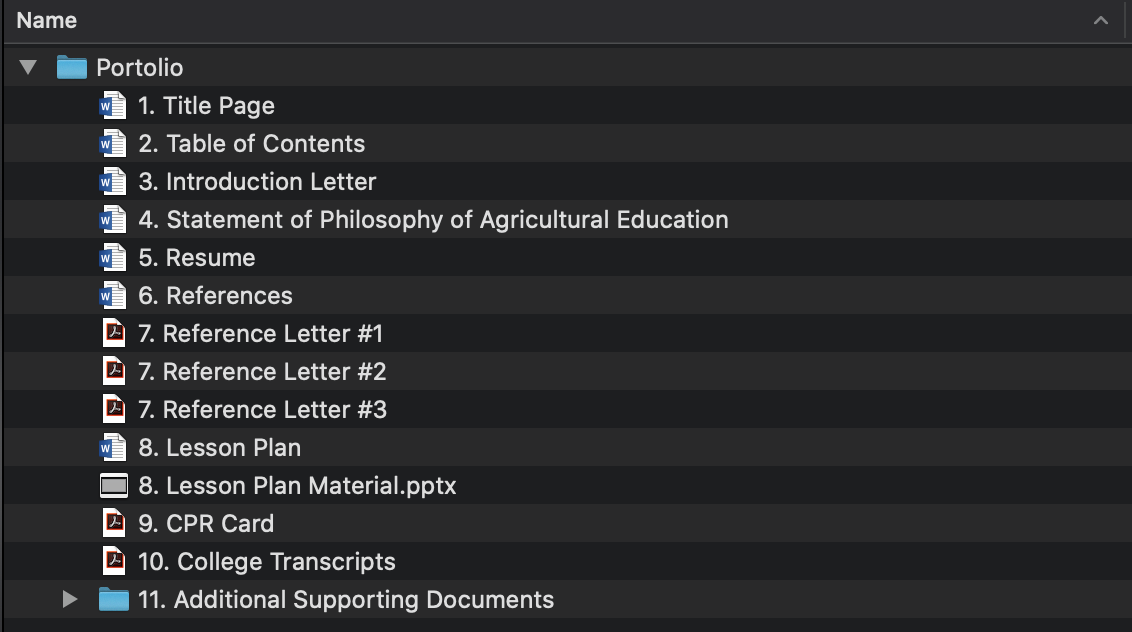
Combine all of these documents into one PDF and upload to Canvas. This will be for grading purposes ONLY to fulfill the AGRI 280 requirements. You will not submit your binder, just ONE PDF containing all of the required documents.
AGRI 280 Portfolio Scoring Rubric
Name:__________________________________
| 1 Minimal |
2 Satisfactory |
3 Commendable |
4 Superior |
|
|---|---|---|---|---|
| Quality of Content | Inappropriate format, structure is lacking, major sections are unclear or confusing. | Format could be improved some major sections are unclear or confusing. | Logical format, major sections are clear and easy to understand. | Logical and consistent format, major sections are clear and easy to understand. |
| Neatness | Page layouts have no structure. Space is crowded and/or wasted. | Page layout appears to waste space or be too crowded. | Page layout appears to waste some space or to be crowded in some areas. | Pages are well laid out with little wasted space and crowding. |
| Completeness of Information | Includes all required components, great difficulty communicating ideas. | Includes all required components, some difficulty communicating ideas. | Includes all required components, communicates ideas clearly. | Includes all required components, communicates ideas clearly and completely. |
| Organization | Page layouts have no structure. | Page layouts are organized into paragraphs and/or sections. | Page layouts organized in a logical way, headings and styles are consistent. | Consistent format extends from page-to-page, design is intentional. |
| Evidence of Appropriate Effort | Spelling and punctuation errors are distracting and interfere with communication. | Spelling and punctuation errors are evident, but do not interfere with communication. | Errors in spelling and punctuation are minor and few. | Very few or no errors in spelling and punctuation. |
| Visual Appeal | Design is inappropriate. | Design could be improved or made more appropriate. | Design is attractive and colorful. | Design is attractive, colorful and shows creativity. |
Course Policies
Students should read the following policies to ensure they understand the expectations of the university and the instructor for this course.
Plagiarism Detection: The campus subscribes to Turnitin, a plagiarism prevention service, through Canvas. You will need to submit written assignments to Turnitin. Student work will be used for plagiarism detection and for no other purpose. The student may indicate in writing to the instructor that he/she refuses to participate in the plagiarism detection process, in which case the instructor can use other electronic means to verify the originality of their work. Turnitin Originality Reports WILL NOT be available for your viewing.
University Policies
Students with Disabilities: Upon identifying themselves to the instructor and the university, students with disabilities will receive reasonable accommodation for learning and evaluation. For more information, contact Services to Students with Disabilities in the Henry Madden Library, Room 1202 (278-2811).
The following University polices can be found at:
- Adding and Dropping Classes
- Cheating and Plagiarism
- Computers
- Copyright Policy
- Disruptive Classroom Behavior
- Honor Code
- Students with Disabilities
- Title IX
UNIVERSITY SERVICES
The following University services can be found at:
- Associated Students, Inc.
- Dream Success Center
- Learning Center Information
- Student Health and Counseling Center
- Writing Center
Intellectual Property Provision
As part of your participation in virtual/online instruction, please remember that the same student conduct rules that are used for in-person classrooms instruction also apply for virtual/online classrooms. Students are prohibited from any unauthorized recording, dissemination, or publication of any academic presentation, including any online classroom instruction, for any commercial purpose. In addition, students may not record or use virtual/online instruction in any manner that would violate copyright law. Students are to use all online/virtual instruction exclusively for the educational purpose of the online class in which the instruction is being provided. Students may not re-record any online recordings or post any online recordings on any other format (e.g., electronic, video, social media, audio recording, web page, internet, hard paper copy, etc.) for any purpose without the explicit written permission of the faculty member providing the instruction. Exceptions for disability-related accommodations will be addressed by Services for Students with Disabilities (SSD) working in conjunction with the student and faculty member.
Contact Information for Chair or Dean
If there are questions or concerns that you have about this course that you and I are not able to resolve, please feel free to contact Dr. Randy Perry – randyp@csufresno.edu or Dr. Dennis Nef – dennisn@csufresno.edu, Dean of the college to discuss the matter.
Health Screening
Students who come to campus for face-to-face classes will be required to complete a daily health screening which will include temperature checks. If you have experienced COVID-19 symptoms and/or have tested positive within the past 10 days; or if you have had close contact (less than 6 feet for longer than 15 minutes while unmasked) with a suspected or confirmed COVID-19 patient within the past 14 days, you are not allowed to come to campus. Please complete the campus online reporting form. A campus official will reply to provide guidance and information.
Safety Measures
Consistent with the Governor’s order and updated state public-health guidelines, face masks or cloth face coverings are required to be worn in public spaces on-campus and during in-person classes to reduce possible exposure to COVID-19 and prevent the spread of the virus. Physical distancing must be practiced by maintaining 6 feet of distance between individuals. Good hygiene of hand washing for a minimum of 20 seconds or using hand sanitizer is required. Please avoid touching your face with unclean hands. Disposable face masks will be provided to anyone who arrives to campus without one.
Please see university website for the most updated information: www.fresnostate.edu/coronavirusIntellectual Property Provision
Subject to Change
The instructor reserves the right to maintain flexibility in the course syllabus in the event of extenuating circumstances.
This HTML version was generated with AI assistance and may contain errors or omissions. The original approved PDF remains the official document of record. An alternative accessible format is available upon request from the document creator in accordance with Title II of the ADA.