AGRICULTURE SPECIALIST STUDENT TEACHING MANUAL
JORDAN COLLEGE OF AGRICULTURAL SCIENCES AND
TECHNOLOGY
DEPARTMENT OF ANIMAL SCIENCES AND AGRICULTURAL
EDUCATION
CALIFORNIA STATE UNIVERSITY OF FRESNO
FOREWORD
Teacher candidates involved in the Agriculture Specialist Field Experience activities designed this guide for use as a part of the approved program of teacher preparation at California State University, Fresno. Dr. Richard A. Rogers edited and compiled the guide into the present format for use by student teachers.
This guide was developed from the former Student Teacher Manual and with input from teachers, administrators and student teachers. Special assistance and input was also derived from the 1995 Cooperating Teachers Conference.
The Agricultural Education Program at California State University, Fresno, is pleased to make this booklet available to you and others concerned with the preparation of teachers of agriculture.
Rosco Vaughn
Teacher Educator
California State University, Fresno
CONTENTS
Calendar of Events
Instructions for the Student Teacher
Local Department Responsibilities of the Cooperating Teacher
Checklist of Participating Experiences for Student Teachers
Reports and Evaluation
Weekly Student Teaching Report
Evaluation of Classroom Teaching
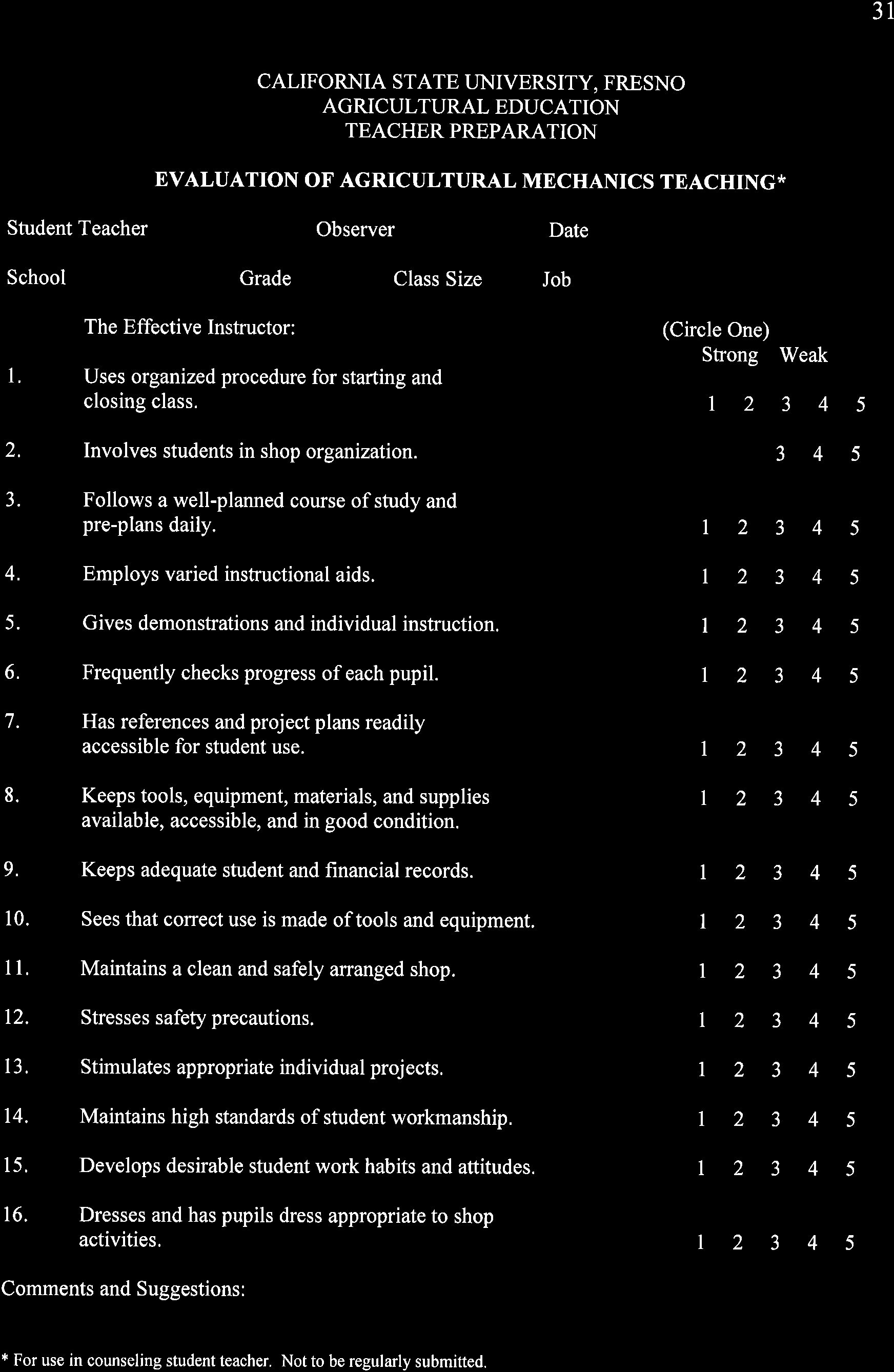
Evaluation of Agricultural Mechanics Teaching
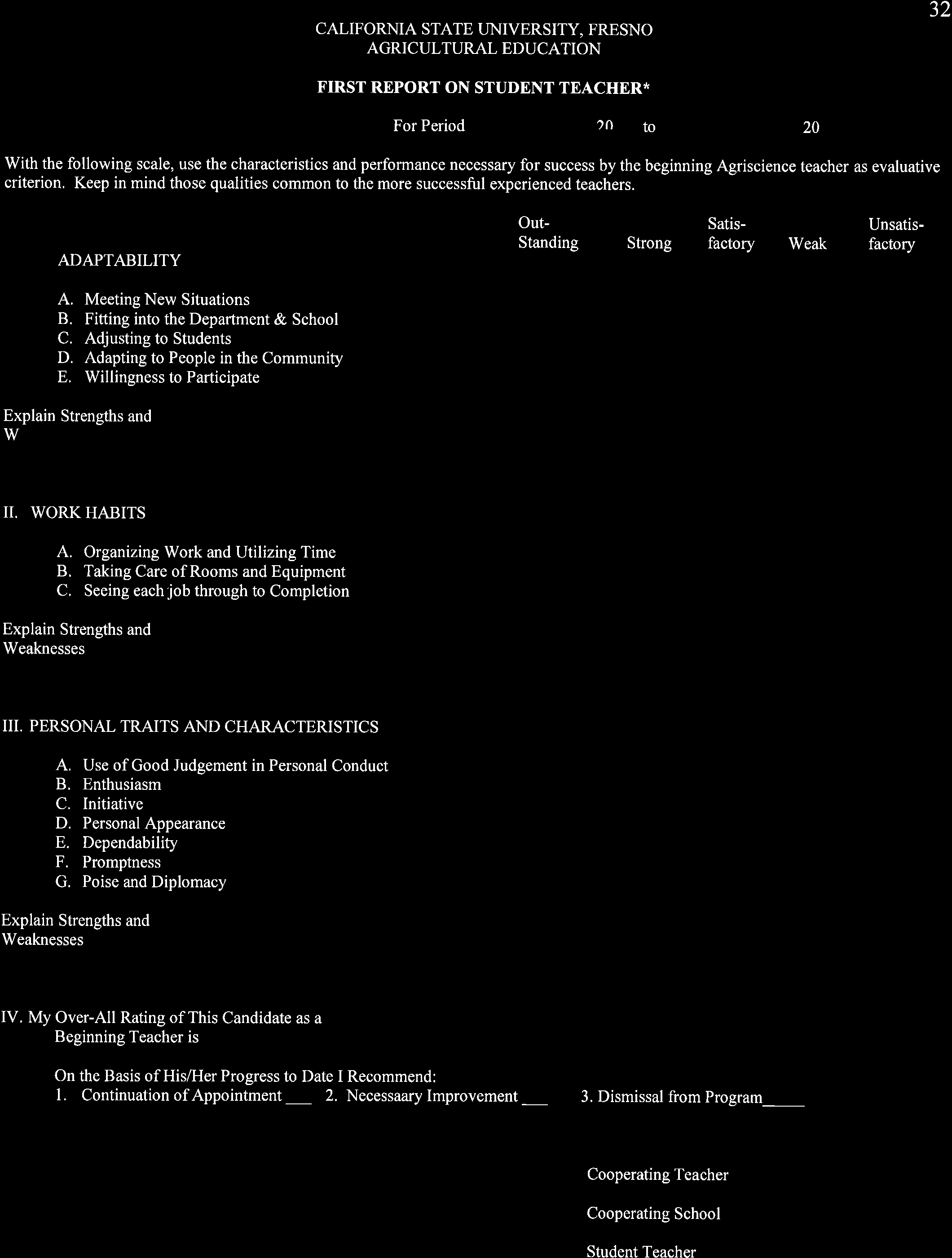
First Report on Student Teacher
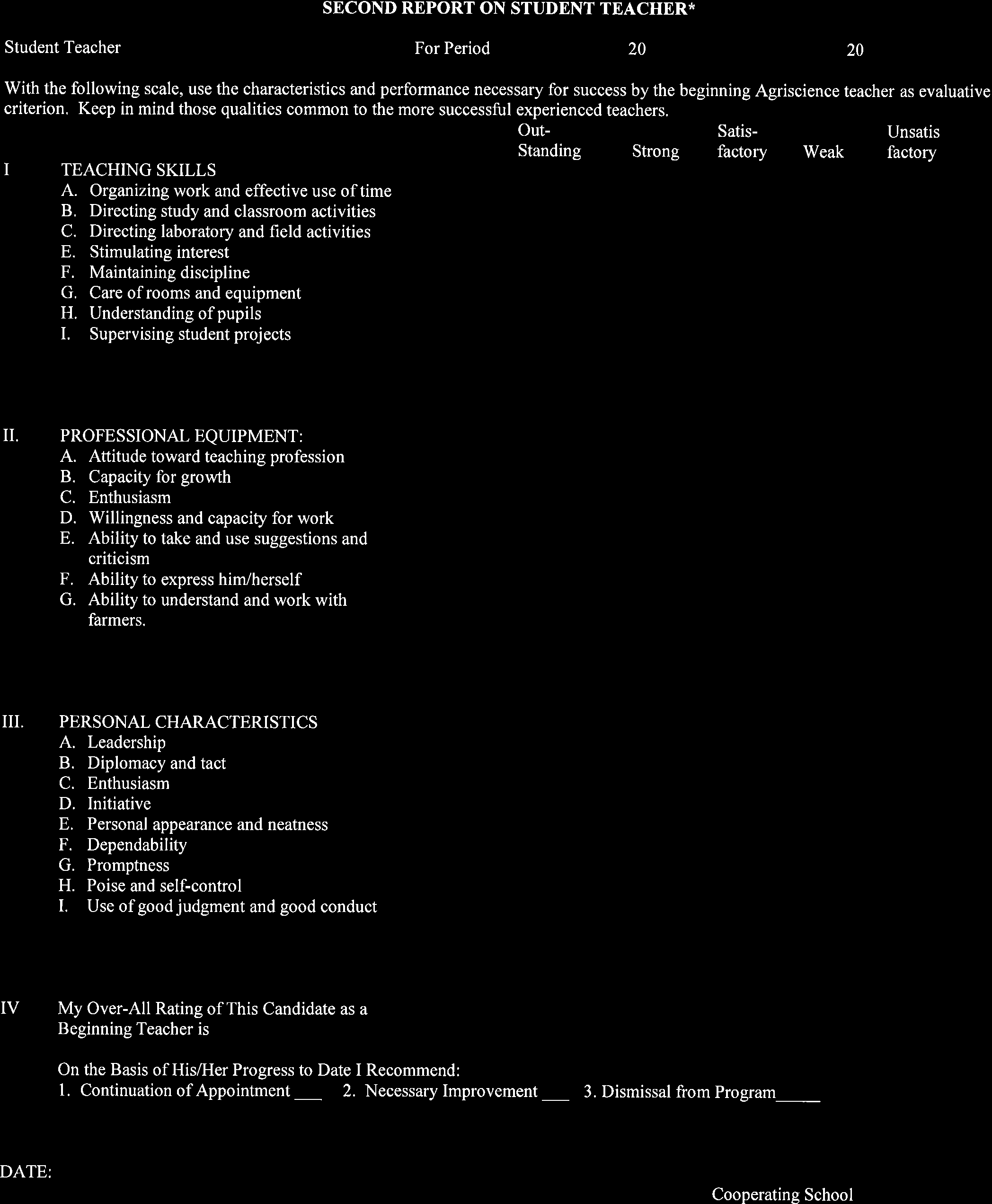
Second Report on Student Teacher
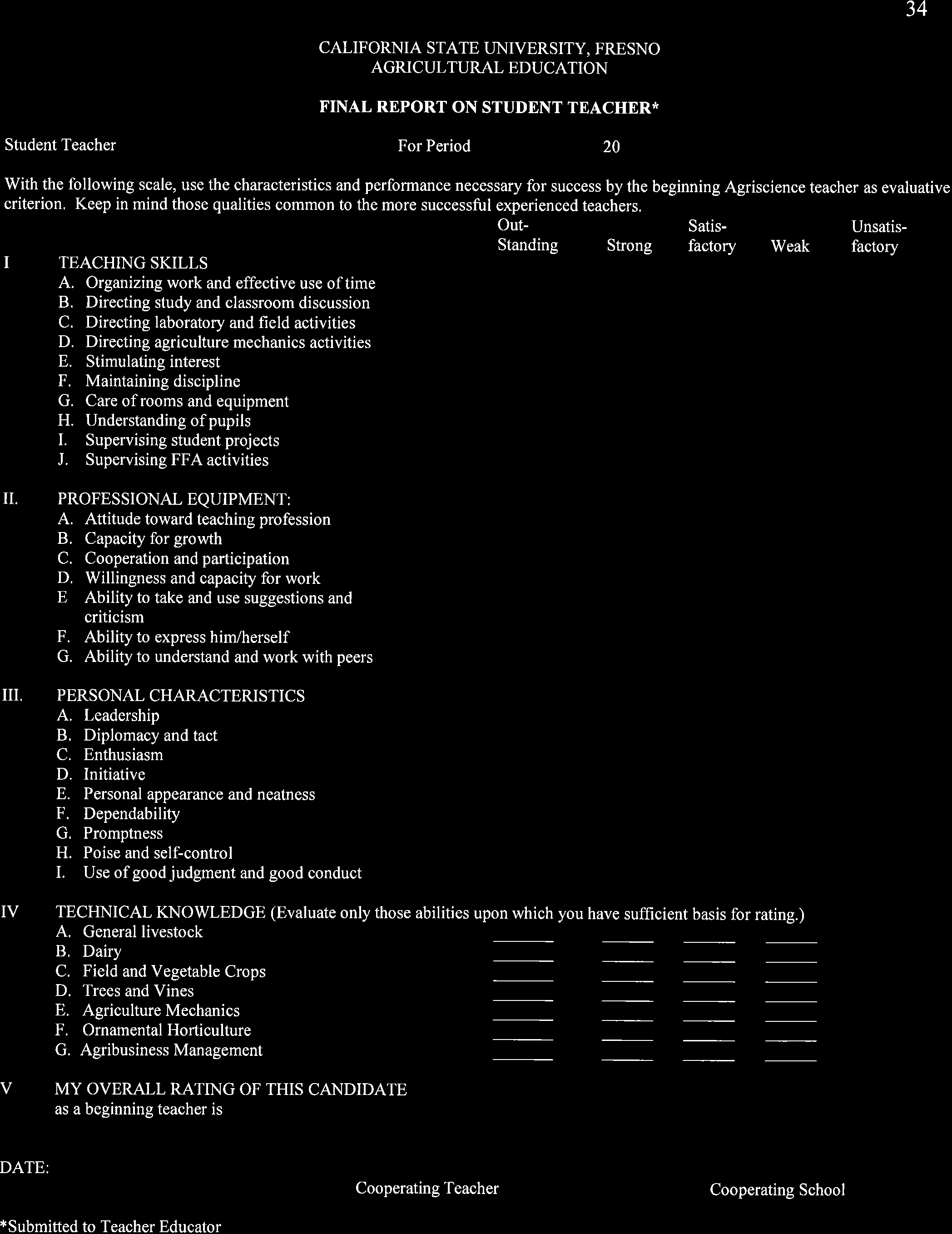
Final Report on Student Teacher
Final Grade Recommendation
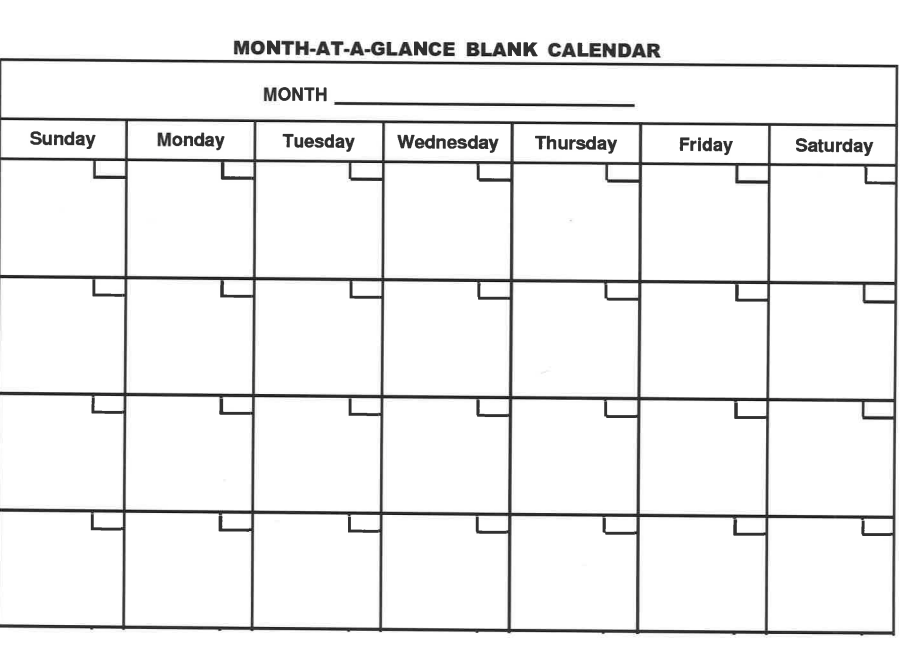
CALENDAR OF EVENTS
This calendar is provided for your use in scheduling activities in which you will participate during your student teaching experience. Appropriate activities include
CATA meetings
FFA meetings
SAE visitations
Faculty meetings
Community activities
Agriculture Department meetings
University seminars
PART I
INSTRUCTIONS FOR THE CANDIDATE
INSTRUCTIONS FOR THE AGRICULTURE SPECIALIST CANDIDATE
The following suggestions are offered for your consideration. The new undertaking you are beginning is without doubt the most important phase of your preparation for service as a teacher of agriculture. Student teaching is your opportunity to learn and to begin to establish your reputation as an agriculture teacher. Observe carefully not only what is done but how it is done in the school to which you are assigned.
First impressions are important. Be genuinely courteous cooperative, and sincere in your dealings with students, cooperating teachers, administrators, other faculty members, school employees, parents and residents in the community. The ability to work well with other people is a skill that every beginning teacher should cultivate. Be discreet at all times in talking to friends and outsiders about what transpires in the agriculture department. You must realize that you are in a position of confidence. Disclosing personal or academic information about your students to anyone other than faculty and administrators at your school is a violation of the 1974 Privacy Act.
It should be realized that the coming and going of teacher candidates causes some interruption of the regular school program. At the same time, you are added personnel in the school and, as such, you should have ideas to present for consideration that can be of value to the education program. Try to make a permanent, tangible contribution to the agriculture department during the student teaching period. (See the AGRI 281 Syllabus).
The cooperating schools are frequently located a considerable distance from California State University, Fresno. If possible, you should move to, or close to, your student teaching site, because you will be expected to participate in the many curricular activities, which occur outside of the regular school day.
I. Administrative Relationships:
A. When you report to the cooperating master teacher he/she will introduce you to the school principal or superintendent. Make contact with your cooperating master teacher at least one week before your assignment begins. Learn the names and faces of the administrative officers of the school, as well as other teachers and school employees.
B. The principal expects you to become one of the teaching staff. Every teacher has certain obligations in the total program and you must be willing to do your share in this respect.
C. Work through your cooperating master teacher in your administrative and professional relationships. He/she is your immediate supervisor.
D. The agriculture specialist candidate should become familiar with the school and department policies as stated in the faculty handbook and similar publications. The areas to be considered should include:
1. Channels of authority.
2. School, community and department standards of dress, conduct, etc.
3. Procedures for conducting classes, directing out-of-class activities and completing
and submitting local reports.
4. Employment provisions.
5. Travel requests and vouchers.
II. Professional and Personal Procedures:
A. Professional:
1. Learn all you can during your student teaching/field experience assignment. An agriculture teacher has a big job; get all the experience possible in all applicable phases of the job - department organization, classroom teaching field and laboratory work, supervising students’ agricultural experience programs and conducting FFA activities.
2. Maintain friendly relationships within the agriculture department and in all the departments of the school.
3. Be discreet in everything you do. You may not find all situations as perfect as you think desirable - few of us do. Watch your conduct. Do not become involved in social affairs with high school students.
4. Do not criticize one student in the presence of another. Do not publicly criticize to others in your class, your cooperating master teacher, your administrators, or your school.
5. Demonstrate a willingness to work. Agriculture teaching is not a “bell to bell” job. You should be able to work as diligently as your cooperating master teacher.
6. Plan your teaching and supervising activities well in advance of the date they will occur. Last minute “rushing around” is a sign of a poor teacher.
B. Personal:
1. Personal appearance is important. Be neat and clean. Dress appropriately for the task to be done.
2. Do not hesitate to ask for assistance from your cooperating master teacher. If you do not know how to do a particular job, be sure to say so, then obtain help in learning how to do it correctly.
3. Do not wait to be told what to do. After general instructions have been given to you, or certain activities planned, proceed to get the job done. Use initiative but be sure to keep your cooperating master teacher informed.
4. Do not be afraid to suggest new ideas, but do not be surprised if they are not used. You may even find that certain procedures are contrary to past teaching. Try to find out why the principle that you previously learned is not applied - usually there is a sound and practical reason.
5. Take criticism in the spirit in which it is offered. Suggestions will be offered for your professional improvement and you should ask for suggestions.
6. Of special note to all agriculture specialist candidates and their cooperating master teachers, the following personal and professional behavior items have been identified for special consideration: 1) appropriate dress and hair style; 2) attendance and travel arrangements; 3) properly conducting student and teacher conferences and project visitations; and 4) an awareness of school policies that relate to teachers’ conduct.
III. Special Note to Student Teachers:
A. First contacts are important.
Your cooperating master teacher will introduce you to each class. Be friendly and sincere but reserved. Your earlier contacts will be with each class as a group. Be unobtrusive but present. Try to gain the respect and confidence of the group. Follow the lead of your cooperating master teacher. Be helpful but do not interfere.
B.
The cooperating master teacher will work with you in planning your first teaching assignment. You will begin teaching when you and he/she determine that you are ready.
C.
Become familiar with each pupil’s name and face. Make a copy of the class roll and the seating arrangement. Learn something about the supervised agricultural experience program of each pupil or their plans for a project.
D.
Prepare your lesson plans carefully. Be sure you know what it is you expect to accomplish in each teaching assignment and how you expect to accomplish it. Check on local agricultural practices and conditions. Prepare plans that will provide for directing, guiding, and leading your students to do and to learn.
E.
You will have more time to prepare lesson plans for present and future use during your student teaching period than any other period in your teaching career. Plan and build carefully.
F.
Secure the cooperation of your class but do not try to do it by being lax in your classroom management.
1. Endeavor to maintain an orderly, business-like classroom atmosphere. As you gain experience, you can more easily direct and supervise class work that allows greater and more desirable student activity and freedom. You must maintain proper control of your classes. Remember that the other teachers in the department have gained student respect; where they may loosen up with the students somewhat; you cannot do it in the same manner.
2. Always conduct yourself in a professional manner where students are concerned, you are a teacher – 24 hours per day.
3. Be consistent in your disciplinary actions and procedures.
4. Be firm and fair, and show a genuine interest in every student.
G.
Use effective teaching devices and methods. Observe the methods used by other teachers in the department.
H.
Be prompt and dependable. Keep your appointments, be on time, do things expected of you on time and in an acceptable fashion.
I.
Learn from your cooperating master teacher.
1. How does he/she handle situations and problems? Keep a record of special “knacks” or procedures that you observe.
2. How does he/she work with people in conducting the program? Copy and use all the good points you can, but remember that no two people will do the same thing the same way so relax and be yourself and adapt to your own personality.
IV. Managing Your First Class:
A.
A relaxed, poised, and enthusiastic teacher creates a sense of well being to the emotional climate of the classroom. Your first teaching day should be free of classroom interruptions so that teaching-learning activities can begin immediately, and a friendly, cheerful, well-organized, and businesslike beginning may be made.
B. Getting started on the right foot.
1. Arrange the room attractively, place materials in convenient locations, plan routine procedures, and organize the first learning activity in detail.
2. Be on time, have everything ready, be ready yourself.
3. Before starting anything be sure you have the attention of every member of the class.
4. Encourage students to ask questions.
5. Make sure students know exactly what you are trying to teach, (ie: make your objectives clear.
6. Be prompt in getting down to their level; don’t teach over their heads. Use visual aids whenever possible.
7. Don’t try to cover too much material; teach well that which you teach.
8. Summarize your lesson, stressing important points.
9. Make your assignments clear and definite and not too hard at first.
10. Leave the classroom properly arranged and materials put away at the end of each period.
V. Supervision of Students’ Agricultural Experience Programs
A.
Become familiar with district and department procedures regarding supervision of agricultural experience programs in areas such as:
1. Transportation
2. Records
3. Parent Contacts
B.
Visit several students and their supervised agricultural experience programs with your cooperating master teacher before undertaking “solo” supervision visits.
VI. General Instructions:
A. Keep the required records on the Weekly Student Teaching Report Form and submit weekly reports on time.
B. Student teachers are assigned full-time to work on activities of the agriculture department, except for time assigned to trips for student teacher class meetings, special problems, or other outside activities previously arranged for and approved.
C. Student teachers are directly responsible to their cooperating master teacher and through him/her to the school administration.
D. Be sure to keep all required or desirable records such as mileage, meals, and hotel expenses. Be sure you can substantiate all items listed for reimbursements. Find out early from your cooperating master teacher the local school policy regarding these matters before incurring expenses.
E. Transportation: understand the district policy regarding the use of all types of school vehicles. Inquire about the use of a private vehicle for school business if it becomes necessary to use one.
F. The local school authorities have granted permission for you to observe and do student teaching/field experience in their school. The continuance of this privilege to those who will follow you depends upon how well you do your work and the manner in which you conduct yourself.
G. Whenever you leave the school during regular school hours for any reason, be sure you have the approval of your cooperating master teacher and, when necessary, the school administrator.
H. Learn all that you can about the school and agriculture department organization.
This will include such items as:
Class schedules
Course outlines
Policies and procedures
Department and state reports
Department budget
Department filing system
Department Plan
Sources & kinds of reference and resource materials
FFA activities
Sources of supplies and materials
I. Remember, it is the agriculture specialist candidate who must do the adjusting, not the department to which you are assigned.
VII. Responsibilities with Liability Implications:
A. All injuries to students and accidents of any nature, no matter how small, should be reported immediately to the cooperating master teacher.
B. Report all incidents of racial ethnic or sexual harassment to your cooperating master teacher immediately.
C. You are encouraged to inquire about Professional Liability Insurance to add to your personal health and life insurance protection.
VIII. Tips for Handling Classroom Discipline:
A. Show a sincere interest in every student in the group.
B. Be consistent; students are quick to spot inconsistencies.
C. Don’t create situations that encourage students to lie, to challenge your authority, to test your intentions, or build minor infractions into discipline problems.
D. Learn to recognize potential problems and take preventative action.
E. Don’t punish the group for the misbehavior of one student.
F. Never yell at the class or make threats to keep order.
G. Praise in public – censure in private.
H. Allow students to save face when they are in a tight spot, but not at the expense of others.
I. Endeavor to solve your own discipline problems, but with the complete knowledge of your cooperating master teacher, and within the requirements of the school’s overall discipline policies.
PART II
RESPONSIBILITIES OF THE COOPERATING MASTER TEACHER
RESPONSIBILITIES OF THE COOPERATING MASTER TEACHER
Your role as a cooperating master teacher is one of great responsibility. Student teaching/field experience is usually regarded as the most important phase in any teacher education program. It is quite likely that you will have more to do with the future performance of the student teacher than any other person. There is no doubt that you will greatly influence the professional attitudes of the student teacher and provide him/her with the opportunity to increase both his/her professional and technical competence. You are encouraged to review the following suggestions:
I. First Contacts:
A. It is very important to make an initial contact with the student teacher before he/she is introduced to your classes. Put the student teacher at ease, and make him/her feel useful and important to your program.
B. Be sure that the agriculture specialist candidate is introduced to the administrator(s) immediately, and to other faculty members and school employees.
C. Introduce the candidate to the classes and assign him/her minor activities that will permit him/her to observe the cooperating master teacher and to get acquainted with the individual students.
D. Acquaint the candidate with the school and agriculture department plan and facilities, and with the activities, policies, and procedures of the school and department. This will undoubtedly be a progressive undertaking, but each student teacher should be familiar with such items if he/she is to succeed.
II. First Assignments:
A. Assign activities or responsibilities that will give the agriculture specialist candidate an opportunity to adjust to the new situation and which will offer him/her the opportunity to:
1. Become familiar with the materials and facilities of the department, reference materials, equipment, supplies, etc.
2. Become acquainted with the individual pupils and their agricultural experience programs and home situations.
3. Become familiar with school faculty and important resource persons in the community.
B. Arrange for the teacher candidate to assist pupils in such individual assignment activities as record books, FFA committee work, individual reports, tool and equipment maintenance, and individual problems.
C. The student teacher should take over one class at the beginning of the semester unless there are factors that require a delay in the first assignment.
D. Make assignments for teaching or participation in FFA activities early enough so that the teacher candidate can prepare himself/herself.
E. Coordinate student teacher assignments with your course outlines, but if possible, start the student teacher with a teaching job in the field in which he/she is well qualified.
F. Check teaching plans with the agriculture specialist candidate before he/she teaches the class, but let him/her handle the class when he/she does his/her teaching. Give him/her an opportunity to develop confidence in himself/herself, by letting him/her be alone with the class for the first few days.
G. Set up a long-range schedule of assignments and responsibilities for FFA and other activities that will allow the teacher candidate to plan his/her personal work schedule.
H. The student teacher should have at least one regular preparation period each day for organization and planning.
I. Make it a point to have agriculture specialist candidates visit pupil’s supervised agricultural experience programs with you early in the semester.
J. Arrange for the agriculture specialist candidate to have a full-time teaching load for at least four weeks during the semester, preferably toward the end of the semester.
K. The student teacher must accomplish the minimum amount of student teaching as specified under state credential requirements.
IV. Supervision and Evaluation of Agriculture Specialist Candidates:
A. Check teaching plans regularly and provide feedback.
B. Supervise and check candidate’s activities in supervising the agricultural experience programs of students.
C. After the candidate has established himself/herself with the class, make careful evaluations of classroom, shop or field instruction and offer constructive criticism. If possible, this should be done immediately following the class period.
D. See that candidates regularly complete their Weekly Student Teaching Report. The student teacher is to furnish you a copy of this report each week.
E. Each agriculture specialist candidate should have his/her own class responsibilities, and his/her performance with that class should not be interfered with by other teachers. Likewise, except in an emergency, the supervising master teacher should not “take away” the control and direction of the class when a student teacher is functioning.
F. Observe the ability of each agriculture specialist candidate to work with other people in the school and community. Development of the ability to follow proper professional procedures and to get along well with people is as important for the candidate as is the development of skill in classroom teaching.
G. Agriculture specialist candidates should be instructed on school safety regulations and on procedures to follow in handling student injuries and accidents. Current school policies should be checked to determine the extent of coverage for student teachers.
H. Submit first, second, and final evaluation reports on each candidate as promptly as possible. When they pertain, the strengths and weaknesses of the candidate should be identified in detail on the progress reports. The progress reports should be discussed with and signed by the candidate prior to their submittal. It is the responsibility of the candidate to provide the cooperating master teacher with a blank copy of each evaluation report well in advance of the due date for submittal.
I. The agriculture specialist candidate is graded subjectively on his/her performance and his/her overall development of professional attitudes. The final grade will be either ‘Credit’ or ‘No Credit’. A ‘No Credit’ grade will be for ‘D’ or ‘F’ level of performance only. At the first indication that a student teacher is doing ‘No Credit’ level work, the university supervisor must be notified so that immediate action or remediation may be taken. In no case should the cooperating teacher wait until the end of the semester to report a ‘No Credit’ level of student performance. It is important to note that the actual issuance of a grade is the responsibility of the university supervisor.
Ag Specialist Program Objectives
AGRICULTURE EDUCATION
CALIFORNIA STATE UNIVERSITY, FRESNO
Exit Evaluation of Objectives for the Agriculture Specialist Credential Candidate
The objectives on the attached form contain professional competencies required of candidates for the Agriculture Specialist Credential. As each objective is accomplished, the approximate date of accomplishment should be filled in and initialed for verification by someone in a position to evaluate the achievement of that objective. The only people who may verify the accomplishment of these objectives are California State University, Fresno faculty, cooperating master teachers and the administrators of the cooperating schools.
Signature(s) of those initialing this form:
Name:__________________________ Title:__________________________
Remove from the student teaching manual and turn in to the teacher educator on the last day of instruction of the University semester.
Ag Specialist Program Objectives
CURRICULUM PLANNING, DEVELOPMENT, EVALUATION (TPE 3)
1. Utilize Core Curriculum in Agriculture.
2. Utilize Advanced Cluster Curriculum in Agriculture.
INSTRUCTION - PLANNING (TPE 4)
1. Structure a Course.
2. Design a Course Unit.
3. Plan a Lesson.
4. Select Instructional Materials
5. Develop Instructional Materials.
INSTRUCTION - EXECUTION (TPE 2)
1. Present a Lesson.
2. Direct Student Activities.
3. Apply Basic Instructional Strategies.
4. Utilize Educational Technology and Resources.
INSTRUCTION - EVALUATION (TPE 5)
1. Evaluate Performance of Students.
2. Develop Tests and Rating Sheets.
3. Practice Self Evaluation.
MANAGEMENT (TPE 2)
1. Project Instructional Resource Needs and Prepare Budgets.
2. Procure Supplies, Facilities and Transportation.
3. Maintain Records and a Filing System.
4. Provide for Student Safety in the Shop/Laboratory.
5. Promote and Maintain Appropriate Student Behavior.
6. Maintain the Classroom, Shop and/or Laboratory.
GUIDANCE (TPE 1)
1. Obtain Background Information on Students.
2. Develop Constructive Interrelationships with Students.
3. Counsel Students.
4. Involve Resource Persons/Agencies in Assisting Students.
5. Conduct 5 Home Visits.
6. Assist Students in Planning Postsecondary Education and/or Employment.
SCHOOL - COMMUNITY RELATIONS (TPE 6)
1. Plan and Publicize the Activities of the Agriculture Program.
2. Maintain Positive Community Relationships.
3. Obtain School-Community Feedback on the Agricultural Education Program.
4. Maintain Good Intra-school Relationships.
STUDENT ORGANIZATION - FFA (TPE 2)
1. Supervise FFA Chapter Activities.
2. Serve as Advisor at a Chapter Meeting.
3. Participate in State and/or National FFA Activities.
PROFESSIONAL ROLE AND DEVELOPMENT (TPE 6)
1. Exhibit Professional Behavior and Conduct.
2. Participate in Professional Association Activities.
COORDINATION (TPE 2)
1. Participate in Administrative Coordination.
2. Supervise Entrepreneurial SAE’s.
3. Supervise Placement SAE’s.
4. Plan and Conduct 5 SAE Visits.
5. Supervise Students at Off-Campus Activities
ADVISORY COMMITTEE FOR AGRICULTURAL EDUCATION (TPE 6)
1. Participate in an Advisory Committee Meeting.
REPORTS AND EVALUATION
Evaluation of performance is an integral part of the student teaching/field experience program. Periodic evaluations provide benchmarks for directing the educational experiences toward improved growth and development.
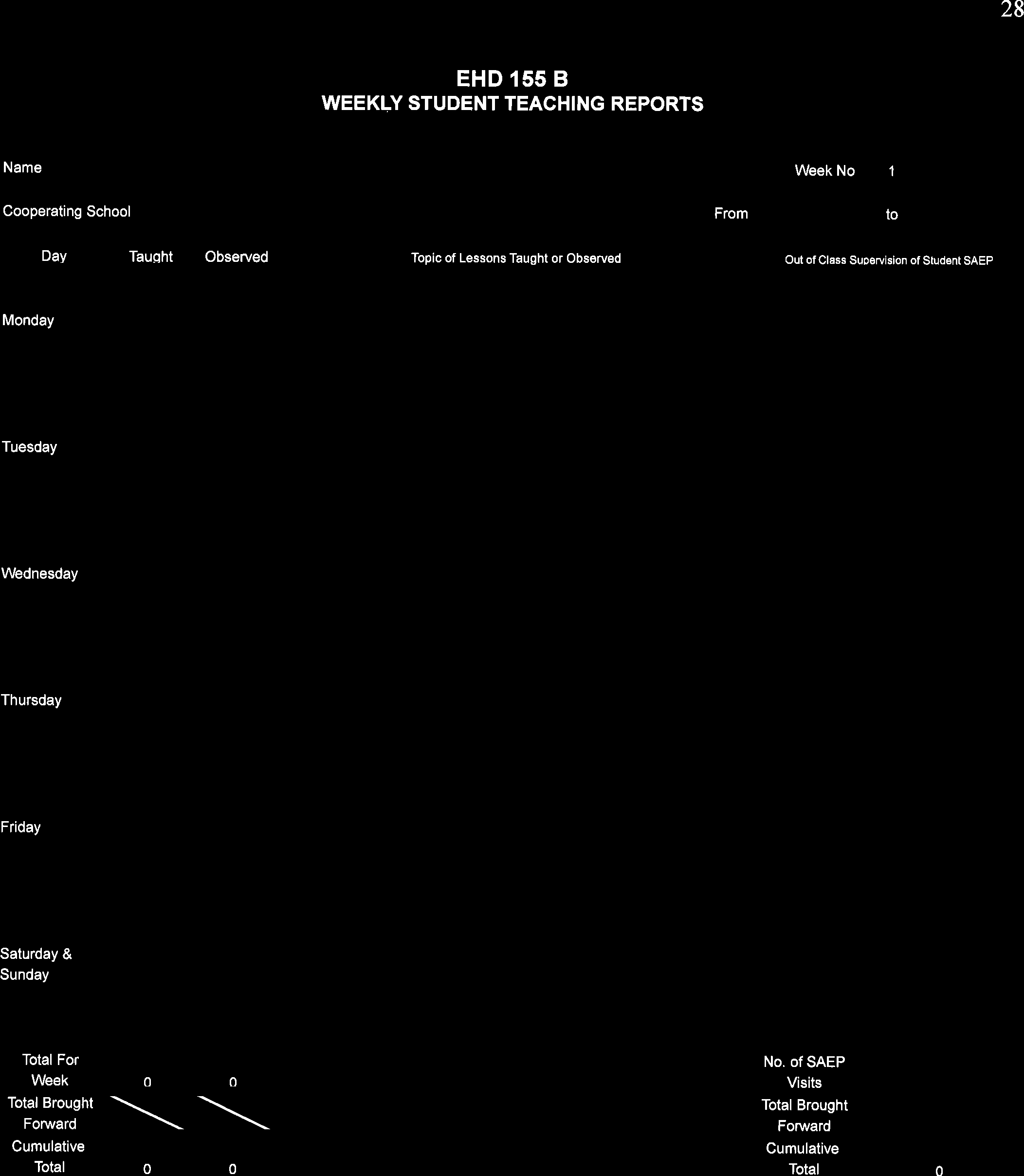
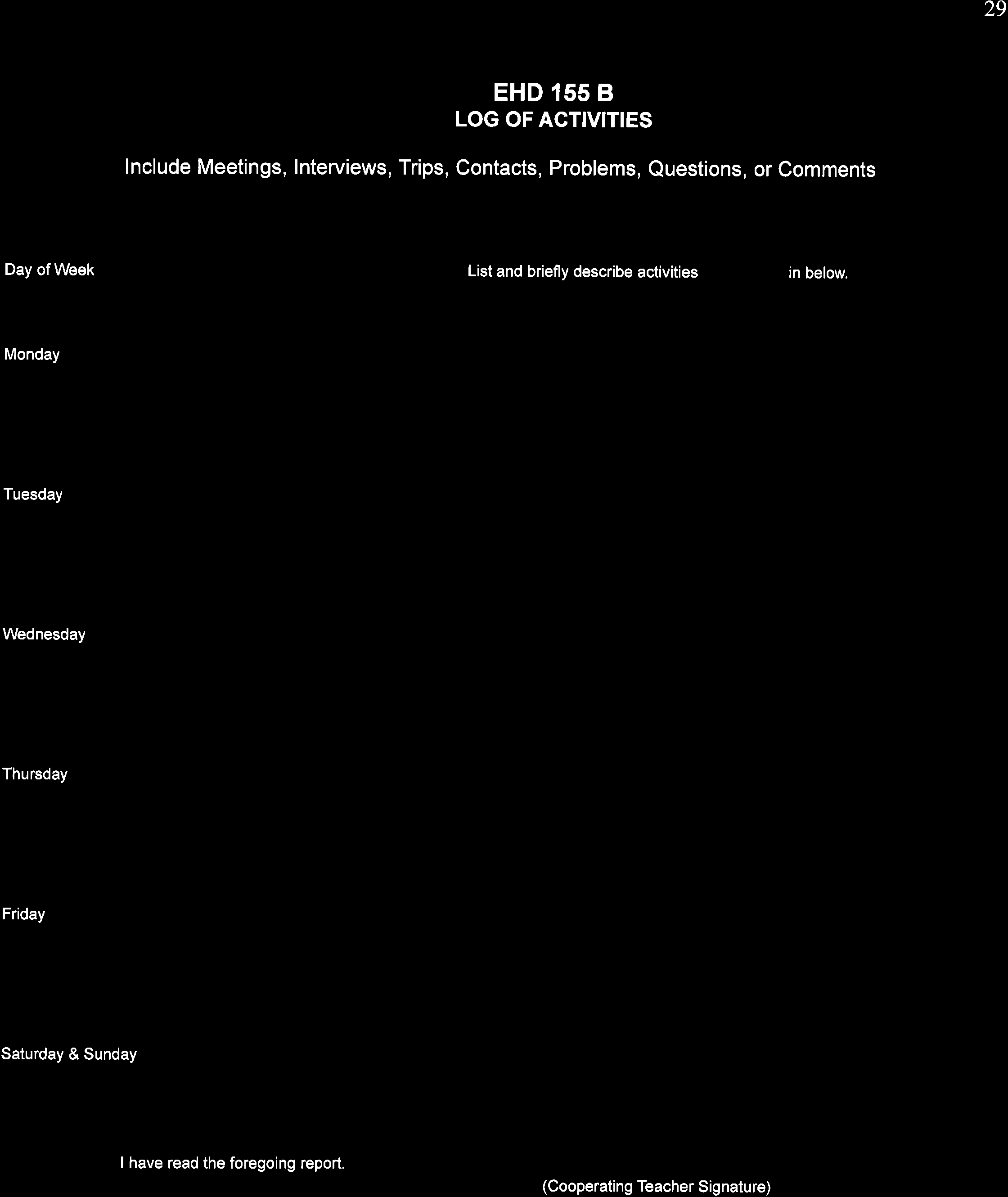
The Student Teaching Weekly Report is a weekly record of the candidate’s activities. It provides insight into the nature of the educational experiences and serves as an official record of the duties performed by the candidate. This report is to be signed by the supervising master teacher with copies being distributed to the teacher educator, cooperating master teacher and the agriculture specialist candidate on a weekly basis.
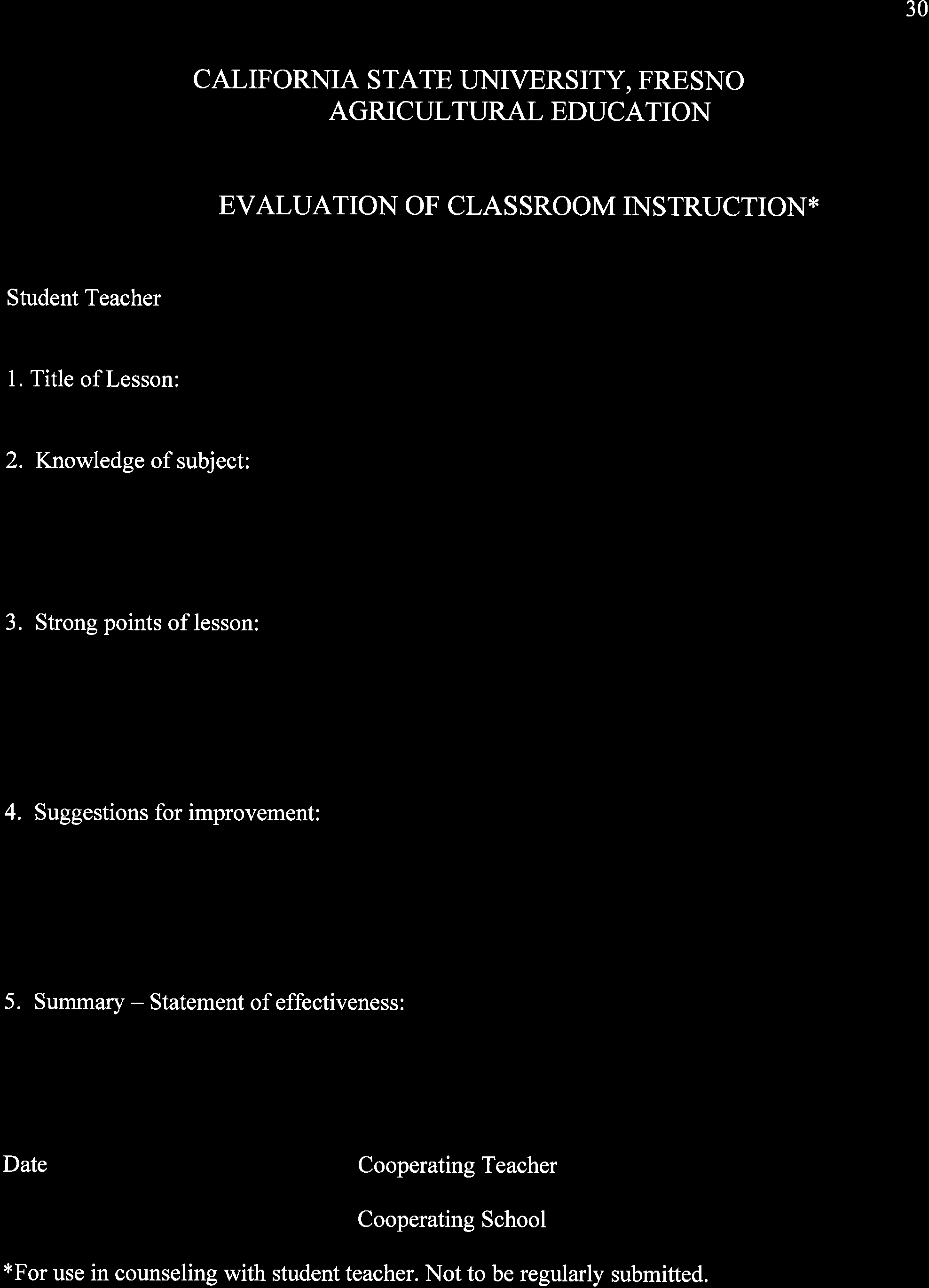
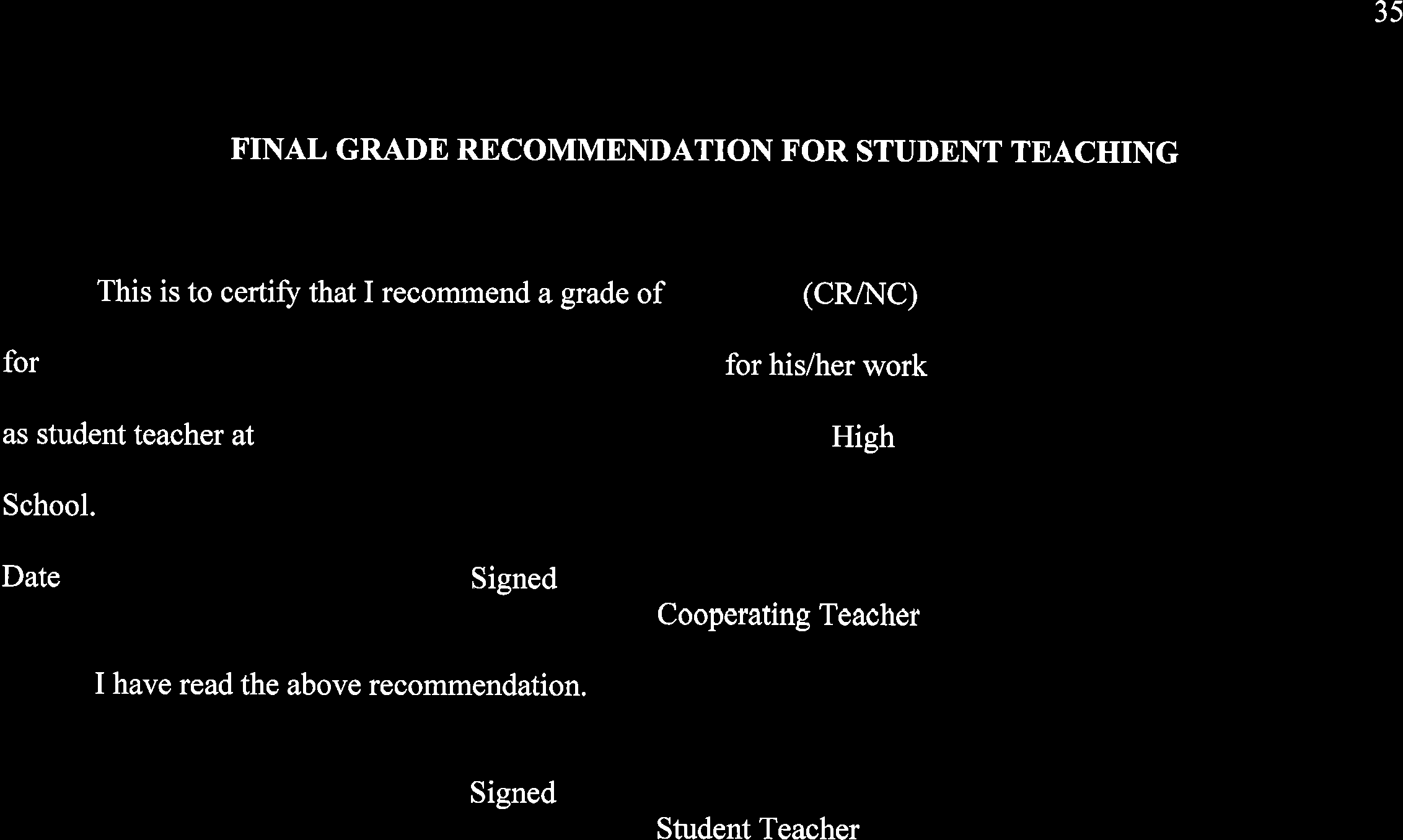
Examples of several other forms that can be used in evaluating classroom teaching and instruction in agricultural mechanics are included in this guide for reference. Also included are the three official reports and grade recommendation form to be submitted by the supervising master teacher at specified dates during the student teaching/field experience period.
The first two official reports (First Report and Second Report) submitted by the cooperating master teacher are progress reports and should be reviewed with the student teacher before being submitted to the teacher educator. The Final Report is the final evaluation and should be sent to the teacher educator at the end of the student teaching assignment.
This HTML version was generated with AI assistance and may contain errors or omissions. The original approved PDF remains the official document of record. An alternative accessible format is available upon request from the document creator in accordance with Title II of the ADA.