ECE Specialist Clinical Experience
The Master’s in Early Childhood Education program provides students seeking the Early Childhood Specialist Credential with formal field and clinical experiences related to their course of study. Other field experiences are embedded in required Program coursework and provide additional opportunities for the Advanced Program candidate to apply theory to practice.
Table Denoting Number of Clinical Hours
| Course Title | Description | Hours |
|---|---|---|
| LEE 241 Fieldwork in ECE 3 Units |
This field experience is intended to support the application of skills and understandings related to leadership, early childhood education, child development and constructivist theory in a “real world” ECE setting. Self-study, a type of action research, will serve as a guiding framework for this course. To demonstrate the candidate’s competence for the Early Childhood Specialist Credential, the candidate’s district supervisor uses the program’s rubric to systematically assesses the ECE ePortfolio students produce in LEE 241 | Minimum 24 – Maximum 45 |
| LEE 232 Literacy in ECE 3 units |
This field experience is intended to support the implementation of early literacy strategies connected to literacy theory and research | 15 |
| LEE 235 Concept Development in ECE 3 units |
This field experience is intended to support the transfer of conceptual developmental theory to practice as students assess infants in the fours stages of development and interview children about the conception of the world. | 10 |
| LEE 250 Leadership in ECE 3 units |
This field experience is intended to support the application of adult learning theory and organizational leadership theory to the implementation of professional learning for adults (e.g. professional development sessions and coaching sessions). | 10 |
Field Experiences and Field Self-Study Requirements for LEE 241
This course is our most comprehensive fieldwork course that involves ongoing field experiences in an ECE setting such as ECE programs, ECE classrooms, children’s centers, etc. Through this process, students will have the opportunity to critically and continuously reflect on practice so that they can bridge the gap between theory, practice, research, and advocacy. This course also includes seminars to allow opportunities for synthesis of knowledge gained through ECE graduate-level course work. Field experience may include different ages and diversity of children as well as varied ECE program types. During their ECE field experience, students develop a self-study plan and e-portfolio informed by the NAEYC Standards.
ECE field experiences typically average three hours per week for eight weeks of the course. Field experiences may involve teaching, visits to ECE programs, classroom observations, etc.
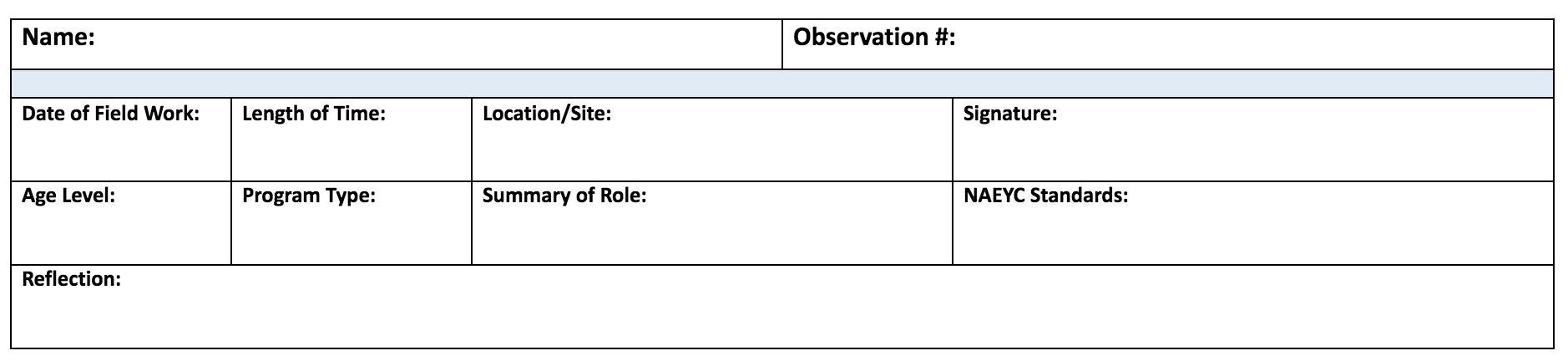
- FIELD SITE DESCRIPTIONS: Students provide in writing the names and program types (ECE center, classroom, agency, etc.) of the places where they complete their field hours. They must include the reasons for selecting each of the field sites. They must provide information on the children-ages, background, etc./teachers/ administrators involved. They must describe their activities each week linked to the NAEYC Standards, and complete the field self-study Activities Form obtaining proper signatures to verify completion of field hours.
- ORGANIZATION: Students create a system such as a notebook, file folders, and/or an album for the field assignment to document their field experience and collect evidence of these experiences.
- EXAMPLES OF ECE PRACTICE (2 Examples): Students provide concrete evidence of their specific field activities
to document their progress. For ECE Program Leaders, this may include teaching, observations,
work with families, etc. For ECE Teacher Leaders, evidence must be provided of ECE
teaching with children to demonstrate quality ECE practices in two ECE levels (infant/toddler,
preschool, TK-2 grades).
Each Example of ECE Practice should include at least one video (no more than 10 minutes) (two examples = 2 videos) and other evidence such as photos, experiences samples or products. If children or other adults are shown, written consent must be obtained. The purpose of the videos and other evidence is to allow the LEE 241 supervisor and others in the fieldwork course to provide feedback helpful in improving the quality of the student’s ECE practice and leadership skills. - THE FIELD SELF-STUDY: The student determines a problem or interest area to study in more depth at one or more of the field sites. The field self-study may be included in the field hours, but typically involves additional time.
- QUESTIONS: Students explain how this study addresses their specific ECE interest or focus. They develop a series of questions to inform the study and reflect the purpose and context of the field self-study.
- PARTICIPANT(S) OR DATA SOURCES: Students determine who is going to participate in the study or other data sources. They obtain written informed consent if needed.
- THEORETICAL FRAME: Students choose a theoretical frame, ECE philosophy, etc. to guide their field self-study. They read at least two related books or articles relevant to the fieldwork self-study.
- DOCUMENTATION PLAN: Students record information, collect data and document findings. In addition to observational notes or a journal, students may develop interview forms, use photographs or video tape, collect experience samples, etc.
- MODIFY AND FINALIZE FIELD SELF-STUDY PLAN: Students conduct an observation to try out the methods selected and finalize the field self-study plan. The LEE 241 instructor approves the proposed field self-study.
- IMPLEMENTATION: Students conduct the field self-study and document their findings using an ePortfolio format.
- REFLECTION: After completing field self-study, students write a reflection concerning the findings, what was learned and how this field self-study assisted in enhancing student’s professional experiences and leadership in ECE.
- FIELD SELF-STUDY PRESENTATION: The field self-study is shared at the LEE 241 seminar. The presentation is usually brief, 10-20 minutes. The presentation includes navigating through the ePortfolio which is typically used to help explain the study and findings.
Example Self-Study ePortfolios
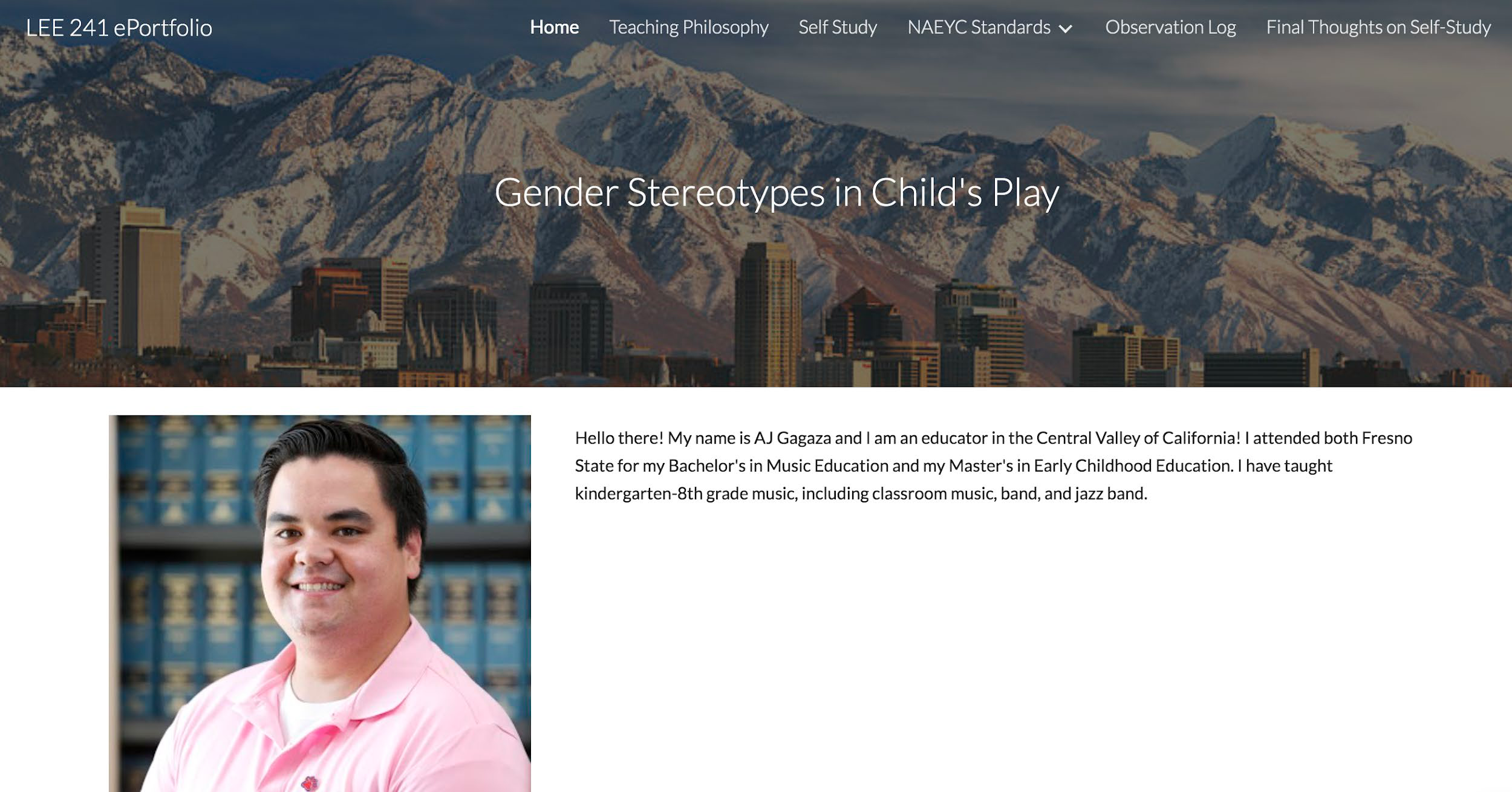
- Gender Stereotypes in Child’s Play
- Enhancing my Coaching Practice through Self-Study
- Self-Study in the Family Child Care Context
District Supervisor Assessment: For students pursuing the Early Childhood (EC) Specialist Credential, the District Supervisor reviews and scores the ECE ePortfolio students produce in LEE 241 using the program rubric. District Supervisor is defined as a district employee who has earned a clear credential. It is preferred that they have also taught at least 3 years in TK-3rd grade. District employees serving in the following roles are able to serve as District Supervisors to candidates pursuing the EC Specialist Credential: Early Learning District Coordinator, Early Learning District Instructional Coach, Early Learning Mentor Teacher, School Principal, or Early Learning Site Supervisor. The syllabus for LEE 241 provides students with a District Supervision Letter that invites them to participate in supporting candidates pursuing EC Specialist credential and explains how to reliably complete the assessment.
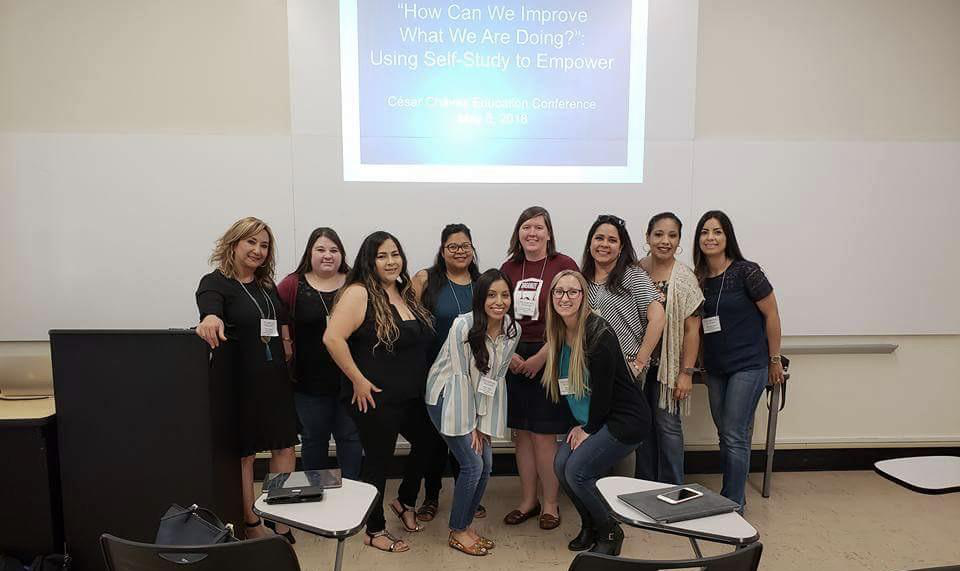
LEADERSHIP ACTIVITY: To demonstrate ECE Graduate Student’s leadership in our ECE field, students must present their field self-study to another interested audience, such as staff at the school or other field site where the study was conducted, parents or an ECE organization. Most recently our students have presented their self-study ePortfolios at the Cesar Chavez in Education Conference held at Fresno State annually.
This HTML version was generated with AI assistance and may contain errors or omissions. The original approved PDF remains the official document of record. An alternative accessible format is available upon request from the document creator in accordance with Title II of the ADA.