Course Syllabus
ERE 288 Educational Measurement and Program Evaluation (3 units)
California State University – Fresno
Kremen School of Education and Human Development
Spring 2020 | Jan 17 – Mar 20, 2020 | Digital Campus
Dr. Mariya Yukhymenko
Office: ED 449
Work Phone: (559) 278-3928
Email: mariyay@csufresno.edu
Office Hours: Tuesday 11am-1pm,
Wednesday 1pm-2pm. Consultations are available via email or Zoom on workweek days.
Please email to schedule a meeting.
Catalogue Description & Class Notes
Prerequisite: ERE 153. Procedures and issues involved in the measurement and evaluation
of educational programs; planning, etc. Applications in educational settings are emphasized.
This section has a prerequisite. For more information, please refer to the current
California State University, Fresno General Catalog or consult with your academic
adviser.
Enrollment in 200-series courses is limited to those who have met graduate degree
program admission requirements, including appropriate GRE/GMAT/MAT scores. Exceptions
may only be made by the Graduate Dean. Advanced, post-baccalaureate credential students
may enroll in no more than six units of 200-series course work prior to submission
of GRE/MAT scores.
This is a fully online course
Canvas Access & Help
Login to Canvas at: https://fresnostate.instructure.com/
Canvas information for students: http://fresnostate.edu/academics/canvas/students/index.html
How do I get help with Canvas?
Contact the Academic Technology Resource Center for Canvas help. They are located
on the second floor of the Henry Madden Library in the Center for Faculty Excellence.
You can also call them (278-7373) or email (canvas@mail.fresnostate.edu) for help.
For 24/7 help with Canvas, click the "Help" icon in the left, global course navigation
menu in Canvas.
Canvas Student App: http://fresnostate.edu/academics/canvas/students/student-app.html
Textbooks and Materials
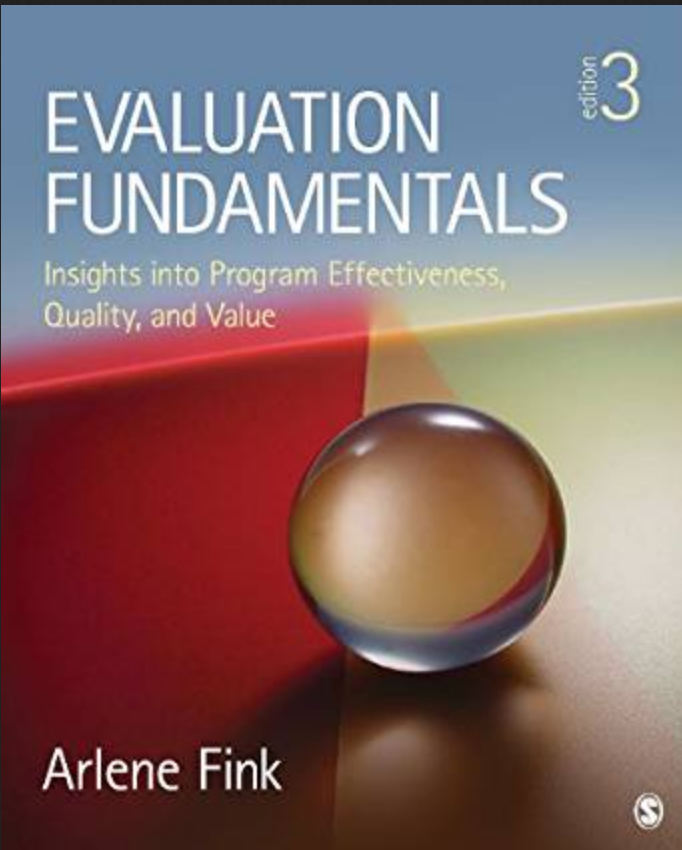
Fink, A. (2014). Evaluation fundamentals: Insights into program effectiveness, quality, and value (3rd ed). Thousand Oaks, CA: SAGE Publications, Inc.
- Print ISBN: 9781452282008, 1452282005
- eText ISBN: 9781483324234, 1483324230
This is the main textbook in the course. It will help you in completing the assignments in the course. The first chapter is available online; but not other chapters. Weekly Chapter Connections are based on the textbook. The textbook is available at the Fresno State Kennel Bookstore. You can also access the Kennel Bookstore website to see the prices and options: http://www.kennelbookstore.com/SelectTermDept.aspx, select the term, "ERE" for the department, and an appropriate course and section to "Add Selection" and "See Course Materials" online. This textbook is also available on other websites (e.g., Vital Source: https://www.vitalsource.com/referral?term=9781483324234; Amazon), which are typically cheaper than the university bookstore.
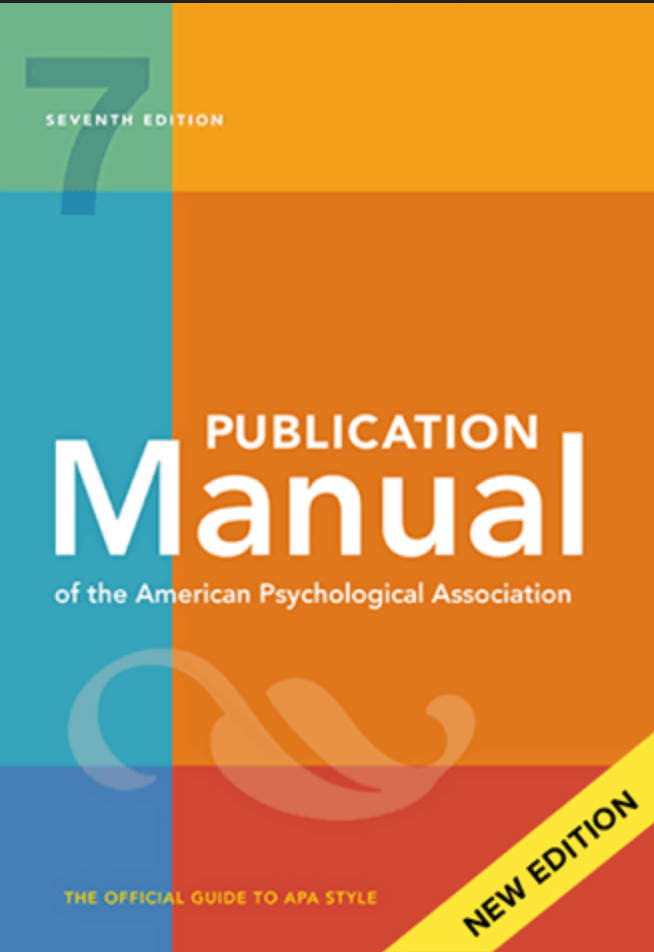
APA (2019). Publication Manual of the American Psychological Association (APA 7th edition). American Psychological Association.
- Print ISBN: 9781433832154, 1433832151
- eText ISBN: 9781433832185, 1433832186
The Publication Manual of the APA provides clear and specific guidelines on how to format their academic papers. Because graduate students are expected to adhere to the APA guidelines for overall paper layout, citations, abstract, style, and references, this book is an excellent resource because it explains paper elements and formats, writing style and grammar, bias-free language guidelines, spelling, punctuation, abbreviations, capitalization, italics, tables and figures, reference list and in-text citations. This is a new edition, which was released in October 2019. It is available at the Fresno State Kennel Bookstore, as well as on other websites (e.g., Vital Source: https://www.vitalsource.com/referral?term=9781433832185, Amazon). You might also be able to pick up a hard copy at the Fresno State Library on a first come first serve basis.
APA Style Resources:
- Owl Purdue Website: http://owl.english.purdue.edu/owl/resource/560/10/
- APA Style Blog: http://blog.apastyle.org/
- Materials in Canvas.
These resources will be useful for students who are just beginning to use the APA style or who are familiar with its use. Explore the websites for content that can best support your needs. Bookmark these helpful webpages.
Course Description
This course is designed to build your understanding of educational measurement and educational programs. In this course, you will plan a program evaluation of a real-world educational program.
You will encounter assignments with no points assigned and others with points. We will utilize the peer-led team learning (PLTL) in this course, which will allow you to talk through the material and interact with others regarding program evaluation and gain a deeper understanding of the content. The important thing to remember is that virtually everything should contribute to your knowledge and skills base related to program evaluation.
Embedded Fieldwork
Assignments for this course will be based on projects, plans, and assessment data from actual sites and/or organizations. Students must be able to demonstrate to the instructor that these assignments are connected to real-life practical applications.
Purpose of Course
The course purpose is to promote students’ understanding of educational measurement and program evaluation. Specific goals include:
- Promote students’ appreciation of the role of reliability and validity in test score use.
- Promote students’ understanding of the processes involved in program evaluation.
- Encourage students’ understanding of the applicability of educational measurement and program evaluation to their professional practices.
- Enable students to develop research questions and strategies to evaluate a program in their field.
- Foster students’ ability to evaluate diverse sources of information (e.g., journal articles, computer output) relevant for test score use and program evaluation.
Course Goals and Objectives
Upon completion of the course, students will be able to:
- Identify the role of reliability and validity in test score use.
- Evaluate an instrument’s test manual to determine appropriateness of score use.
- Generate research questions relevant to program evaluation.
- Interpret results pertinent to evaluating program effectiveness.
- Identify and describe the steps involved in program evaluation.
- Gain factual knowledge, including terminology, classifications, methods, trends.
- Learn to apply course material to improve thinking, problem solving, and decisions.
Course Format
The course will use online activities. Students are expected to actively participate in class.
Notes Related To Online Learning
Required Technology
All course materials and instruction are presented online, which means that you will need regular access to a computer with a connection to the Internet. You may access the course from any computer that is capable of connecting to the Internet. If you have difficulty with your home or work computer, it is your responsibility to procure access to another computer (such as a local public computer or a computer at a local library).
You will need the following software:
An Internet browser that is compatible with Canvas Learning Management System, Google Site, and YouTube.
Course Requirements:
Your success in this course depends on your full participation, which includes active engagement with all of the course materials, activities, and instructor. You are expected to login to the course frequently to access course materials and announcements. You are also expected to read all course content thoroughly and complete all activities as assigned each week. You have full responsibility for engaging with the course content and monitoring your own progress. Timely completion of assignments will provide the primary evidence of your participation in the course, along with the quality of your work.
The course is structured with a weekly schedule to assist you in planning the time needed to devote to learning content. The concepts presented in this course build upon one another, and each module and textbook chapter provide you with information needed to master content in subsequent modules. It is important that you master the learning objectives associated with each topic as they are presented to build the foundation for information covered in subsequent topic.
The course is self-paced in that you have control over when you complete assignments within a given week. However, each instructional week has a designated starting and ending date, and assignments must be completed and submitted in Canvas on or before the due date and time specified in the schedule. Students who wait until the weekends to first check for new course materials will likely have difficulty keeping pace with the course and schedule. All required course readings and materials will be available via the textbooks or the Internet links provided in the course materials. YouTube videos will be used in this course to help your learning.
If you encounter a problem accessing any of the course materials, you are expected to notify the instructor of the problem as soon as possible. It is your responsibility as a student to monitor your progress in meeting the learning objectives of each instructional week and textbook chapter, and applying the content. If you determine that you are not mastering the content covered each week, it is your responsibility to contact the instructor to seek assistance. This may include asking questions, requesting clarification on a topic, requesting a face-to-face meeting or a Zoom conference meeting, and inquiring about additional instructional resources.
Study Expectations
This is a 3-unit course, which lasts for half of the semester. Aligned with the CSU Fresno policy, it is expected that students will spend approximately 15 hours of study time per week. Some students may need more outside study time and some less.
Email and Online Etiquette
How you will be perceived, your credibility, and your level of professionalism will be judged based on how you communicate with others online. Following email and online etiquette can help you be perceived professional and courteous.
Email Etiquette
I want you to become a successful professional. Therefore, let me draw your attention to the email etiquette. As a student, there is a certain level of formality when sending emails to your peers or professors, which is very different from daily texts or communication via messages with your friends. Follow these simple tips, which can help you be perceived professional, credible, and serious:
Write from your Fresno State email account. That immediately lets your professor see that your email is legitimate and not spam. The cryptic or cutesy or salacious personal email address that might be okay when you send an email to a friend is not appropriate when you're writing to a professor.
Include the course number in your subject line. "Question about ERE153 assignment"
is clear and sounds genuine, while "a question" looks like spam. "Question about assignment"
without identifying the class you are in may leave your professor with the chore of
figuring that out.
Think about what you're saying. Here are some ways to write to your professor (as
well as your colleagues at work and in other professional situations) well:
- Include a greeting with an appropriate level of formality. To not sound demanding or terse, make sure your email includes a courteous greeting and closing. "Hi/Hello Dr. Yukhymenko" is an appropriate greeting.
- Ask politely. "Could you email me the page numbers for the next reading? Thanks!" is a lot better than "I need the assignment."
- Proofread what you have written. To be perceived professional and serious, check the spelling of your email. You want your email to show you in the best possible light.
- Include a closing and sign with your name. Closing with “Kind regards,” “Thank you,”
“Sincerely,” followed by your name are also appropriate.
When you get a reply, say thank you. Just hit Reply and say "Thanks," or a little bit more if that's appropriate. The old subject line (which will now have a "Re:" in front) will make the context clear.
Additionally, take a look at this article, which describes the most important things
in email etiquette, this will help you a lot when you communicate with your professors,
applying for jobs, sending follow up emails after job interviews, and communicating
with your employer in the future:
101 E-mail Etiquette Tips (https://www.netmanners.com/e-mail-etiquette-tips/).
Online Etiquette
“Netiquette” is network etiquette; quite simply it is the do's and don'ts of online
communication. Netiquette covers both common courtesy online and the informal "rules
of the road" of cyberspace. Follow this link and explore the Core Rules of Netiquette
(http://www.albion.com/netiquette/corerules.html).
You can also watch a video on Netiquette: https://youtu.be/DwdqQjCfWSc (2:02).
Course Requirements and Grading Policy
Key Assignments:
- Individual: Module 0 Activities 10 points
- Individual: Chapter Connections (9x10 points) 90 points
- Team: Weekly Reports of Progress (8x10 points) 80 points
- Team: Final Report for Program Evaluation Planning 160 points
- Contribution to the team work (reported by classmates) 20 points
TOTAL 360 points
Grading:
| Grade | Range | Description | Explanation |
|---|---|---|---|
| A | 90 - 100% | Excellent | An excellent grasp of all course materials. |
| B | 80 - 89.99% | Good | Mastery of the majority of the course materials. |
| C | 70 - 79.99% | Average | Mastery of approximately two-thirds of the course materials. |
| D | 60 - 69.99% | Poor | Mastery of fewer than half of the course materials. |
| F | < 60% | Failure | Not an adequately grasp of any of the course materials. |
Final Grade
This course uses a combination of individual and team assignments to assist students master course material. Individual assignments are used to allow students critically examine the concepts in this course. The team assignments are used to reinforce student learning by applying the concepts and are designed to maximize your collaboration and communication with students. Your final grade will be based on the following course requirements:
- Individual: Module 0 Activities (10 points)
Module 0 is design as a course orientation to allow students having a good start to this course. It provides an overview of resources related to online learning, Canvas, course structure and expectations. There are a few activities that students will need to complete as part of this module and course orientation. You will have until the end of Module 1 to complete and submit activities of Module 0. Work submitted beyond that will be considered late and be subjected to the late submission policy (see Course Policies below). - Individual: Chapter Connections (90 points)
For the class to be successful, all students must participate and contribute. Furthermore, what I want and expect from you as a student is that you are actively present in this class and that you communicate with your classmates, share your experiences, and critically examine the concepts presented with an open mind. To help you with these tasks, 25% of your final grade will be devoted to helping you to prepare for class and engage with class content. Chapter Connections will vary each week (e.g., a chapter summary, concept map, person on a street interview) and will require that you read, critically reflect on the chapter material, and then evaluate, analyze, and synthesize the material. You are expected to complete these assignments weekly. They will be due at the end of each week (i.e., 11:59pm on Friday each week). Assignments submitted after 11:59pm will be considered late and be subjected to the late submission penalty (see Course Policies below). - Team: Weekly Reports of Progress (90 points)
During the course, you will work in teams to design an evaluation of an existing, real-world educational program of your choice. At the end of the course, your team will submit a final report of the Program Evaluation Planning (i.e., assignment 4). To facilitate the process of completion of the final report, each team will submit weekly reports during the course with specific activities (e.g., identification and description of the program, Logic Model, proposed evaluation questions, proposed measures). See Canvas for specific information. - Team: Final Report of Program Evaluation Planning (150 points)
Students will work in teams during the duration of the course to select an educational program oftheir choice and to design evaluation of it. The final report will largely be based on the weekly work, combined in one cohesive document. - Contribution to the team work (reported by classmates) (20 points)
Because this course incorporates group work, each student will complete a peer-report of contribution of their teammates to the team work using predetermined rubrics.
See Canvas course for more details on the specific requirement for each component and corresponding grading rubrics.
Course Policies
Due dates
All work is due by 11:59pm on the due date unless otherwise specified.
Readings
Students will be responsible for completing assigned readings during each module,
and be prepared to discuss and apply these materials to real-world educational program(s).
Submission of Assignments
Being able to apply a style guide is an important aspect of this course. You are required
to use the 6th edition of the APA manual for the assignments submitted as a word attachment.
All assignments must follow the APA style and be typed in Times New Roman 12-point
font, double spaced, and turned in as Google Docs.
Late Work
Assignments submitted within one week after the due date would be reduced by one letter
grade or point equivalent. Assignments submitted beyond one week late will receive
no credit.
- While late work is never advised, it is clear that periodically life gets in the way and students must be given some latitude regarding late assignments. If there is an unexpected situation that arises, please contact me before a due date and request an extension.
Missed Work
If you do not complete or submit a required course quiz or assignment, you will receive
a grade of 0 for that item. If you are ill or have a serious problem that prevents
you from submitting an assignment on time, refer to the late assignment policy above.
Plagiarism
You are expected to cite and attribute the work of others properly, format all direct
quotations in the APA style, and submit your work. Assignments will be checked for
plagiarism using anti-plagiarism software. See Cheating and Plagiarism University
Policy for the range of penalties for plagiarism.
Sending and Receiving Email
The instructor will respond to all questions, inquiries, and other electronic correspondence
in timely, but not necessarily immediate, manner. Most electronic communication will
be answered within 48 hours on workweek days. It is expected that students will follow
the basics of email etiquette.
Tentative Course Schedule
| Date/Class | Topic | Chapters /Assignments Due |
|---|---|---|
| Module 0 Jan 17 |
Introduction to the course and online learning |
|
| Module 1 Jan 18 - Jan 24 |
Introduction to program evaluation and evaluation methods |
|
| Module 2 Jan 25 - Jan 31 |
Evaluation questions and evidence of merit |
|
| Module 3 Feb 1 - Feb 7 |
Designing program evaluations |
|
| Module 4 Feb 8 - Feb 14 |
Sampling |
|
| Module 5 Feb 15 - Feb 21 |
Collecting information: The right data sources |
|
| Module 6 Feb 22 - Feb 28 |
Evaluation measures |
|
| Module 7 February 29 - March 6 |
Managing evaluation data |
|
| Module 8 March 7 - March 13 |
Analyzing evaluation data |
|
| Module 9 March 14 - March 20 |
Evaluation reports |
|
Subject to Change Statement
This syllabus and schedule are subject to change in the event of extenuating circumstances.
If you are absent from class, it is your responsibility to check on announcements
made while you were absent.
Helpful Learning Resources
Tutoring
For free tutoring on campus, contact the Learning Center in the Collection Level (basement level) of the Henry Madden Library: http://www.fresnostate.edu/studentaffairs/lrc. You can also reach them by phone at 559-278-3052.
Writing Center
The Writing Center is here to help any Fresno State Student with any writing students are working on: http://www.fresnostate.edu/artshum/writingcenter/index.html. They offer small writing groups, one-on-one tutoring, and online tutoring. Location: ED184. You can also reach them by phone at 559-278-0334.
Graduate Writing Studio
Submit a quick question online via Mr. Write to the Graduate Writing Studio (e.g., how to cite a source, how to format your paper, need a grammar or punctuation tip) or meet with a consultant (in person or virtually) for more complex questions in Henry Madden Library, 2119: https://www.fresnostate.edu/academics/gradstudies/graduatewritingstudio.html. You can also reach them by phone at 559-278-2450.
Graduate Statistics Studio
The Graduate Statistics Studio offers in-person and digital statistics consultations to graduate students working on class assignments and/or theses, projects, and dissertations. The Graduate Statistics Studio is located in the Graduate Study Center, Henry Madden Library, 2119. Go online to make an appointment: http://www.fresnostate.edu/graduatenet/students/statspage.html. You can also reach them by phone at 559-278-2450.
Lynda.com
Lynda.com is an excellent tutoring resource available for Fresno State students for free. You can see SPSS Tutorials at http://www.lynda.com/SPSS-training-tutorials/1009-0.html.
Policy Statements
Students with Disabilities
“Upon identifying themselves to the instructor and the university, students with disabilities will receive reasonable accommodation for learning and evaluation. For more information, contact Services to Students with Disabilities in the Henry Madden Library, Room 1202 (278-2811).”
Honor Code
“Members of the CSU Fresno academic community adhere to principles of academic integrity and mutual respect while engaged in university work and related activities.” You should:
- understand or seek clarification about expectations for academic integrity in this course (including no cheating, plagiarism and inappropriate collaboration)
- neither give nor receive unauthorized aid on examinations or other course work that is used by the instructor as the basis of grading.
- take responsibility to monitor academic dishonesty in any form and to report it to the instructor or other appropriate official for action.
Instructors may require students to sign a statement at the end of all exams and assignments
that
‘I have done my own work and have neither given nor received unauthorized assistance
on this work.’”
Cheating and Plagiarism
"Cheating is the actual or attempted practice of fraudulent or deceptive acts for the purpose of improving one's grade or obtaining course credit; such acts also include assisting another student to do so. Typically, such acts occur in relation to examinations. However, it is the intent of this definition that the term 'cheating' not be limited to examination situations only, but that it include any and all actions by a student that are intended to gain an unearned academic advantage by fraudulent or deceptive means. Plagiarism is a specific form of cheating which consists of the misuse of the published and/or unpublished works of others by misrepresenting the material (i.e., their intellectual property) so used as one's own work." Penalties for cheating and plagiarism range from a 0 or F on a particular assignment, through an F for the course, to expulsion from the university. For more information on the University's policy regarding cheating and plagiarism, refer to the Class Schedule (Legal Notices on Cheating and Plagiarism) or the University Catalog (Policies and Regulations).”
Computers
"At California State University, Fresno, computers and communications links to remote resources are recognized as being integral to the education and research experience. Every student is required to have his/her own computer or have other personal access to a workstation (including a modem and a printer) with all the recommended software. The minimum and recommended standards for the workstations and software, which may vary by academic major, are updated periodically and are available from Information Technology Services (http://www.fresnostate.edu/technology) or the University Bookstore (http://www.kennelbookstore.com). In the curriculum and class assignments, students are presumed to have 24-hour access to a computer workstation and the necessary communication links to the University's information resources."
Disruptive Classroom Behavior
"The classroom is a special environment in which students and faculty come together to promote learning and growth. It is essential to this learning environment that respect for the rights of others seeking to learn, respect for the professionalism of the instructor, and the general goals of academic freedom are maintained. Differences of viewpoint or concerns should be expressed in terms which are supportive of the learning process, creating an environment in which students and faculty may learn to reason with clarity and compassion, to share of themselves without losing their identities, and to develop and understanding of the community in which they live. Student conduct which disrupts the learning process shall not be tolerated and may lead to disciplinary action and/or removal from class."
Copyright Policy
“Copyright laws and fair use policies protect the rights of those who have produced the material. The copy in this course has been provided for private study, scholarship, or research. Other uses may require permission from the copyright holder. The user of this work is responsible for adhering to copyright law of the U.S. (Title 17, U.S. Code). To help you familiarize yourself with copyright and fair use policies, the University encourages you to visit its copyright web page: http://www.csufresno.edu/library/about/policies/docs/copyrtpolicyfull.pdf
Technology Innovations for Learning & Teaching (TILT) course web sites contain material protected by copyrights held by the instructor, other individuals or institutions. Such material is used for educational purposes in accord with copyright law and/or with permission given by the owners of the original material. You may download one copy of the materials on any single computer for non-commercial, personal, or educational purposes only, provided that you (1) do not modify it, (2) use it only for the duration of this course, and (3) include both this notice and any copyright notice originally included with the material. Beyond this use, no material from the course web site may be copied, reproduced, re-published, uploaded, posted, transmitted, or distributed in any way without the permission of the original copyright holder. The instructor assumes no responsibility for individuals who improperly use copyrighted material placed on the web site.”
Other Helpful Resources
Fresno State Accessibility Statements
To learn about Fresno State’s accessibility, follow the link
http://www.fresnostate.edu/academics/cfe/resources/accessibility/index.html
Office 365
Office 365 is available to Fresno State faculty, staff, and students for free. You
can download and install Office 365 on up to five devices for free. Available programs
of Fresno State's Office 365 Suite include: Word, Excel, PowerPoint, Publisher, Access,
OneNote, and OneDrive (for PCs), and Word, Excel, Powerpoint, OneNote, and OneDrive
(for MACs). Please see “How to Get Office 365.” If you have any questions, please
contact the Help Desk at (559) 278-5000.
https://help.fresnostate.edu/students/software/office365.php
Services for Students with Disabilities
Services for Students with Disabilities (SSD) at California State University, Fresno,
coordinates academic support services for students with disabilities.
http://www.fresnostate.edu/studentaffairs/ssd/
International Student Services and Programs
International Student Services and Programs office (ISSP) at California State University, Fresno provide support to international students. http://fresnostate.edu/academics/issp/
The Dream Success Center at Fresno State
Fresno State's Dream Success Center is dedicated to serving our AB540 - Dream students.
The center provides personal and academic support to help Dreamers and other students
succeed in college and realize their dream of a college degree. The center is a welcoming
safe place for current Fresno State students and are here to be their advocates, resource,
and support. To learn more about the Dream Success Center please visit or contact
the Dream Success Center.
https://www.fresnostate.edu/studentaffairs/dsc/
Fresno State Student Cupboard
The Fresno State Student Cupboard is a free food and hygiene pantry for current Fresno
State students. Located in the Industrial Technology building, room 144, the Student
Cupboard is open 5 days a week for a total of 30 hours to provide students with access
to items. When a student comes into the Student Cupboard, they will show their Fresno
State ID card and tell us how many individuals in their household will be utilizing
the food. Students are allowed to shop for one bag of groceries per day, and are able
to choose from a variety of perishable and non-perishable food items. Once a month,
we provide full hygiene packs for students who sign up to participate. For more information
about the Fresno State Student Cupboard, please call 559.278.6621.
http://www.fresnostate.edu/studentaffairs/foodsecurity/student-cupboard.html
Fresno State Support Net
SupportNet is an early alert referral program whereby faculty and staff can refer
students who need academic and/or personal assistance. Students are encouraged to
meet with a SupportNet advisor who will provide the appropriate academic assistance
and university resources.
http://www.fresnostate.edu/studentaffairs/lrc/supportnet/index.html
Academic Success Workshops
This office provides an abundance of training on different skills and abilities that
will help improve your academic abilities. The workshops will make you a more effective
and successful learner that you can apply in school and beyond. Here are some of the
topics: Stress Management, Steps to Academic Success, Time Management, Mind Mapping,
Note-Taking, and many more.
http://www.fresnostate.edu/studentaffairs/lrc/workshops/index.html
Other Fresno State Services
This website provides a listing of all the services offered at Fresno State for students.
http://www.fresnostate.edu/studentaffairs/home/current-student.html
This HTML version was generated with AI assistance and may contain errors or omissions. The original approved PDF remains the official document of record. An alternative accessible format is available upon request from the document creator in accordance with Title II of the ADA.