Nursing 137 Teaching Strategies for the Health Care Client Syllabus
California State University, Fresno
School of Nursing
School Nurse Services Credential Program
Syllabus: Nursing 137
Summer 2020
Table of Contents
Course Information, Prerequisites, Description, Faculty Information 3
Course Objectives 3
Course Goals, Required Text and Movie Rental 4
Course Schedule and Assignment Due Dates 5
Evaluation Methods and Grading Criteria 6
Health Education Proposal (HEP) 7
Barriers to Learning Presentation 9
Course Delivery 11
Resources, Course Policies and University Policies 12
Course Information, Prerequisites, Description, Faculty Information
Course Number: N137
Course Title: Teaching Strategies for the Health Care Client
Units: 3 Unit Class
Semester: Summer
Delivery: Class participation online though Canvas
Prerequisites: Prerequisites: upper division status
Central California Center for Health and Human Services
1625 E. Shaw Ave., Suite #146
Fresno, CA 93710
Grading: Letter (A B, C, D, F)
Faculty:
Candace Hilvers, MSN, RN, PNP
Email: chilvers@csufresno.edu
Cell: 559-731-8082
Margaret Jolly, MSN, RN, CSN
Email: majolly@mail.fresnostate.edu
Cell: 559-630-4434
Best contact times: Monday-Friday after 12:30 p.m. Anytime Saturday or Sunday
Catalog Description: Exploration of the nurse's role as a teacher in the health caresetting.
Principles of teaching and learning applied to teaching of individuals and groups.
Opportunities for online presentation, interactive class assignments and group work.
Canvas will be used for content and delivery of the course.
Purpose
The purpose of the course is to develop teaching strategies and apply learning theories to multi-complex and multicultural individuals and groups in the health care setting and community.
Course Objectives
Upon completion of the course the student should be able to:
1. Incorporate the National Health Education Standards into health education.
2. Describe their learning style by utilizing the VARK survey. Describe its usefulness
with patients and individuals in their practice.
3. Assess and describe challenges in web-based learning and proper etiquette when
utilizing the internet as it relates to communication and discussion in a classroom
setting.
4. Describe the teaching role of the nurse within the context of their current role
and or health care setting. Describe how client teaching is affected and shaped by
the current health care trends/demands.
5. Identify health teaching needs and strategies utilizing the nursing process and
the Neuman Health Systems Model.
Course Objectives Continued
6. Apply educational and social cognitive theories (e.g., teaching and learning motivation,
social learning theory) and health promotion theories and models (e.g., Health Belief
Model, Transtheoretical Model) to an individual casestudy.
7. Assess and develop a proposal for a Health Education Plan that can be implemented
in their place of work.
8. Research and present a barrier to learning common in their area of work. Develop
a specific teaching plan that can be used in their work place that incorporates strategies
to overcome the barriers of choice.
9. Identify teaching strategies and instructional design methods that have been tested
and found to be most effective in adult instruction.
10. Identify their own personal cultural competency and assess their workplace for
cultural competence and compare literature regarding cultural competence in the work
place.
11. Compare and contrast research related to cultural communities in health care.
Goals of the Course
The goals of the course are to introduce students to:
1. Incorporation of the National Health Education Standards into health education
2. Client education in clinical practice
3. Health promotion: models and applications to patient education
4. Integration of cultural systems and beliefs
5. Educational theories for teaching and motivating patients
6. Staff development in client education
7. Community health promotion: assessment and intervention
8. Assessment, planning, educational interventions and evaluation of patient education
9. Patient education resources on the internet
What You Need to Purchase
Required Text
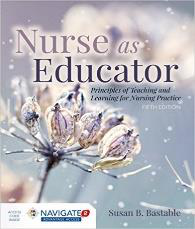
Bastable, S. (2017). Nurse as Educator: Principles of Teaching and Learning for Nursing Practice (5th ed.). Burlington, MA: Jones and Bartlett Learning. ISBN-13: 978-1284127201
• The text is also available electronically.
Rent video Where the Heart Is
Note: Students will be required to submit all assignments in accordance with the most
current edition of the APA Manual. Secondary resources related to citation format
may be less than accurate and should not be utilized.
Required Materials:
N137 Module: Provides weekly assignments and due date. This document provides specific
directions for activities and posting of online materials for the course.
N137 – Course Schedule- See Weekly Module for Detailed Assignments
| Day | Date | Topic | Assignment |
|---|---|---|---|
| 1 & 2 | June 22 and June 24 (Mon/Wed.) | Module #1 (10 participation points) Getting to know you Course introduction & review of syllabus |
• Tour of course • Introductions of students • Web search activities • Chapters 1 and 13, chapter 2 pages 42-53, chapter 4 pages 158-159 |
| 3 | June 29 (Mon.) | Module # 2 (10 participation points) Integration of Cultural Systems and Beliefs |
• Review responses to web search activities • Chapter 8 in text • Web link activities |
| 4 | July 1 (Wed.) | Module #3 (10 participation points) Health Belief Models Compliance Barriers to Learning (BTL) presentations begin |
• First week for BTL presentations • Review chapter 1, pages 21-25, read chapter 6, review chapter 13 pages 584-586 • Web link activities |
| 5 | July 6 (Mon.) | Module #4 (10 participation points) Health Education Plan (HEP) work Learning theories BTL |
• First Health Education Plan (HEP) work • Chapter 3, review chapter 6. • Review the posted BTL’s |
| 6 | July 13 (Mon.) | Module #5 (10 participation points) HEP work Literacy BTL |
• HEP work • Read Chapter 7 • Web link activities • Review the posted BTLs |
| 7 | July 15 (Wed.) | Module #6 (10 participation points) Watch video Assessment/Planning in Client Education |
• Chapters 4 and 10 in text • Review literacy articles in Web Links under Weekly Module 6 • Review last week’s responses to group work • Rent/watch video Where the Heart Is • Review the posted BTLs |
| 8 | July 20 (Mon.) | Module #7 (10 participation points) Adult Learning BTL Teaching strategies/ learning theories |
• Review Chapter 5, pages 192, 196, 212 • Adult Learning/Multiple Intelligence Web link videos • Review the posted BTLs |
| 9 | July 22 (Wed.) | Module #8 (10 participation points) Neuman’s System Model BTL |
• Review chapter 6 and 13 • Web link- Neuman’s theory • Review the posted BTLs |
| 10 | July 27 (Mon.) | Module #9 Finalize HEPs | • Finalize HEP • Chapter 14 |
| 11 | July 29 (Wed.) | Module #10 Final Exam online |
• Post final Health Education Plan work |
Evaluation Methods and Grading Criteria
This syllabus and schedule are subject to change in the event of extenuating circumstances. If you are absent from class, it is your responsibility to check announcements made while you were absent.
The final grade for Nursing 137 will be derived from following:
Grading Scale:
| Grade | Points | Percentage |
|---|---|---|
| A | 268.5 - 300 | 89.5 – 100 |
| B | 238.5 - 268.4 | 79.5 – 89.4 |
| C | 208.5 - 238.4 | 69.5 – 79.4 |
| D | 178.5 - 208.4 | 59.5 – 69.4 |
| F | below 178.4 | below 59.4 |
Student Modules/Participation (80 pts.)
It is essential that all students participate via Canvas in this course. The students
in the course are School Nurse Credential students. The experiences of the students
in the course should be shared to broaden the learning experience for all. As health
care continues to change, roles, programs and teaching strategies do as well, and
we should share our ideas and experiences. All discussion on Canvas is confidential
and will not leave the classroom real or virtual.
The site listed below provides information and training regarding Canvas.
http://fresnostate.edu/academics/canvas
You may visit the Academic Technology Resource Center on the second floor of the Henry
Madden Library in the Center for Faculty Excellence.
Call them at 278.7373
Email them at canvas@mail.fresnostate.edu
Student participation is weighed heavily because all of the course work is conducted
on-line and all other assignments cannot be completed or obtained without student
participation. Student participation will be active in the following: reviewing student
presentations, responses to presentations, health education plan submissions and review,
instructor/student interaction and weekly module assignments.
1. Barrier to Learning Presentation (BTL) 100 33%
2. Health Education Plan 100 33%
3. Modules/ Participation 80 27%
4. Final 20 7%
4. Final 20 7%
Total Points/Percentage 300 100%
Health Education Proposal (HEP)
Health Education Proposal (HEP) (100 pts.) (see rubric in assignment section)
The HEP is built into the course assignments: review module for specific HEP instructions.
HEP example is provided in the HEP forums.
The purpose of the Health Education Proposal is to provide the student the opportunity
to look broadly at health education. The student is encouraged to design a proposal
that would be appropriate for the current health issues and educational needs of their
area.
This proposal should be well structured so the student could implement this plan if
the opportunity presented itself. The proposal will be a topic of the student’s choice
based on literature review, interest, and experiences and problem identification.
The student should preferably choose a project in their current place of work that
they could build on or assist with for this assignment. This assignment is meant to
be something that can be used in the student’s work place.
The research and writing of this proposal are built into the weekly assignments. The
student will be asked questions about their proposal throughout the course so the
instructor can review and offer feedback and direction as needed. This is also open
for other students to review and share ideas. The paper will then be put together
in APA format by the student and submitted by the due date.
The student will submit the final HEP in the assignment section of the course. The
paper will be graded through the grade book and feedback can then be given.
The paper itself should be presented in APA format and in an organized, easy/quick
to read style. You may use bullet points and subtitles to organize.
Review chapters 6, 12 and 13 for helpful tools and information on what to include
in your proposal
Other Resources for ideas or literature support:
National Association of School Nurses website (https://www.nasn.org/): under “policy and advocacy” you can review their position statements and school
wellness policy for concepts and topic ideas.
The research section also has evidence-based practice, but you must have a member
login to access this information.
Agency for Health Care Quality and Research (http://www.ahrq.gov) a good resource for additional health care information for outside the school system.
Assessment (20 pts.)
In this section, the background should be evaluated through research and talking with key individuals in the community and in the student’s work environment.
1. Introduction
• Focus group: the group the plan is focused on
• Whom will the plan benefit?
Planning (10 pts.)
Describe the general concept to improve the problem identified. Identify who will be the focus of the education; include short and long-term goals of the plan.
1. Description of the plan or solution to assist in correcting the identified problem.
Who will be the focus of the education to make the change or assist in the improving
the problem?
2. Short-term goal:
• What initial outcome would you expect to see within a few months to one year? You
may want to consider some improvement in current statistics or behavior that can be
measured.
3. Desired long-term goal: (within 2 years would like to see). You may want to include
additional improvement in the same statistics or behavior.
Implementation (20 pts.)
1. Teaching strategies of choice and rationale:
• Identify a specific teaching strategy from the text or literature.
• Why is this a good strategy for the focus group and provide literature to support
it. Use your text for help.
2. Learning theory and rationale:
• Apply a learning theory appropriate for this group and support your teaching strategy.
Provide rationale. Use your text here for help and referencing.
3. Neuman’s Theory Application:
• Apply Neuman’s Theory to your HEP with a brief explanation.
Organizational Support (20 pts.)
1. Individuals key to the success of your plan.
• Who are the people you need to support your plan? Administrators to those against
the plan may need to be considered as support individuals.
• Who are the people in your work environment and/or community that are key to your
proposal? Their input and support are necessary.
• List these individuals out with the rationale or role they will have in the plan,
implementation, evaluation or overall support.
2. Setting:
Where is this plan to be presented and where are you going to implement your plan
to your focus group?
Evaluation (15 pts.)
1. Evaluation:
• How will you evaluate the effectiveness of your plan; how will you measure specific
short term and long-term goals/objectives?
• Chapter 14 in text will assist you with an evaluation plan.
Referencing and APA format (15 pts.)
Clearly identify areas of opinion/experience versus areas of paper that require appropriate support of literature. Spelling and grammar are clear and paper is scholarly written within the bullet/outline format allowed. Paper is well organized with subheadings.
Barriers to Learning Presentation and Individual Teaching Plan (100 pts) (2parts)
The purpose of this presentation is to provide each student with an opportunity to
research and assess barriers to learning that they come in contact with and how best
to deal with those barriers when teaching clients. The student is to choose a specific
learning barrier of their choice. Examples are: illiteracy, ADHD, children or adults
with special medical needs that makes learning difficult, developmental delay issues,
etc. The student will research the barrier of choice for information on the barrier
to include background, significant statistics as well as strategies used for teaching
to facilitate learning. This assignment will be posted on Canvas on the date the student
is assigned by the instructor.
Each week ALL students will review the presentation submitted and submit one critical
thinking question to the student about the presentation. The student who presented
must respond to at least three of the questions they believe to be most important.
If the student wishes to respond to more they may.
It is very important that this presentation be a presentation related to the facts. Avoid a lengthy narrative. Organize the paper to facilitate quick reading and understanding (something other students could use as a reference in their work place). Remember you will be reading 2 to 3 of these per week and lengthy papers are hard on the eyes and can be discouraging to read. Failure to follow this format could result in a loss of points for the assignment.
Part 1 (50 pts.)
1. Background/history of the learning barrier:
• What has your personal experience been with this barrier to learning and what does
research say about it?
2. Research statistics to support the significance of the problem with learning barrier.
3. Specific strategies to facilitate learning that the students can use in practice:
• List the strategies to assist with facilitating learning.
• You will want to use references to support the appropriateness of your strategy
for the learning barrier.
Part 2 (50 pts.)
Teaching Plan following barrier to learning summary:
The student will now take the strategies to overcome the barrier and design an individual
teaching plan to incorporate the newly learned strategies. The student is strongly
encouraged to design this teaching plan as one they can implement with an individual,
they may be working with currently.
This presentation will include the following: (2 pages including references)
1. Individual of focus: When identifying the individual use initials…not names.
2. Assessment gathered by the student supporting the need for the teaching. Refer
to Ch. 7 pg. 160 box 7-2. Refer to Ch. 7 pg. 160 box 7-2. Refer to Ch. 4 pp. 122-131.
3. Refer to Ch. 4 pp. 122-131.
4. Evidence of learner readiness: How does the student know the individual is ready
to “hear” this information? Refer to Ch. 4 pgs. 121-139.
5. What three objectives do you hope to accomplish with this teaching? Write in measurable
terms. Are these realistic for the learner or is it only what you think they should
learn. Refer to Ch. 10.
6. Teaching methods and rationale: implement your barriers to learning strategies
here. Include a rationale for each strategy. Refer to Ch. 11.
7. Learning or motivational theory that supports your strategy or case study.
8. Visual aids or handouts you might use.
Part 2 Continued
9. Evaluation of the persons learning: How would you evaluate their learning based
on the above objectives? If you have the opportunity to teach the plan what was the
result? Refer to Ch. 14.
10. Evaluation of your teaching effectiveness? If able to conduct the teaching, what
would you change next time? What did you like that worked well?
Student should keep papers within the suggested length. Posting lengthy presentations
and papers online can be discouraging to read and overwhelming to other students.
Lengthy documents can also increase the time spent due to downloading of the documents
and moving from area to area within the course.
Final Comprehensive Exam (20 pts.)
There will be a 20-question multiple choice/ True and False comprehensive final exam. The exam will be on Canvas and will be easy for the student to access. There will be a time limit for the exam to be determined by the instructor prior to the final exam. The students will be given a study guide to assist in their preparation. The best way for the student to prepare for the final exam is to participate in the course. Participating in the BTL’s, group work and text readings will assist in the preparation for the exam. Exam questions will be based on BTL presentations and text readings.
Course Delivery
• The syllabus and all weekly Modules are posted on Canvas. Call 278-7373 if you have
problems related to Canvas. The Academic Technology Resource Center is located on
the second floor of the Henry Madden Library in the Center for Faculty Excellence.
Website is fresnostate.instructure.com
• The announcement section of Canvas will be used to inform students of any changes
in coursework or updates for the class.
• Students are able to check their scores in the “Grade” section.
• The details of weekly assignments are provided in the weekly modules under “Assignments:
or “Modules”” and also available in a printable word doc. format in the “Files” section.
This is an official communication from California State University, Fresno. It is
your responsibility to maintain the security and integrity of your e-mail account.
Always choose a secure password and do not share that password with anyone. If you
have questions regarding the security of your e-mail account, please contact the Help
Desk at 559.278.7000 or help.csufresno.edu. If you receive a personal notification from the university, login to My Fresno State and click on "Student Portfolio" for your current status.
Resources, Course Policies and University Policies
Library
Link to Library: http://www.csufresno.edu/library/
Technology Services Help Center
https://fresnostate.edu/help/
Browser Recommendations
https://community.canvaslms.com/docs/DOC-10720
Netiquette
Policy regarding online conduct: It is expected and understood that information either personal or professional discussed in the Canvas arena be kept confidential and not used in a negative fashion either verbally or over Canvas. Professional conduct, support and respect for someone’s views will be expected. If you have questions or problems you may reach the instructor via internet, phone or office visit.
Course Policies
• Students are expected to notify the faculty on the first day of class if any of
the course prerequisites have not been completed.
• Students are expected to complete the required assignments and readings in preparation
for weekly quiz or assignment. It is also suggested that additional references to
augment knowledge in the various subject areas be utilized.
• Lateness Policy: Failure to meet the deadlines related to the written assignments
or papers will result in a deduction of 2 points per day.
University Policies
Students with Disabilities
Upon identifying themselves to the instructor and the university, students with disabilities
will receive reasonable accommodation for learning and evaluation. For more information,
contact Services to Students with Disabilities in Madden Library 1049 (278- 2811).
For university policy refer to: http://www.fresnostate.edu/studentaffairs/ssd/about-ssd/services-and-accommodation-policies-and-procedures.html
Honor
“Members of the CSU Fresno academic community adhere to principles of academic integrity
and mutual respect while engaged in university work and related activities.” You should:
a. Understand or seek clarification about expectations for academic integrity in this
course (including no cheating, plagiarism and inappropriate collaboration) n
b. Neither give nor receive unauthorized aid on examinations or other course work
that is used by the instructor as the basis of grading.
c. Take responsibility to monitor academic dishonesty in any form and to report it
to the instructor or other appropriate official for action.
Instructors may require students to sign a statement at the end of exams and assignments
that “I have done my own work and have neither given nor received unauthorized assistance
on this work.”
For University Policy refer to: http://fresnostate.edu/academics/academicintegrity/reducing/honorcode.html
Cheating and Plagiarism
“Cheating is the actual or attempted practice of fraudulent or deceptive acts for
the purpose of improving one's grade or obtaining course credit; such acts also include
assisting another student to do so. Typically, such acts occur in relation to examinations.
However, it is the intent of this definition that the term 'cheating' not be limited
to examination situations only, but that it includes any and all actions by a student
that are intended to gain an unearned academic advantage by fraudulent or deceptive
means.
Plagiarism is a specific form of cheating which consists of the misuse of the published
and/or unpublished works of others by misrepresenting the material (i.e., their intellectual
property) so used as one's own work.”
Penalties for cheating and plagiarism range from a 0 or F on a particular assignment,
through an F for the course, to expulsion from the university. For more information
on the University's policy regarding cheating and plagiarism, refer to the Schedule
of Courses (Legal Notices on Cheating and Plagiarism) or the University Catalog (Policies
and Regulations)
For University Policy refer to: http://fresnostate.edu/studentaffairs/studentconduct/policies/cheating-plagiarism.html
Computers
“At California State University, Fresno, computers and communications links to remote resources are recognized as being integral to the education and research experience. Every student is required to have his/her own computer or have other personal access to a workstation (including a modem and a printer) with all the recommended software. The minimum and recommended standards for the workstations and software, which may vary by academic major, are updated periodically and are available from Information Technology Services or the University Bookstore (http://www.kennelbookstore.com). In the curriculum and class assignments, students are presumed to have 24-hour access to a computer workstation and the necessary communication links to the University's information resources.”
Disruptive Classroom Behavior
“The classroom is a special environment in which students and faculty come together to promote learning and growth. It is essential to this learning environment that respect for the rights of others seeking to learn, respect for the professionalism of the instructor, and the general goals of academic freedom are maintained. Differences of viewpoint or concerns should be expressed in terms which are supportive of the learning process, creating an environment in which students and faculty may learn to reason with clarity and compassion, to share of themselves without losing their identities, and to develop and understanding of the community in which they live. Student conduct which disrupts the learning process shall not be tolerated and may lead to disciplinary action and/or removal from class.”
For University policy refer to: http://www.fresnostate.edu/studentaffairs/studentconduct/concerning-disruptive-students/index.html
Copyright policy
Copyright laws and fair use policies protect the rights of those who have produced
the material. The copy in this course has been provided for private study, scholarship,
or research. Other uses may require permission from the copyright holder. The user
of this work is responsible for adhering to copyright law of the U.S. (Title 17, U.S.
Code). To help you familiarize yourself with copyright and fair use policies, the
University encourages you to visit its copyright web page: https://library.fresnostate.edu/about/policies/copyright-policy
The Canvas course web sites contain material protected by copyrights held by the instructor,
other individuals or institutions. Such material is used for educational purposes
in accord with copyright law and/or with permission given by the owners of the original
material. You may download one copy of the materials on any single computer for non-commercial,
personal, or educational purposes only, provided that you (1) do not modify it, (2)
use it only for the duration of this course, and (3) include both this notice and
any copyright notice originally included with the material. Beyond this use, no material
from the course web site may be copied, reproduced, re-published, uploaded, posted,
transmitted, or distributed in any way without the permission of the original copyright
holder. The instructor assumes no responsibility for individuals who improperly use
copyrighted material placed on the web site. For University policy refer to: https://library.fresnostate.edu/info/copyright-policy
Plan Ahead
Students should start planning ahead for the following activities that will be done
in class. Due to the fast pace nature of the class, students should plan on working
on the following:
• Identify a barrier to learning you encounter in your daily work environment. Be
prepared to research this barrier and identify some strategies to assist your clients
in the learning process despite the barrier to learning.
• Identification of a Health Education Plan topic. What is going on at work? This
should be something you can implement at work and be a useful plan for you.
• Renting a movie- Look ahead in some video rental stores. Do they carry Where the
Heart Is? Make sure you have access to that movie.
This HTML version was generated with AI assistance and may contain errors or omissions. The original approved PDF remains the official document of record. An alternative accessible format is available upon request from the document creator in accordance with Title II of the ADA.