School Psychology Program Practicum and Internship Handbook

Educational Specialist in Psychology
Department of Psychology
California State University, Fresno
TABLE OF CONTENTS
School Psychology Program Overview 3
School Psychology Program Objectives 4
Practica 5
Practicum Placement 6
Practicum Expectations 7
Fall Year 1 7
Spring Year 1 8
Fall Year 2 10
Spring Year 2 12
Practicum Logs 14
Evaluations
Practicum Student Evaluation by Field Supervisor – Year 1 16
Practicum Student Evaluation by Field Supervisor – Year 2 18
Student Evaluation of Field Supervisor 20
Internship 21
Internship Class Requirements 22
Internship Agreement 27
Logs
Daily Log 29
Monthly Summary 31
Evaluations
Intern Evaluation by Field Supervisor 32
Teacher/Administrator Evaluation 34
Parent Evaluation 35
School Psychology Faculty Evaluation of Students 36
Remediation Plan 37
Coronavirus-19 Notes 38
2
SCHOOL PSYCHOLOGY PROGRAM OVERVIEW
Mission
The School Psychology Program at California State University, Fresno is dedicated
to preparing highly competent professional psychologists according to the scientist
practitioner model. Graduates, as a result of their broad-based training, are prepared
to make significant contributions to this challenging field through professional practice.
The School Psychology Program is founded in the principles summarized above, taken
from the Preamble of the APA Ethical Principles of Psychologists, and strives to prepare
school psychologists who will model these ideals.
The Educational Specialist (Ed.S) program provides future school psychologists (students)
with a solid professional and academic foundation reflecting depth and diversity in
both psychology and education. All students develop an understanding, respect for,
and responsiveness to culture and individual differences. The program emphasizes the
importance of delivering school psychological services from a consultation framework
to prevent and remediate learning and adjustment problems experienced by children
and adolescents. Students are taught to link assessment methodologies to the development
of empirically-based interventions. They learn to view problems from a systems/ecological
perspective focusing on the child, the family, the school, and the community, and
to use a scientific problem-solving approach in their work. Both the theoretical and
the empirical bases of professional practice are emphasized, in a diverse range of
settings including inner city, suburban, and rural. Furthermore, the program provides
future school psychologists with a solid professional and academic foundation reflecting
depth and diversity in both psychology and education. The Program fosters special
sensitivity to cultural diversity of all people and respect for the uniqueness and
human dignity of each person. Self-awareness, regard for others, and respect for cultural
and individual differences are actively cultivated and expected of all students.
Professional preparation also concentrates on specific skills development in a number
of service function areas, but the major emphasis of the Program is the preparation
of the school psychologist as a highly competent problem solver. Thus, rather than
being trained to respond to specific problems in specific ways, students are prepared
to draw upon a personal foundation in psychology and education to effectively develop,
implement, and evaluate strategies for preventing or resolving problems as they occur.
Additionally, students learn to collaborate with other helping professionals and with
parents in serving the mental health and educational needs of all children and youth.
SCHOOL PSYCHOLOGY PROGRAM OBJECTIVES
The California State University, Fresno School Psychology Program has adopted a scientist–practitioner model with an emphasis on problem-solving. At the completion to the program students are expected to be able to:
- Operate within a scientist-practitioner framework by using the scientific method and research to guide practice and demonstrate accountability.
- Demonstrate respect for and sensitivity to cultural and individual differences.
- Deliver school psychological services from a consultation framework with an emphasis on problem-solving to prevent and remediate learning and adjustment problems experienced by children and youth.
- Link assessment methodologies to the development, implementation, and evaluation of research-based interventions.
- View problems from a systems/ecological perspective focusing on the child, family, school, and community.
- Demonstrate a theoretical and empirical basis for professional practice.
- Engage in evaluation of individual practice and school-based and/or community based programs.
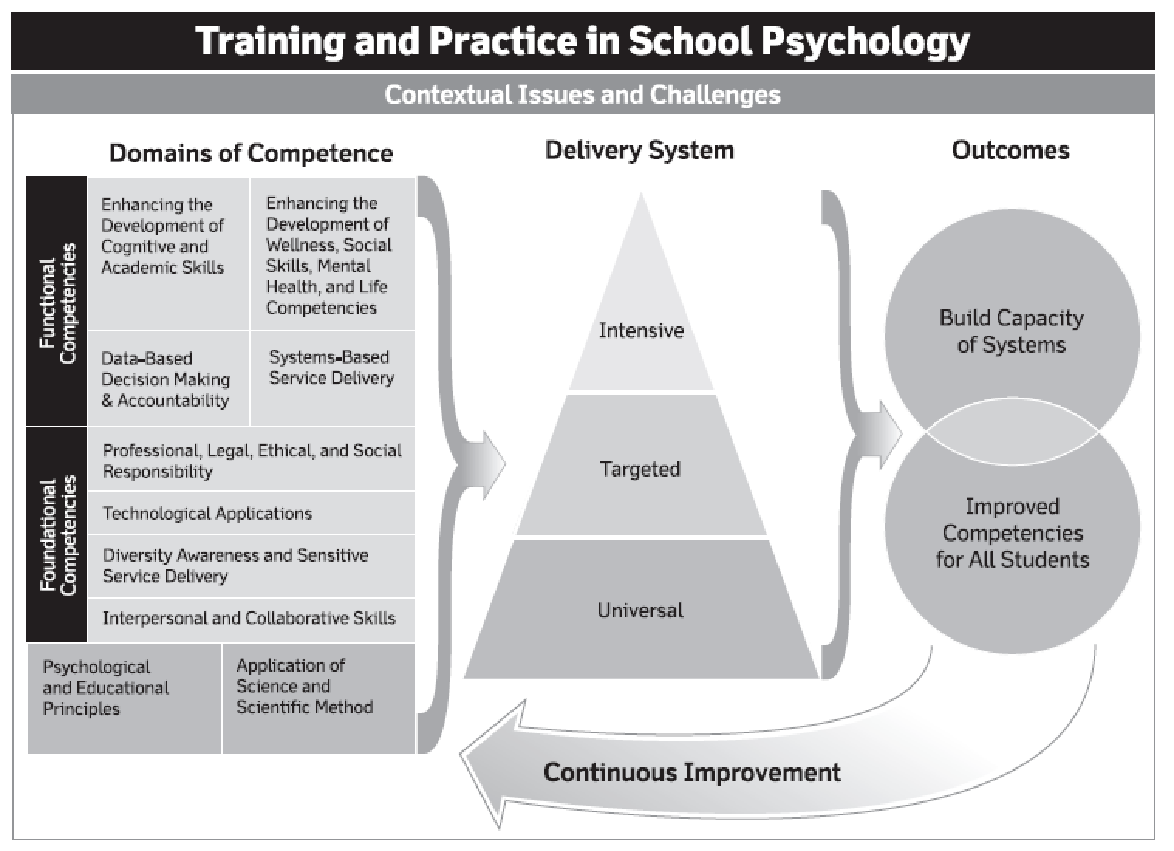
In 2020 NASP adopted the new standards and the Practice Model.
PRACTICA
The practicum is designed to:
1. provide the student with experiences that facilitate the integration of coursework
and theory with the practical aspects of applied practice; and
2. provide a framework for the gradual shaping of the student’s skills, allowing the
student to evolve to an independently functioning professional.
Along with courses in basic concepts and theory and specialized techniques, students
participate in practicum experiences that provide supervised applications of their
skills. All students must complete supervised practice of 600-clock hours of practica
prior to internship.
The practicum process involves four stages:
1. observation
2. assisting the field-based credentialed school psychologist
3. performing with assistance from the field-based credentialed school psychologist
4. working independently
The Program Coordinator places students on practicum each semester of the first two
years in the program; sites will rotate for each of the four semesters. Students receive
field supervision from their assigned local school psychologist. Practicum supervisors
are credentialed school psychologists with a minimum of 3 years of experience. University
supervision is provided by the California State University, Fresno, School Psychology
Program Faculty through practicum class, Psychology 287.
School Psychology Program Courses
The following courses have practicum requirements:
Psychology 278: Intervention and Prevention in School Psychology
Psychology 279: Consultation and Supervision in School Psychology
Psychology 282: Cognitive and Behavior Therapy
Psychology 285: Assessment of Learning and Developmental Problems
Psychology 286: Instructional Consultation
Psychology 287: Practicum in School Psychology
Psychology 274S: Multicultural Psychology – Service Learning Practicum
Students are assigned to practicum placements for two half days per week during the
first year and two days per week during the second year. A day is considered at least
8 hours per week in the schools for a minimum of 100 hours each semester during the
first year and 180 hours per semester during the second year. Total practicum hours
for the program = minimum of 560. First year students will have two practicum sites
in the fall; one will be with a school psychologist at a comprehensive site and the
other at a service-learning site. In the spring the practicum will be with a different
school psychologist. Second year students will typically be placed with one school
psychologist for the two days of practicum per week. Practicum logs will be maintained
each week and summarized each semester.
Practicum Placement
The faculty in the School Psychology Program assign students to their practicum sites. Students are given the opportunity to request districts for practicum. Field-based credentialed school psychologists serve as site supervisors. Students are assigned to specific site supervisors based on their year in the program, the needs and interests of the student, and the appropriateness of the field-based site. Field supervisors are selected who have knowledge and skills appropriate for the semester of practicum. The Central Valley of California is a large area, and car travel is a necessity. Appropriate dress is expected for practicum; please discuss with field supervisors. In general no cleavage, short skirts, no visible tattoos, no hair dyed an unnatural color, and no visible body piercing except earrings for females. Jeans are not acceptable unless recommended by your field supervisor.
Evaluation of Practicum and Program Progress
Student performance of practicum is evaluated twice each year using multiple products.
1. All students must maintain a daily log of their practicum activities. The Practicum
Log form is on page 14 of this document. Time, activities, and student contacts are
recorded.
2. Students are evaluated by the Program Faculty within the context of the competencies
specified on the School Psychology Faculty Evaluation of Students. See page 36.
3. Students are evaluated by the field-based credentialed school psychologist each
semester using the School Psychology Practicum Student Evaluation (see page 16). The
student is responsible for insuring that the evaluation form is returned to the Coordinator
of the School Psychology Program prior to finals week of each semester.
4. Students complete the Student Evaluation of Field-Based Supervisor form located
on page 20 to assure match between program expectations and field experiences.
The Program faculty meet with each student at the end of each semester to review the
School Psychology Practicum Student Evaluation and experiences. The Advisee Record
form is completed with the faculty and student at that time. Specific areas of strength
and areas for improvement are discussed with the student.
Sources of Practicum Evaluation Data
Sources of Data Timeline Person Responsible
Practicum Log Each Week Student
School Psychology Practicum
Student Evaluation Form
End of Each Semester Student and On-site
Supervisor
Faculty Rating End of Each Semester Program Faculty
PRACTICUM EXPECTATIONS
Practicum students: these are typical assignments. It is your responsibility to get a list of current assignments and due dates to your field supervisor at the beginning of the semester.
Fall – Year 1
The first semester of practicum is designed to allow students to learn about the role
of the school psychologist as a team member, school systems, and special education.
Besides supporting the class assignments listed below, field supervisors are encouraged
to expose their practicum student to as many educational experiences as feasible.
Students will benefit from spending time in classrooms, especially special education
classes.
Psych 287-1 (Practicum supervision)
MINI-INTERVIEWS: During practicum each student, with the help of their field supervisor,
will arrange the following experiences: attend an Individual Education Plan meeting;
spend time with and shadow a speech therapist, a school nurse, etc. – see list below.
These may be conducted in any order. Students will complete a one-page bullet-point
format list of things they learned from each interview and shadowing experience for
class discussion. Each experience list should have at least 5 bullet points about
what you have learned.
- School Psychologist
- RSP special education teacher
- SDC/SH special education teacher
- Speech Pathologist
- School Nurse
- Assessment
- School counselor or school social worker
- School Administrator
- IEP meeting
- Consultation or SST meeting
- Bilingual School Psychologist, Teacher or Aide
OBSERVATIONS: Students will turn in 3 structured observations (see dates on syllabus).
Observations are to be conducted at your practicum site. Please write a one page narrative
of each observation including the following: (1) referral concerns, (2) student’s
age or grade, gender, (3) target behavior, (4) type of observation and rationale for
type of observation, (5) observation setting (e.g., classroom, playground, large group
instruction, one-to-one), (6) numerical/statistical summary of data, (7) anecdotal
or real-time observations to supplement quantitative data. The narrative should be
a paragraph or two that could be inserted into a psycho-ed or intervention report.
Attach original data collection sheet.
● Observation #1: ABC observation; turn in recording form and narrative with description
of student, target behavior, environment, and hypothesized function of behavior
Spring – Year 1
The second semester is exciting for students! Besides observing, they are starting
to learn to write psychoeducational reports and have their own consultation project.
Field supervisors will need to help them find a cooperating teacher and target student
for the consultation project. The field supervisor will guide the student as he or
she works on their first “pre-psych” reports. We expect these to be evaluations the
field supervisor is currently conducting. The practicum student is expected to conduct
the file review, collect background information, conduct observations, interviews,
and write up that part of the report.
The pre-psych reports and consultation project can be done at either your comprehensive
school site or special site. The special site assignment is working with a school
psychologist who serves classes for students with autism, emotional disorders, or
preschoolers. Practicum students are expected to learn about the role of school psychologists
in working with children or adolescents with low-incidence disorders.
Psych 287-1 (Practicum supervision)
At a minimum, a practicum student will complete the following activities on-site during
this semester of practicum. Each student’s individualized practicum plan may include
activities that are not specified here.
General Site
● You will write two “pre-psych” reports for/with your field supervisor. These are
on actual students that your practicum supervisor is evaluating. Your part will be:
o Record review: Educational, family, developmental, and health history. Previous
interventions or assessment results.
o Current information: grades, CELDT/ELPAC, state test, attendance data as appropriate.
o Parent and teacher interview
o Observations
● Observe the evaluation process: query your field supervisor about why certain measures
are chosen, etc.
● If possible, attend the IEP meetings for the students whose reports you worked on.
Share information from your observations.
Psych 279 (Consultation)
1. Consultation practice case
● You will need to initiate a consultation case in your school. Informed consent letters
to teachers and parents will be provided; signatures are required before beginning
Fall Year 2
Year 2 practicum is a steep learning curve for students!! You are now allowed to administer
standardized tests on practicum and are expected to complete several comprehensive
evaluations with the support of your field supervisor. The first two assessments should
be reevaluations, not initials. One of the assessments will serve as a case study
for Psych 285 so will be for a student considered for a Specific Learning Disability.
A big challenge in Fall Year 2 is the Functional Behavior Assessment, development
of a Behavior Intervention Plan, implementation, and evaluation of the behavior intervention.
You will need to be guided to a potential child for this project, with a back-up in
mind as sometimes permissions are delayed, students move, or are suspended or expelled.
NOTE: This project will cover the entire semester; it is critical that you identify
a case as soon as possible. Parent permission is due in mid-September.
Psych 287-2 (Practicum)
Evaluations: Each student will complete and/or assist in three evaluations at your
school site. The first two should be reevaluations. Utilize information from a variety
of data sources including the classroom teacher; parent/guardian; pupil; and direct
observations in multiple settings. The evaluations must include a written report.
For all class reports, identify the pupil by first name, grade, and age only.
- The following assessments are required in the evaluation:
o Child Background (e.g., academic history; health history; discipline)
o Structured Classroom Observation by the practicum student
o Parent and Teacher input - The following assessments are recommended in the evaluation when appropriate;
o General/Cognitive Ability test (e.g., KABC; WISC-IV)
o Adaptive Behavior Assessment (e.g., ABAS-2; Vineland)
o Curriculum Based Measurement, Progress Monitoring (e.g., DIBELS)
o Academic Assessment data (e.g., WIAT-II, or WJ-III ) - Presentation at 2 IEP meetings.
Psych 278 (Intervention and Prevention)
Behavior Intervention Project: The Intervention project for this course consists of
FOUR separate assignments needing to meet the requirements detailed below. They are
the:
● Functional Behavior Assessment (FBA)
● Behavior Intervention Plan (BIP)
● NASP Proposal
● Final Presentation
FBA and BIP: Each student will complete an FBA that results in a full written evaluation
report. The FBA will require consultation skills and decision-making abilities in
which the problem solving process is implemented. Conducting the FBA will require
a records review, staff and parent interviews, and direct observations. Data collected
through the FBA process will lead to the development of a BIP. Interim reports (e.g.,
interview forms, data collection sheets, behavioral worksheets, etc.) are required.
Prior to implementing the designed intervention, a minimum of three baseline data
points are required; these may be collected within the same week, but cannot all be
collected on the same day.
Spring Year 2
Finally, you will be conducting a counseling project; either cognitive behavior therapy
or solution focused therapy. Again it is important to identify one or more children
for this project as soon in the semester as possible.
In spring this cohort is also interviewing for internships! If your practicum supervisor
has time to help you with tips and practice interviewing, that would be great!
Psych 287-2 (Practicum)
Assignments
● At-risk youth paper: Write a 2-3-page paper reflecting on how your role as a school
psychologist (practicum student) has varied due to the diversity of your practicum
sites. Describe your experiences working with foster families, incarcerated youth,
homeless youth, students in danger of dropping out of school or being retained? Relate
this to the current focus on childhood trauma. Consider assessment, consultation with
teachers, parental input and collaboration, community and social services, etc. What
strategies and skills do you need to serve all students?
● RTI/MTSS interview: Interview teachers and/or administrators regarding campus implementation
of RTI/MTSS. Note the stage of implementation and activities, strategic systematic
supports in place/available, challenges they have encountered, advice, and who the
leaders of the initiative were.
● IEP reflection paper: Write a 1-page paper describing your participation, observations,
and reflections from an IEP in which you were involved. The paper shall be a minimum
of one page, maximum two pages double-spaced and is due one week after the IEP meeting.
● Psychological-educational evaluations: Second year students need to complete and/or
participate in three evaluations (initial or reevaluation).
o Structured classroom observations are required for all evaluations.
o You must include a graph in each assessment report.
o Parental participation in the assessment must be documented.
o Reports may be in the format utilized by the district in which you are completing
your practicum.
o You and your field supervisor should sign reports.
o Report dates are indicated on the syllabus. Late reports will receive zero points
unless (1) I have been notified in advance this could not be completed by the due
date and (2) I have confirmed there was nothing you could have done to complete the
report in time with your field supervisor.
o Include a reflection on the assessment experience and any changes you would make
in a similar situation.
Psych 282 (Cognitive Behavior Therapy)
Develop CBT and counseling skills with children:
● Each student will work with the practicum supervisor to secure a counseling case
in order to complete this course. Initiation, communication, and collaboration with
the supervisor are vital in this process. For a successful learning experience, the
deadline for securing a counseling case is Feb. 21, about one month after the school
starts. The student will utilize either the cognitive behavior therapy or brief solution-focused
therapy model.
● Students turn in two recorded audio CBT sessions that they view as best representing
their skills. Turn in two audio records only. No transcript is required.
● Case presentation: By the end of the semester, students present their cases. The
content of the case presentation includes (but is not limited to): background information,
major problems addressed, cognitive techniques you used, progress of the sessions,
behavioral intervention used, what to do differently, why terminate if you do, a summary
(5 major points of your views) of your development as a therapist in a school setting
over the course of the semester.
Psych 286 (Instructional Consultation)
Consultation/Intervention Project: The term project will be a consultation and intervention
case study in which the problem solving process is implemented. This will be conducted
at your practicum site. Students will design one academic intervention project (e.g.,
peer tutoring, differential reinforcement, repeated reading, reading instruction,
cover-copy-compare or drill). The project must include:
● At least weekly progress monitoring (e.g., CBM, DIBELS, academic accuracy) of an
academic skill
● 3 baseline data points (which may, and probably should, be gathered in one week
preceding intervention implementation; spring semester is surprisingly short with
breaks, conventions, and CST. Archival data may be utilized IF this will be the data
gathered during implementation)
● A minimum of 8 weekly intervention data points.
● The intervention should be implemented at least 3 times per week for a minimum of
15 minutes.
● You do not have to directly implement the intervention, and may supervise a consultee.
● Regardless you need to collaboratively design the intervention and implementation
integrity must be documented and social validity assessed.
● Interim reports (e.g., a teacher interview and assessment of the educational environment,
intervention plan) will be expected. Consider this information (i.e., assessment of
the classroom) in designing the intervention.
● The intervention must be based on the empirical literature; two articles directly
related to the proposed intervention will be required. The goal must be to improve
academic competence in a specific skill.
● The project will be documented as a manuscript.
Remediation Plans Related to Practica Experience
Should there be areas of weakness or concern in a Practicum student’s skills, knowledge,
social skills, dress, punctuality, and/or other competency areas, the student and
the Program Faculty are responsible for developing a Remediation Plan (see page 37).
The Plan may include more on-campus supervised activity, coursework, or additional
practicum hours.
PRACTICUM LOG
SCHOOL PSYCHOLOGY PROGRAM
California State University, Fresno
TIME SITE/AGENCY TASK/ACTIVITY
Activity Code
POPULATION*
7:00 7:30 8:00 8:30 9:00 9:30 10:00 10:30 11:00 11:30 12:00 12:30 1:00 1:30 2:00 2:30
3:00 3:30 4:00 4:30
*CODE: (1) W=Caucasian, H=Hispanic, AA=African American, A=Asian (Cambodian, Lao,
Hmong, Japanese, Chinese, Indian); NA = Native American. Use O for other, or add your
own code. (2) Grade or age of student
HOURS TODAY_________SEMESTER HOURS ________
Practicum Log Summary
DATE DATE add columns Total
CODE ACTIVITY
1a Cognitive Assessment
1b Social emotional Assessment
1c Academic Assessment
1d CBA/DIBELS
2 File review
3a Interview - teacher
3b Interview - parent
4 Report writing
5 IEP meetings
6 Behavioral observations
7a Consultation/SST - teacher
7b Consultation/SST - family
8 Intervention
9a Individual counseling
9b Group counseling
10 Professional development
13a Supervision (field - formal)
13b Supervision - informal
14 Travel
15 Other
Total
SCHOOL PSYCHOLOGY PRACTICUM STUDENT EVALUATION – YR 1
CALIFORNIA STATE UNIVERSITY, FRESNO
Field Supervisor Form
Practicum student: __________________________________ Date: ____________________
Field Supervisor: __________________________________________________________
Placement: _______________________________________________________________
Circle the number corresponding to the observed behaviors according to the following
scale:
3. Accomplished
Exhibits evidence of knowledge and competence that exceed expectations for a beginning
practicum student.
2. Emerging
Beginning to function more independently.
1. Not Met
Competence below the level expected of a practicum student1
NA. Not applicable or observed
Consultation and Behavioral Intervention Skills
1. Practicum student works with teacher as consultee to identify target problem.
(NASP Standard 3, 4.1, 4.2)
1 2 3
NA
2. Practicum student works with parent/family to support individual student goals.
(NASP Standard 3, 4.1, 4.2, 6)
1 2 3
NA
3. Practicum student considers culture when developing interventions. (NASP Standard
7)
1 2 3
NA
4. Practicum student works with consultee to analyze baseline data, develop intervention
plan, and helps obtain necessary materials. (NASP Standard 3, 4.1, 4.2)
1 2 3
NA
5. Practicum student displays skills in using technology to monitor progress and graph
results. (NASP Standard, 8.1)
1 2 3
NA
6. Practicum student utilizes data for intervention evaluation. (NASP Standard 2,
4.1, 4.2, 8.1)
1 2 3
NA
7. Practicum student displays knowledge of biological, cultural, developmental, and
social influences on behavior and mental health. (NASP Standard 4.2, 7)
1 2 3
NA
8. Practicum student displays knowledge of empirically based behavioral interventions
and techniques. (NASP Standard 4.2, 5.2)
1 2 3
NA
9. Practicum student effectively interviews teachers, parents, and students. (NASP
Standard 2, 3, 6)
1 2 3
NA
Assessment and Academic Interventions
10. Practicum student displays knowledge of biological, cultural, developmental, and
social influences on development and learning. (NASP 4.1, 7)
1 2 3
NA
11. Practicum student displays knowledge of learning principles (e.g., reinforcement,
repetition) and how these can be used to support students. (NASP 4.1, 4.2)
1 2 3
NA
12. Practicum student displays skills in observations of students. (NASP Standard
2) 1 2 3
NA
13. Practicum student participates in system-wide academic data collection (e.g.,
DIBELS). (NASP Standard 2, 5.1)
1 2 3
NA
Professional Characteristics
4 = Exemplary; 3 = Average; 2 = Needs Improvement; 1 = Unacceptable
a. Interactions with staff in terms of pleasantness, cooperation, courtesy. 1 2 3
4
b. Assertive and tactful in stating concerns and asking questions. 1 2 3 4
c. Initiative and enthusiasm for the field. 1 2 3 4
d. Rapport and respect with students. 1 2 3 4
e. Professional dress. 1 2 3 4
f. Responds appropriately to feedback 1 2 3 4
g. Organization, reliability, punctuality, responsibility. 1 2 3 4
What would you consider to be the practicum student’s major strengths?
In what areas could the practicum student show improvement?
In what area(s) has progress been most marked during practicum?
Other comments relevant to evaluation of this student’s practicum experience.
_______________________________________ ________________________________________
(Supervisor) (Date) (Practicum student) (Date)
SCHOOL PSYCHOLOGY PRACTICUM STUDENT EVALUATION – YR 2
CALIFORNIA STATE UNIVERSITY, FRESNO
Field Supervisor Form
Practicum student: __________________________________ Date: ____________________
Field Supervisor: __________________________________________________________
Placement: _______________________________________________________________
Circle the number corresponding to the observed behaviors according to the following
scale:
4. Accomplished
Exhibits evidence of knowledge and competence that exceed expectations for a beginning
practicum student.
3. Emerging
Beginning to function more independently.
2. Not Met
Competence below the level expected of a practicum student.
NA. Not applicable or observed
Consultation and Behavioral Intervention Skills
1. Practicum student effectively communicates and collaborates with teachers, parents,
and other school professionals. (NASP Standard 3)
1 2 3 NA
2. Practicum student works with teacher/parent as consultee to identify target problem.
(NASP Standard 3 & 6)
1 2 3 NA
3. Practicum student considers culture in consultation process, e.g., identifying
and analyzing problems and developing interventions. (NASP Standard 3 & 7)
1 2 3 NA
4. Practicum student works with consultee to analyze baseline and progress monitoring
data, develop intervention plan, and helps obtain necessary materials. (NASP Standard
3, 4.1, 4.2)
1 2 3 NA
5 Practicum student displays skills in using technology to monitor progress and graph
results. (NASP Standard, 8.1)
1 2 3 NA
6. Practicum student utilizes data for intervention evaluation and intervention integrity.
(NASP Standard 2, 4.1, 4.2, 8.1)
1 2 3 NA
7. Practicum student displays knowledge of biological, cultural, developmental, and
social influences on behavior and mental health. (NASP Standard 4.2, 7)
1 2 3 NA
8. Practicum student displays knowledge of empirically based behavioral interventions
and techniques. (NASP Standard 4.2)
1 2 3 NA
9. Practicum student displays knowledge in systems level consultation and intervention,
e.g., classroom, grade level, and school-level. (NASP Standard 3, 5.1, 5.2)
1 2 3 NA
10. Practicum student effectively interviews teachers, parents, and students. (NASP
Standard 2, 3, 6)
1 2 3 NA
Assessment and Academic Interventions
11. Practicum student displays knowledge of biological, cultural, developmental, and
social influences on development and learning. (NASP 4.1, 7)
1 2 3 NA
12. Practicum student displays knowledge of learning principles (e.g., reinforcement,
repetition) and how these can be used to support students. (NASP 4.1, 4.2)
1 2 3 NA
13. Practicum student displays skills in systematic observations of students.
(NASP Standard 2)
1 2 3 NA
14. Practicum student displays knowledge in selecting appropriate assessment measures
for the purpose of identifying educational strengths and needs, and special education
eligibility. (NASP Standard 2, 8.2)
1 2 3 NA
15. Practicum student conducts valid and reliable assessments for the purpose of identifying
student’s eligibility for special education services and/or intervention. (NASP Standard
2, 8.2)
1 2 3 NA
16. Practicum student displays knowledge in synthesizing assessment information for
intervention development. (NASP Standard 4.1, 4.2)
1 2 3 NA
17. Practicum student participates in system-wide data collection (e.g., DIBELS).
(NASP Standard 5.1)
1 2 3 NA
Therapeutic Skills
18. Practicum student establishes rapport with students. (NASP Standard 3, 4.2, 5.2)
1 2 3 NA
19. Practicum student displays effective skills in individual counseling. (NASP Standard
5.2)
1 2 3 NA
20. Practicum student integrates behavioral support and mental health services with
academic and learning goals for students. (NASP Standard 5.2, 6)
1 2 3 NA
21. Practicum student facilitates the design and delivery of interventions to help
students to develop effective social and life skills. (NASP Standard 4.2, 5.2)
1 2 3 NA
22. Practicum student displays skills in conducting groups. (NASP Standard 4.2, 5.2)
1 2 3 NA
23. Practicum student displays knowledge and/or skills in counseling culturally and
linguistically diverse students and families. (NASP Standard 6, 7)
1 2 3 NA
Legal , Ethical, and Professional Behaviors
24. Practicum student displays knowledge of legal procedures. (NASP Standard 8.2)
1 2 3
25. Practicum student report sections are thorough and well written. (NASP Standard
8.2) 1 2 3
26. Practicum student demonstrates understanding of school culture and systems.
(NASP Standard 5.1)
1 2 3
27. Practicum student contributes to staffing conferences and IEP meetings. (NASP
Standard 3, 8.2)
1 2 3
28. Practicum student demonstrates confidentiality and ethical behavior in counseling.
(NASP Standard 8.2)
1 2 3 NA
29. Practicum student engages in appropriate actions when confronted with an ethical
dilemma. (NASP Standard 8.2)
1 2 3
Professional Characteristics
4 = Exemplary; 3 = Average; 2 = Needs Improvement; 1 = Unacceptable
a. Interactions with staff in terms of pleasantness, cooperation, courtesy. 1 2 3
4
b. Assertive and tactful in stating concerns and asking questions. 1 2 3 4
c. Initiative and enthusiasm for the field. 1 2 3 4
d. Rapport and respect with students. 1 2 3 4
e. Professional dress. 1 2 3 4
f. Responds appropriately to feedback 1 2 3 4
g. Organization, reliability, punctuality, responsibility. 1 2 3 4
What would you consider to be the practicum student’s major strengths?
In what areas could the practicum student show improvement?
In what area(s) has progress been most marked during practicum?
Other comments relevant to evaluation of this student’s practicum experience.
_______________________________________ ________________________________________
(Supervisor) (Date) (Practicum student) (Date)
STUDENT EVALUATION OF FIELD-BASED SUPERVISOR
Student: _________________________Supervisor: __________________________
Semester: _______________________ Date: _______________________________
Please rate the performance according to the following scale: 5=excellent, 4=good,
3=average, 2=needs improvement, 1=unacceptable, NA = not applicable
Professional Behavior
Professional behavior with you, the student: was receptive to your questions,
diplomatic in assisting you, pleasant, cooperative, and courteous.
Professional behavior with school staff (administrators, teachers): receptive to
your questions, diplomatic in working with others, modeled ‘best practice.’
Good working relationship with administrative assistants.
Was on time; notified you of change in plans, adaptable to your schedule.
Interested in the field, eager to work with students, motivated to attend workshops
and other professional development opportunities.
Professional image: clean, neat, appropriate dress.
Good work ethic.
Respects children and your rights and confidentiality.
Communication
Demonstrated sensitivity to cultural and linguistic diversity.
Made appropriate comments during meetings and acted in a professional manner
in all meetings.
Information was presented with tact and diplomacy.
Organized and well prepared.
Skills
Demonstrated good to excellent knowledge of the field and modeled best
practices.
Conducted behavioral observations on a regular basis.
Demonstrated problem-solving skills focusing on assessment and intervention of
learning and behavior problems.
Assessment tools were appropriate and administered properly.
Demonstrated individual and group counseling skills.
INTERNSHIP
Commensurate with the National Association of School Psychologists requirement, students
complete an internship of a minimum of 1200 hours. This requirement can be completed
on a full-time basis for 1 year or on a half-time basis for 2 years. School-based
internships are typically 10 months in duration. The internship is a collaboration
between the School Psychology Program and the field site that assures the completion
of activities consistent with the goals of the Program. A written plan specifies the
responsibilities of the Program and the internship site in providing supervision,
support, and evaluation of intern performance (see Internship Agreement, page 27).
In addition, interns receive a minimum of two hours of field-based supervision each
week from a credentialed school psychologist with a minimum of three years of experience.
The internship site provides appropriate support for the internship experience including:
a) a written agreement specifying the period of appointment and any terms of compensation;
b) a schedule of appointments, expense reimbursement, a safe and secure work environment,
adequate office space, and support services consistent with that afforded agency school
psychologists;
c) provision for participation in continuing professional development activities;
d) release time for internship supervision; and
e) a commitment to the internship as a diversified training experience.
(NASP, Training Standards, 2010)
It is recognized that internship is a collaborative venture between the university
and district. Site placements should provide a diversity of experiences while maintaining
stability for interns to become part of a site team and enable them to complete training
requirements. Site placements should be coordinated between the district and university.
Procedure for Applying for an Internship
Before beginning internship, the student must:
a) Be advanced to candidacy
a. 3.0 GPA
b. "B" or above in Psychology 244A
b) Have taken the PRAXIS II Exam; student must retake if not passed at NCSP criteria
a. Submit scores to the School Psychology Program Coordinator
c) Have completed all required coursework with grade of "C" or better
d) Have applied for the Commission on Teaching Credentialing Internship Credential
in School Psychology for internships in California if you have a paid internship.
Internship positions are competitive. Individual interviews and internship offers
are arranged by districts and often advertised on EDJOIN. Students and districts are
encouraged to consult with School Psychology Program Faculty members to facilitate
appropriate internship placements.
Internship Evaluation
Student performance of Internship is evaluated twice during the internship year using
multiple products.
1. All students must maintain a log of their internship activities. The Internship
Log form is on page 29 of this document. Each intern is also responsible for turning
in the Monthly Summary of Internship Log (see page 31).
2. Student progress is reviewed on the Advisee Record by the faculty members each
semester.
3. Students are evaluated by the field-based credentialed school psychologist each
semester using the Field Supervisor/Administrator Form (all field supervisors must
submit forms for each student and one must be submitted from a site administrator)
(see pages 32-34), the School Psychology Intern Evaluation Parent Form (one must be
submitted (page 35), and the School Psychology Intern Evaluation Teacher Form (two
must be submitted (page 34). The student is responsible for ensuring that these evaluation
forms are returned to the University Internship Class Instructor and Coordinator of
the School Psychology Program, prior to finals week of each semester.
4. Interns are enrolled in Internship class (Psych 267) each semester. The class meets
weekly; 2/3 of the classes are in person and 1/3 online.
5. Interns complete the activities to document attainment of NASP standards for internship
class.
6. Interns are evaluated by faculty each semester (see page 36).
At the end of each semester, the Program faculty review the evaluations and meet with
each student to discuss the internship logs, and the School Psychology Intern Evaluation
Forms. The Advisee Record form is completed with the faculty and student at that time.
Specific areas of strength and areas for improvement are discussed with the student.
Remediation Plans Related to Internship Experience
Should there be areas of weakness or concern in an Internship student’s skills, knowledge,
social skills, dress, punctuality, and/or other competency areas, the student and
the Program Faculty are responsible for developing a Remediation Plan (page 37). The
Plan may include more on-campus supervised activity, coursework, or additional internship
hours.
INTERNSHIP CLASS REQUIREMENTS
Program Policies:
Multicultural Services: Students are expected to provide the best possible services
to children of all races, ethnic origins, and creeds. Diversity of all types is to
be respected, including, but not limited to, political, philosophical, social and/or
ethnic.
Intern's Responsibilities: The student shall perform the duties specified in the internship
agreement and those duties must conform to ethical standards. The intern will maintain
a log of all duties performed including Fresno State and Field Supervision hours.
The student will provide telephone numbers and addresses, as well as directions to
the site. It is up to the student to arrange site visitations; this task should be
accomplished within the first two months of the course.
Internship/Field Based Placements should be selected to provide a full range of professional
experiences. In order to meet current NASP standards for California State University,
Fresno and to obtain the School Psychology Credential, students must complete a minimum
of 1200 hours of field based experience. Placement is normally for two semesters -
4 days per week in the schools and supervision on Fridays - 40 hours per week.
School sites primarily concerned with assessment are not acceptable as field based
site placements. For school psychology students, responsibilities should include the
following:
prevention activities
intervention design, implementation, evaluation
assessment
consultation
knowledge of community resources
behavioral observations in natural settings
individual and group counseling
evaluation of services
in-service training conducted and received by the student
The field experience (practicum and/or internship) must be completed in at least two
of three settings (preschool, elementary school, middle school, and/or high school).
At least one hundred (100) clock hours in internship/fieldwork shall be with at least
ten pupils (individually and/or in a group) of a racial/ethnic background different
from that of the credential student (Section 44225 (b) (4) and 44225 (q), CA Education
Code). It is the student's responsibility to indicate on the work log those cases
that comply with this requirement.
Field Based Supervisor's Responsibilities: The Field based Supervisor(s) will meet
with the student on a regularly schedule basis for two hours per week with full-time
interns. These meetings should be documented in the student's work log. At least one
hour should be one-on-one, face to face. The Field Based supervisor must sign off
on the intern’s log sheets to verify accuracy.
The Field Supervisor(s) will complete an evaluation form at the end of the semester
and send it to the Fresno State Professor/Supervisor. The Field Based Supervisor(s)
and Fresno State Professor/
Supervisor will contact one another as needed to review the student's progress. The
Field Based Supervisor should notify the Fresno State Professor of any problems concerning
the intern.
Fresno State Professor/Supervisor Responsibilities: The Fresno State Professor/Supervisor
will meet with the interns for continued professional development. Activities will
include student, professor, and guest presentations, discussion of assigned readings,
and case studies. Individual appointments will be utilized to discuss specific case
loads, problems, and progress. The Fresno State Professor/Supervisor will maintain
regular contact with field supervisors. If feasible the professor will also visit
the placement sites at least once during the course of the semester. The Fresno State
Professor/ Supervisor will evaluate the intern's verbal and written reports, interventions,
consultations, and counseling activities, and the evaluations at termination of the
internship/fieldwork placement. The Fresno State Professor/ Supervisor will give the
student evaluative feedback as deemed necessary, by written and verbal communication.
An internship/fieldwork experience may be terminated by the Fresno State Professor/
Supervisor in consultation with the Field Based Supervisor(s) at any time for probably
cause. Reasons for termination include, but are not limited to: problems in interpersonal
relationships in the field, unethical conduct, lack of preparation for the experience,
and inadequate knowledge and skill level. The student will be given an opportunity
to present his/her case to the Fresno State and Field Based Supervisors.
Work Logs:
These are to be handed in monthly on the 3rd of each month. Use the EXCEL sheet for
the cover sheet; please do not calculate by hand. The logs have been designed to allow
you to document your work by area; that is, consultation, assessment, etc. This will
permit both you and I to maintain a running account of how much time you are spending
in each area and to work with your field supervisor to revise your schedule as needed.
The goal is to ensure a well-rounded and comprehensive internship experience. Summary
sheets must be turned in electronically; logs in one electronic file please! The copy
of the summary sheet signed by your supervisor must be turned in by the 5th of the
month.
Workshop Report:
Interns are required to attend a one day (or 2 half days) workshop or in-service each
semester. Please hand in a one page summary of the professional development activity
attended and relevant handouts the next class after the workshop. Be prepared to share
the information with the class.
Performance Evaluations:
You will need to obtain evaluations of your internship work from your supervisor,
an administrator, 2 teachers and a parent. You are to obtain recommendations from
different administrators, teachers, and parents EACH semester. You need to have evaluations
from ALL field supervisors EACH semester. These are due prior to finals week so that
we might review them with you during finals week. A university supervisor will visit
your internship site at least once during the semester and will maintain contact with
your local supervisor. We are always available (during office hours or by appointment)
for advice, problem-solving, reality-testing, and encouragement.
Site Visit: This is a time for you to show your school site; plan to give me a tour
and introduce me to the people you work with (e.g., principal, RSP teacher, counselor).
Dress appropriately, even if the visit is on a Friday. Schedule a time (15-30 minutes)
for the university supervisor to have a private meeting with your field supervisor(s).
Make sure I have accurate directions, parking instructions, etc.!!
Psych 267 – Internship - Fall
COURSE REQUIREMENTS:
1. 2 assessment reports
a. All assessments must contain classroom observations with data. Observations must
have data and a statement relating observation to the referral concern.
b. All assessments must contain evidence of parental input.
c. Over the course of 2 semesters you should submit assessments that include the following:
(Indicate which criteria each report meets; reports can meet more than one criteria)
● One report should be RTI/MTSS compliant, incorporating CBM/DIBELS or behavioral
intervention data
● One assessment must reflect culturally or linguistic diversity (Indicate the report
you are submitting to meet this requirement and HOW culture, language, or diversity
impacted the assessment. Must be more than “Larry P so gave adaptive measure . .
● One should be of a student assessed for ID or ED
● One must be an initial special education evaluation
● Interns are encouraged to expand their assessment experiences as opportunities are
available to include students with autism, OHI, and TBI.
d. Utilize district templates for assessment reports. Reports should meet your district
guidelines, but must include background information on student and referral questions,
results of intervention, counseling, or assessment, and recommendations. Recommendations
must go beyond special education placement; these should be appropriate recommendations
to assist the student regardless of eligibility
● Please remove all individual identifying information. Use only first names or initials
or XXX. All information regarding cases will be strictly confidential among class
members.
● Include a one to two page reflection paper with each assessment and the IEP meeting,
discussing concerns, questions, what went well, and what you could have done differently.
Reports without a reflection will not be accepted.
● Do not turn in a second report until you have received feedback on the first one.
Late reports will not be accepted without prior notification.
2. A mental health project. Choose one of the following:
a. A counseling case study report (Individual or Group). Counseling reports will include
background information, goals, plan, and progress to date. Pre and post or progress
DATA are to be included.
b. Involvement in a prevention or intervention program, such as bully-prevention,
a threat assessment with follow-up, an in-service, or assisting in developing and
initiating PBIS. Describe the project and your role / training. Program evaluation
data are encouraged.
3. Response to Intervention Project. 1 individual or small group intervention project:
academic or behavioral.
a. Make this a realistic intervention – that is, one you might actually do as a school
psychologist. You should not be doing all or even most of the implementation. You
are the
Psych 276 – Internship - Spring
COURSE REQUIREMENTS:
Reports:
1. 2 assessment reports - IEP must be this semester. See requirements for Fall.
2. Family project. Please complete one of the following:
a) Parent training multi-session – sole or co-presenter. Possible topics: Behavior
management, support homework, mental health resources
b) Parent training in-service (e.g. literacy skills for preschoolers, helping your
child with homework for ESL parents, home interventions for students with ADHD).
c) Individual intervention utilizing conjoint consultation. Submit a copy of materials
for the workshop and social validity data.
3. Program Evaluation. Choose a program in your district that is currently being implemented
or one that you would like to implement. This could be a class-wide intervention,
group counseling, PBIS, RTI.
a) Compare pre – post data or progress monitoring.
b) Or you could access and work with district data for evaluation system-wide intervention
(e.g., RTI, PBIS) data or do some analysis of DIBELS data.
c) Submit a summary that includes the following information.
INTERNSHIP AGREEMENT
Intern: ___________________________________________________________
District: ___________________________________________________
University Supervisor: ___________ __________________ Year: ___________
1. The above named intern has agreed to work a minimum of 32 hours per week on average
for a total of 600 hours per semester. A total of 1200 clock hours over the full academic
year are required for program completion and PPS credential.
2. The district must provide the intern with a minimum of two hours of supervision
each week. It is expected that at least one hour is individual face-to-face supervision.
a. Intern supervisors must have a minimum of three years’ full-time experience as
a credentialed school psychologist.
b. Field supervisors are not assigned to supervise more than two interns unless given
release time to do so.
3. It is recognized that internship is a collaborative venture between the university
and district. Site placements should provide a diversity of experiences while maintaining
stability for interns to become part of a site team and enable them to complete training
requirements. Site placements should be coordinated between the district and university.
All initial placements and changes will be discussed with the university program coordinator
and university field supervisor prior to implementation.
4. The Intern, the Field Based Supervisor, and the University Supervisor will meet
at least once each semester at the school site if feasible. FaceTime, Skype, or phone
may also be utilized.
5. The Intern will meet three hours per week with the CSU, Fresno University Supervisor
including class time, online communication, and individual supervision. Additional
supervision will be scheduled as needed.
6. The School District and Field Based Supervisor will ensure that the Intern is provided:


a. A written agreement from the School District specifying the terms of compensation;
b. A written agreement from the School District specifying the terms of the internship
(hours, duties, benefits, and supervision)
c. Expense reimbursements;
d. A safe and secure work environment and adequate office space;
e. Support services consistent with that afforded agency school psychologists;
f. Provisions for participating in continuing professional development activities;
g. Release time for internship supervision; and
h. A commitment to the internship as a diversified training experience).
7. It has been agreed by the undersigned parties that the Intern will gain experience
in the following areas:
a. Psycho-educational assessment, including file review, interviews, and observations
b. IEP meetings & related paperwork
c. Report writing
TOTAL TRADITONAL ASSESSMENT TIME = MAXIMUM 40%
d. Consultation/Student Study Team meetings
e. Intervention design, implementation, and evaluation, including observations
f. Individual or group counseling (Special & General Education Students)
g. Alternative assessments (CBM, RTI)
TOTAL PROBLEM SOLVING TIME = MINIMUM 25%
h. Continuing Professional Development (workshops, conventions, research)
i. Supervision (Field and University)
TOTAL PROFESSIONAL DEVELOPMENT = MINIMUM 15%
If at any time during the year the Internship School District should fail to live
up to the terms of the internship placement this agreement may be terminated.
If the Intern does not perform his or her duties satisfactorily, this agreement may
be terminated.
__________________________________________ ________________________
(Intern) (Date)
________________________________________ ________________________
(District Representative) (Date)
__________________________________________ ________________________
34
NAME __________________ Date ________
PROFESSIONAL PRACTICE LOG
SCHOOL PSYCHOLOGY PROGRAM - CSUF
TIME SITE/
AGENCY
TASK/ACTIVITY POPULATION* HOURS CODE
7:30 8:00 8:30 9:00 9:30 10:00 10:30 11:00 11:30 12:00 12:30 1:00 1:30 2:00 2:30 3:00
3:30 4:00 4:30 5:00 5:30 6:00 LATER
TOTAL HOURS FOR DAY
*CODE: (1) W=Caucasian, H=Hispanic, AA=African American, A= Asian (Cambodian, Lao,
Hmong, Japanese, Chinese, Indian); NA = Native American. Use O for other, or add your
own code. (2) Grade or age of student
37
INTERNSHIP LOG CODING
| CODE | ACTIVITY DESCRIPTION |
|---|---|
| 1 | Psychoeducational Assessment (Traditional) Any norm-referenced testing: preparing, administering, and scoring |
| 2 | File review, interviews Background information for special education evaluation, record reviews, interviews, phone calls |
| 3 | Report writing At work or at home |
| 4 | Observations for assessment Observations as part of a comprehensive evaluation |
| 5 | IEP meetings Time prepping for and at meeting |
| 6 | Behavioral observations for intervention Structured and anecdotal observations for intervention: classroom, home, recess, etc. |
| 7 | CBA/DIBELS Data collection, recording, and/or graphing for norming/benchmarks, assessment, intervention, progress monitoring, evaluation |
| 8 | Consultation/SST Interviews for intervention; SST meetings |
| 9 | Individual/small group intervention Research for intervention, designing the intervention, implementation, progress monitoring, evaluation |
| 10 | System-wide intervention MTSS, RTI, PBIS |
| 11 | Individual counseling Counseling with either special education (DIS) or general education students (prep time and direct contact) |
| 12 | Group counseling Groups: e.g., social skills, anger management, grief (prep time and direct contact) |
| 13 | Continuing professional development Workshops, professional meetings (e.g., CVA-CASP, CASP, NASP, ABA), in-services, other training |
| 14 | Supervision (University) University supervision including Friday morning class |
| 15 | Supervision (Field) School based field supervision – individual or group (NASP requires minimum 2 hrs/wk) |
| 16 | Travel Between school sites |
| 17 | Other E.g., lunch, reading for internship class, coding logs |
| 18 | Home-School Collaboration Contact with families; this will overlap with another category (e.g., interviews, SST) |
TOTAL Average at least 35 hours/week;
140 hours for 4 week month.
Minimum 36 weeks = minimum 1200 hours
39
INTERNSHIP LOG SUMMARY
| CODE | ACTIVITY | HOURS | % |
|---|---|---|---|
| 1 | Psychoeducational assessment (PNRT) | ||
| 2 | File review, interviews | ||
| 3 | Report writing | ||
| 4 | Observations for assessment | ||
| 5 | IEP meetings | ||
| TOTAL TRADITIONAL ASSESSMENT TIME (PROBLEM IDENTIFICATION) | 0 | #DIV/0! | |
| 6 | Behavioral Observations for intervention | ||
| 7 | CBA/DIBELS data collection | ||
| DATA COLLECTION TIME | 0 | #DIV/0! | |
| 8 | Consultation/SST | ||
| 9 | Individual/small group intervention: research, design, implementation, monitoring, evaluation | ||
| 10 | System-wide intervention (e.g., RTI, PBIS) | ||
| 11 | Individual counseling (DIS, General ed) | ||
| 12 | Group counseling (e.g., social skills) | ||
| PROBLEM SOLVING TIME | 0 | #DIV/0! | |
| 13 | Continuing professional development | ||
| 14 | Supervision ( university) | ||
| 15 | Supervision (field) | ||
| PROFESSIONAL DEVELOPMENT TIME | 0 | #DIV/0! | |
| 16 | Travel | #DIV/0! | |
| 17 | Other | #DIV/0! | |
| 18 | Home School Contact | #DIV/0! | |
| TOTAL | 0 | #DIV/0! |
INTERN
Field Supervisor
Intern Signature Date
Field Supervisor Signature Date
University Supervisor Signature Date
Coronavirus 19 Notes
The school closures due to the coronavirus pandemic required a rapid transition to virtual instruction and services. At this time it is uncertain how K-12 schools will be functioning in 2020-2021; however it does not seem likely we will be returning to pre-pandemic status. Instruction may remain virtual, a hybrid of online and in-person instruction, and/or staggered schedules on campuses to practice social distancing. This is a big adjustment for everyone.
Participate with your practicum supervisor as much as possible. Talk to them about what you were able to do last year and what you may have missed. Ask your supervisor what they are learning about new ways to practice! Hopefully you can conduct phone or Zoom interviews, and attend and participate in video IEP, 504, and SST meetings. If you are a 2nd year student it is critical you get as much assessment and report writing experience as possible.
Class assignments for consultation and intervention or counseling will be modified as necessary, but we hope you will be able to develop and implement interventions, remotely via consultees as necessary. Practicum hour requirements for each semester may also be adjusted to maximize times when children are in face-to-face classes. Keep your supervisor apprised of changes and current expectations for assignments and hours.
We appreciate your creativity and flexibility in as we all figure out to serve schools and students in new ways. As schools resume there will be need for counseling and trauma interventions, and academic and behavioral interventions for children who have been at home for six months and may have missed critical class time. Assessments and IEPs have been delayed and there will be a lot of catching up! We hope you will be an integral part of helping schools resume.
This HTML version was generated with AI assistance and may contain errors or omissions. The original approved PDF remains the official document of record. An alternative accessible format is available upon request from the document creator in accordance with Title II of the ADA.