Student Clinician Manual
Contents
INTRODUCTION .............................................................................................................................................
6
BREAKDOWN OF REQUIRED HOURS .........................................................................................................
6
GOALS .......................................................................................................................................................
7
QUALITY IMPROVEMENT AND PROGRAM EVALUATION ..........................................................................
7
CLINIC SERVICES ........................................................................................................................................
8
CLINIC ENROLLMENT AND MEDICAL CLEARANCE ....................................................................................
8
PREREQUISITES TO CLINIC ENROLLMENT .....................................................................................................
9
CLINICAL PRACTICUM COURSES ...............................................................................................................
9
OBSERVATION GUIDELINES .....................................................................................................................
10
ONLINE SCHEDULE REQUEST SURVEY.....................................................................................................
10
HEALTH CLEARANCE................................................................................................................................
10
INSURANCE .............................................................................................................................................
11
REGISTRATION FOR CLINICAL PRACTICUM .................................................................................................
11
LAB FEE ....................................................................................................................................................
11
STEPS FOR ENROLLING IN CLINIC ............................................................................................................
11
DROPPING CLINIC ....................................................................................................................................
11
CLINIC FACILITIES ........................................................................................................................................
12
CLINIC ROOMS ........................................................................................................................................
12
WAITING ROOM ......................................................................................................................................
12
MAINTENANCE ........................................................................................................................................
12
MEDIA CENTER ........................................................................................................................................
12
Assessment Materials ..............................................................................................................................
12
Reservation Book ....................................................................................................................................
12
Photocopy Machine.................................................................................................................................
12
Telephone ................................................................................................................................................
13
Test Protocols ..........................................................................................................................................
13
CLINIC OFFICE ..........................................................................................................................................
13
CLIENT FILES ................................................................................................................................................
14
FILE CHECK-OUT ......................................................................................................................................
14
FILE CONTENTS........................................................................................................................................
14
Client Contact Record (CCR) (Appendix 4) ...........................................................................................
14
Case History (Appendix 5) ....................................................................................................................
14
Release of Information to the Speech, Language and Hearing Clinic (Appendix 6) ..............................
15
Observation Consent Form (Appendix 7) ...............................................................................................
15
Release of Diagnostic Information (Appendix 8) ...................................................................................
15
Client Data Sheet (Appendix 9) ..............................................................................................................
15
Consent and Release for Photographs or Videotaping (Appendix 10) ...................................................
15
Release of Liability Form (Appendix 11) ...............................................................................................
15
Diagnostic Reports/Re-Assessment Reports (Appendix 12-15) .............................................................
15
Other Clinical Reports, Treatment Summary Reports, Discharge Reports .............................................
15
Clinic Policy and Procedures (Page 68) ..................................................................................................
15
CLINICAL PRACTICUM .................................................................................................................................
16
ASSIGNMENT OF SUPERVISORS ..............................................................................................................
16
SCHEDULING SPEECH CLIENTS ................................................................................................................
16
SCHEDULING AUDIOLOGY CLIENTS .........................................................................................................
17
CANCELLATION OF CLINIC SESSION BY A CLIENT ....................................................................................
17
CANCELLATION OF CLINIC SESSION BY A CLINICIAN ...............................................................................
17
ASSESSMENT, TREATMENT PLANS, AND TREATMENT SUMMARY REPORTS .........................................
17
REFERRALS ..............................................................................................................................................
17
RECORD KEEPING ....................................................................................................................................
18
WRITTEN ASSIGNMENTS .........................................................................................................................
18
Speech Pathology ....................................................................................................................................
18
Audiology ...............................................................................................................................................
18
EMERGENCY PROCEDURES .....................................................................................................................
18
Accident or Sudden Illness .....................................................................................................................
18
Campus fire .............................................................................................................................................
18
SAFETY PRECAUTIONS .............................................................................................................................
19
HEALTH PRECAUTIONS ............................................................................................................................
19
PROFESSIONAL APPEARANCE .................................................................................................................
19
IDENTIFICATION BADGES ........................................................................................................................
19
CONFIDENTIALITY ...................................................................................................................................
20
OFF-CAMPUS CLINICAL PRACTICUM .......................................................................................................
21
GRADES ...................................................................................................................................................
21
EVALUATION OF CLINIC SUPERVISORS ...................................................................................................
21
END OF SEMESTER CHECK-OUT ..............................................................................................................
21
Audiology Students .................................................................................................................................
22
Speech-language pathology students ......................................................................................................
22
Off-Campus Students ..............................................................................................................................
22
Appendix 1 ..................................................................................................................................................
23
OBSERVATION GUIDELINES .....................................................................................................................
23
Appendix 2 ..................................................................................................................................................
25
OBSERVATION HOURS LOG - Speech Pathology and Audiology .............................................................
25
Appendix 3 ..................................................................................................................................................
26
MATERIALS AND EQUIPMENT CHECK-OUT PROCEDURES ......................................................................
26
Appendix 4 ..................................................................................................................................................
27
CLIENT CONTACT RECORD ......................................................................................................................
27
Appendix 5 ..................................................................................................................................................
28
CASE HISTORY- First page .......................................................................................................................
28
Appendix 6 ..................................................................................................................................................
29
RELEASE OF INFORMATION ....................................................................................................................
29
Appendix 7 ..................................................................................................................................................
30
OBSERVATION CONSENT ........................................................................................................................
30
Appendix 8 ..................................................................................................................................................
31
RELEASE OF DIAGNOSTIC INFORMATION ...............................................................................................
31
Appendix 9 ..................................................................................................................................................
32
CLIENT DATA SHEET ................................................................................................................................
32
Appendix 10 ................................................................................................................................................
33
CONSENT TO PHOTOGRAPH ...................................................................................................................
33
Appendix 11 ................................................................................................................................................
34
Release of Liability ..................................................................................................................................
34
Appendix 12 ................................................................................................................................................
36
DIAGNOSTIC REPORT-first page sample .................................................................................................
36
Appendix 13 ................................................................................................................................................
37
TREATMENT PLAN-first page sample ......................................................................................................
37
Appendix 14 ................................................................................................................................................
38
WRITTEN TREATMENT OBJECTIVES ........................................................................................................
38
Appendix 15 ................................................................................................................................................
39
TREATMENT SUMMARY- first page sample ............................................................................................
39
Appendix 16 ................................................................................................................................................
40
AUDIOLOGY REPORT- sample .................................................................................................................
40
Appendix 17 ................................................................................................................................................
41
CALIPSO INSTRUCTIONS ..........................................................................................................................
41
Appendix 18 ................................................................................................................................................
47
CHECK-OUT CHECK-LIST FOR CSDS 230 ..................................................................................................
47
CHECK-OUT CHECK-LIST FOR CSDS 250 ..................................................................................................
48
CHECK-OUT CHECK-LIST FOR CSDS 257/267 ...........................................................................................
49
APPENDIX 19 ...............................................................................................................................................
50
Student Performance Evaluation ............................................................................................................
50
....................................................................................................................................................................
52
Policies and Procedures Manual .................................................................................................................
55
INTRODUCTION ...........................................................................................................................................
56
GOALS .....................................................................................................................................................
56
ETHICAL STANDARDS ..............................................................................................................................
56
NONDISCRIMINATION POLICY ................................................................................................................
56
CSDS 257/267 Policies and procedures ......................................................................................................
57
Departmental Policy ...............................................................................................................................
57
Departmental Procedures .......................................................................................................................
57
Clinical Placements .................................................................................................................................
57
Grading ...................................................................................................................................................
58
Overall Grading Policy for CSDS 230, 250, 257 & 267 .................................................................................
59
Clinical Remediation Plan (CRP) INSTUCTIONS .......................................................................................
60
CLINICAL REMEDIATION PLAN (CRP) SUMMARY ....................................................................................
62
CLINICAL INCIDENT REPORT INSTRUCTIONS...........................................................................................
64
CLINICAL INCIDENT REPORT (CIR) ...........................................................................................................
66
GRADE DISPUTE INSTRUCTIONS .............................................................................................................
67
Speech-Language Pathology Complaint Procedure to CAA ..................................................................
68
CLINIC SERVICES ..........................................................................................................................................
69
Audiology ................................................................................................................................................
69
Speech-language Pathology ....................................................................................................................
69
CSDS Research Clinics .............................................................................................................................
69
CLINIC FEES .................................................................................................................................................
70
CLIENT ADMISSION .....................................................................................................................................
71
SPEECH-LANGUAGE PATHOLOGY ...........................................................................................................
71
Making Appointments for Speech Therapy ............................................................................................
72
AUDIOLOGY .............................................................................................................................................
73
CLIENT POLICY AND PROCEDURES ..............................................................................................................
74
CLIENT DISMISSAL .......................................................................................................................................
77
REFERRAL ....................................................................................................................................................
78
RECORDS .....................................................................................................................................................
78
CLIENT RECORDS .....................................................................................................................................
78
STUDENT CLINICIAN RECORDS ................................................................................................................
79
CONFIDENTIALITY OF STUDENT CLINICIAN RECORDS ............................................................................
79
ASSESSMENTS .............................................................................................................................................
80
GENERAL INFORMATION ........................................................................................................................
80
DIAGNOSTIC AND THERAPY SUPPLIES ....................................................................................................
80
CLIENT DATA SHEET ................................................................................................................................
80
ASSESSMENT REPORT .............................................................................................................................
80
REPORTS ......................................................................................................................................................
81
CLIENT REPORTS......................................................................................................................................
81
CLINIC SUPERVISORS ...................................................................................................................................
82
QUALITY IMPROVEMENT ............................................................................................................................
83
CLINIC MEETINGS ....................................................................................................................................
83
CLIENT PROGRESS ...................................................................................................................................
83
CONSUMER SATISFACTION .........................................................................................................................
83
SUPERVISOR QUALIFICATIONS AND EVALUATION .....................................................................................
84
SAFETY PRECAUTIONS .................................................................................................................................
85
RESEARCH ...................................................................................................................................................
86
STUDENT ACCESS TO FILES AFTER GRADUATION .......................................................................................
86
ASHA CODE OF ETHICS ................................................................................................................................
87
Introduction
Clinical practicum is part of the requirements for a Master’s Degree in speech-language
pathology. The American-Speech-Language-Hearing Association (ASHA) also requires students
in speech-language pathology and audiology to complete clinical practicum to be eligible
for the Certificate of Clinical Competence (CCC).
This student clinician manual is designed to provide guidelines for students planning
to enroll, or who are already enrolled, in clinical practicum. In addition to following
these guidelines, you should be familiar with ASHA’s Code of Ethics, ASHA’s position
on various areas of clinical practice, and ASHA’s requirements for the CCC. ASHA’s
position statements and guidelines are published periodically in the ASHA journal
and all information (Code of Ethics, etc.) are accessible on ASHA’s official website
(www.asha.org) and at the end of this manual. Students joining the National Student Speech-Language-Hearing
Association (NSSHLA) will receive ASHA and other journals. Students majoring in speech-language
pathology or audiology are strongly encouraged to join NSSHLA.
All students are encouraged to see their advisor each semester. You should discuss
your questions about clinical practicum with your advisor, the clinic director, or
clinic supervisor.
Breakdown of Required Hours
You will earn required hours at the California State University, Fresno (CSUF) Speech,
Language and Hearing Clinic and at various off-campus sites. Supervised clinical practicum
can also be earned in conjunction with assignments related to coursework in certain
classes.
A minimum of 400 clinical hours are required prior to receiving the M.A. degree in
speech-language pathology. Students must complete a minimum of 25 observation hours,
and 375 clinical hours. The following is the breakdown of required hours:
25 hours undergraduate observation
20 hours (approx.) Audiology Clinic (CSDS 250)
100 (approx.) hours minimum Student Teaching (CSDS 257)
255 hours split between On-Campus Clinic or off-campus collaborations (CSDS 230) and
Externship (CSDS 267)
Goals
The goals of the Speech-Language-Hearing and Research Clinics at California State
University, Fresno are:
• To provide high quality services for children and adults with disorders of speech,
language, or hearing.
• To provide training, education and research opportunities for students in the Department
of Communicative Sciences and Deaf Studies.
• To serve as a community resource and advocate for individuals of all ages with communicative
disorders.
Quality Improvement and Program Evaluation
Delivery of quality service is a continuing process in the Speech, Language and Hearing
Clinic. You will be involved in regular meetings with your supervisor to ensure the
consistent and timely review of services. Client and clinician performance is evaluated
regularly throughout the semester.
Measurable treatment objectives are written at the beginning of each semester for
clients receiving speech-language services. These objectives are based on formal and
informal assessment of a client’s communicative status. Treatment modifications are
made as needed. Treatment objectives and procedures, progress, and recommendations
are reported in a written treatment summary report at the end of the semester. The
clinic supervisor reviews results of all evaluations. Recommendations are shared with
clients in the form of verbal and written reports. Informative feedback is provided
throughout the semester.
Consumer satisfaction is also measured at the end of each semester or service period.
The clients will receive a survey to complete. Responses are tallied by the clinic
office and reviewed by the clinic supervisor and clinic director. Areas sampled include
supervisor knowledge and responsiveness, clinic facilities, and overall satisfaction
of client progress. A copy of all surveys are stored on Google Drive and may be obtained
from the clinic office.
Evaluations of clinic supervisors are made each semester by student clinicians. The
clinic office compiles the results of these evaluations and stores them on Google
Drive by supervisor. The clinic director reviews each of the evaluations and addresses
issues noted.
Additional information related to clinic administration may be reviewed in the clinic
policy and procedure manual located in the back of this manual.
Clinic Services
Speech-language pathology and audiology services are provided by student clinicians
under the direct supervision of a licensed and certified professional. All supervisors
are licensed by the State of California Board of Consumer Affairs and are certified
by the American Speech-Language-Hearing Association (ASHA) in the area they supervise.
Fees are charged for services at the Fresno State Speech and Hearing Clinic. These
fees enable the clinic to maintain current materials and equipment. Students should
not discuss fees with clients. Any questions regarding reduced fees, inability to
pay, payment plans, and so forth should be referred to the clinic director.
Clients who are Medicare Part B eligible may be invited to enroll in the Communicative
Sciences and Deaf Studies (CSDS) Research Clinic by faculty, if appropriate. These
clients, if they agree and meet the requirements, will be asked to sign the Consent
Form to participate in the appropriate research project/clinic. These clients will
not be charged for services rendered in these clinics.
Clinic Enrollment and Medical Clearance
Prior to beginning the clinical component of the speech-language pathology or audiology
program, a file is established for each student scheduled for clinic enrollment. The
file becomes a part of the clinic’s records and is maintained for reference of such
information as verification of clinical hours and review of student performance (evaluations).
These files are maintained for seven years following graduation.
Each student’s clinical practicum folder will contain the following:
• 25 undergraduate observation hours log
• Health clearance
• TB (annually)
• HepA&B
• MMR
• Any pertinent written comments or documentation from the clinic director or department
chairperson
• Remediation plans or incident reports are held here until final check-out when they
are moved to the student’s formative assessment file with all other student clinical
evaluations.
• Copies of any letters of recommendation or other appropriate correspondence
• Certificate of Clearance
Prerequisites to Clinic Enrollment
Clinical Practicum Courses
The following clinical practicum courses must be completed prior to graduation: CSDS
230, 250, 257, and 267.
Students must complete specific coursework as an undergraduate student before they
are eligible to enroll in clinical practicum. Check regularly with your advisor to
make sure you are following the correct sequence of classes.
Students earning clinical practicum hours in conjunction with class assignments must
comply with the requirements for participation in clinic-completion of observation
hours, immunizations, and health clearance prior to working with clients.
To avoid delay in enrolling in clinical practicum, students should see their advisor
each semester. Any changes in requirements will be discussed with students at that
time.
Transfer students should discuss pre-clinic requirements with their advisors when
they plan their academic program. Practicum hours earned at another university may
be accepted at California State University, Fresno as long as the hours were supervised
by someone with the CCC and appropriately signed records are available directly from
the other university. Transfer students should discuss transfer of clock hours with
their advisor and the clinic director, especially the 25 undergraduate observation
hours. All students MUST have 25 documented observation hours prior to their first
clinical experience.
Students enrolling in an Externship (CSDS 267) must have completed the following:
A minimum of three (3) semesters of CSDS 230 clinic experience, CSDS 207, CSDS 213,
and CSDS 220. Students will be able to accumulate additional hours in adult assessment
and treatment in their externship of supplementary clinics such as Aphasia or LOUD
Crowd Research Clinics. Students will be required to complete a full semester minimum
of 4 days/week to the last day of instruction in their externship.
Students enrolling in Student Teaching (CSDS 257) must have completed the following:
A minimum of three (3) semesters of CSDS 230 clinic experience, CSDS 204, 214, and
215 or concurrent. Students need approximately 100 clinical contact hours in the school
setting, and will be required to complete, at least 4 full days to the last day of
instruction in their student teaching.
Observation Guidelines
ASHA and California Licensure require students to obtain a minimum of 25 clock hours
of supervised clinical observation prior to beginning their clinical practicum in
speech-language pathology or audiology. (Students must also have completed their 25
observation hours prior to working with clients in CSDS 110.) Observation hours may
obtained for treatment and evaluation of children or adults with communicative disorders.
These 25 hours may be any combination of audiology and speech-language pathology observation.
A minimum of 15 clock hours must be obtained at the California State University, Fresno
Speech and Hearing Clinic. A maximum of 10 hours can be completed at off-campus sites,
as long as the SLP being observed has a current state license and CCCs.
Refer to Appendix 1 & 2 for specific observation guidelines and log sheets.
Online Schedule Request Survey
An online survey will be sent to all graduate students at the start of advising week each semester. A link to the survey will be sent to each student via email and will allow each student to make specific requests for on and off campus placements for the upcoming semester. This includes students scheduled to take CSDS 230 (On-Campus or collaborative off-campus clinic), CSDS 257 (Student Teaching) and CSDS 267 (Externship). Specific types of settings as well as specific districts, supervisors and facilities will be accepted. Please note: Every effort will be made to honor each request but NO PLACEMENT IS GUARANTEED. Students will be placed based on availability and Clinic Director discretion.
Health Clearance
Health regulations are enforced for students’ and clients’ protection against certain
communicable diseases. Before beginning on- campus practicum, students must present
evidence of MMR vaccination (one time only), Hepatitis A and B, and testing for tuberculosis
(TB). A TB clearance is required every year. The health clearance must be obtained
prior to beginning clinic each semester. Students will not be assigned clients until
they have met the health clearance requirements. You must follow all medical clearance
requirements the school district may require prior to your placement in CSDS 257 student
teaching.
Tdap vaccine is not required for on-campus clinic, but is required for many CSDS 267
placements. Completion of an American Heart Association Approved cardiopulmonary resuscitation
(CPR) class is not required to enroll in on-campus clinic, but may be required for
placement in medical facilities for CSDS 267.
Insurance
All students providing clinical services are required to be enrolled both the university, as well as the corresponding clinical practicum. Students enrolled in clinical practicum (on or off campus) are covered by the University’s blanket professional liability insurance policy. Students are not required to carry their own private liability insurance policy while enrolled in the appropriate clinical practicum at the University.
Registration for Clinical Practicum
After all necessary documents have been received or by the clinic director and uploaded to CALIPSO, the student is accepted into clinical practicum. Remember that students who fail to complete and submit/upload their required documentation by the due date may be denied enrollment in clinical practicum. Students continuing in clinical practicum (CSDS 230, 250, 257, 267) must respond to the online schedule request survey to be placed in the clinic of their choice.
Lab Fee
Student clinicians must pay a lab fee at the beginning of each semester (accounting office will bill you automatically). The fee is used to defray costs of replacing consumable items, worn out tests, and so forth. A fee is paid for each section of registered clinical practicum. For example, students enrolled in audiology practicum and speech-language pathology practicum pay fees for each clinical section. Students enrolled in off-campus practicum are not required to pay lab fees.
Steps for Enrolling in Clinic
Initial enrollment in clinic requires completion and CALIPSO upload of the following:
• Requisite coursework
• 25 hour observation record
• MMR vaccination
• TB test (annually)
• Hepatitis A and B vaccination
After the first semester in clinic, the student must do the following:
• Verify health requirements are valid.
• Completed Online Schedule Request Survey (to ensure desired placement)
If you need assistance, please ask the clinic office or clinic director.
Dropping Clinic
Registering for clinical practicum is considered a professional commitment. If a student withdraws from clinic before the clinic practicum begins (prior to first clinic meeting), the student is expected to notify the clinic director in writing, stating the reasons for withdrawal. The clinic withdrawal will be noted in the clinician’s file. Once clinical practicum begins, students may not withdraw without permission from the clinic director. Withdrawal without permission may result in future disqualification from the clinical program.
Clinic Facilities
Clinic Rooms
Eight individual clinic rooms and two preschool clinic rooms are available for assessment,
treatment, and consultation. These rooms are located on the second floor of the Professional
Human Services (PHS) Building in room 222. The rooms are equipped with observation
windows and receivers/headphones. Audiological assessments are performed on the first
floor of the PHS building in room 101.
The clinic rooms are sound treated, but not sound proof. To avoid disturbing other
clinicians and to maintain confidentiality, student clinicians should discuss information
with their clients and supervisors in the treatment room-not in the hallways or observation
areas.
Waiting Room
The waiting room is located in PHS 220 and is equipped with a sitting area and bathroom. After the initial meeting with clients, clinicians should instruct their clients to meet them in the waiting room for subsequent sessions.
Maintenance
No scotch tape is to be placed on the clinic walls. Tacks are permitted on the wallboard.
At the end of their sessions, student clinicians will turn off room lights, pick up
and return materials found in their rooms and wipe down tables.
Report broken equipment immediately. Clinicians must notify the clinic office of any
malfunctions of equipment.
Use of the white board requires special marking pens. These pens may be obtained from
the clinic office. Use of any other pens may cause permanent damage to the white board.
Media Center
The media center is located in PHS 244 and is open Monday through Friday from 8:00am to 5:00pm. Student clinicians are responsible for returning items to the correct locations and leaving the room in order. Refer to Appendix 3 for check out procedures.
Assessment Materials
A comprehensive list of assessment materials are found in the media center next to the reservation book. Every assessment available in our clinic is on the list along with the label used, the number of copies available, and the cabinet number where they can be found.
Reservation Book
If you want to reserve tests you must do so by using the reservation book. The book is kept in the media center. Students enrolled in clinic or instructors reserving items will have priority in using them. Certain materials will be checked-out for the semester only. Assessments may not be checked out overnight for the first 3 weeks of clinic.
Photocopy Machine
There is a small photocopy machine available for student clinician use in the Grad Research Lab/Lounge. Student clinicians may make photocopies for clinic use only. Students are not permitted to use the photocopy machine for other course materials without permission form either the clinic director or office staff. Please let the department office staff know if the paper is running low so it can be replaced.
Telephone
The telephone is for clinic use only and is available to student clinicians conducting clinical business. Personal calls are not permitted unless authorized by the clinic staff or clinic director.
Test Protocols
Test protocols are available in the media center. Please advise the clinic office if a protocol is running low (fewer than 10 copies). Please do not use the last protocol. Alert the office so a copy can be used temporarily until more can be ordered. If a copy must be used, please be sure to transfer all data to the formal protocol once they are delivered and shred the copy.
Clinic Office
The clinic office is located in PHS 252. The office is open Monday through Friday
from 8:00am to 5:00pm, unless otherwise posted.
Clients are instructed to come to the clinic office for their first meeting. At that
time the clients may pay their fees to the clinic office.
The clinic office is for clients, parents/caregivers, and other clinical business.
Students are not to congregate in the clinic office and not to stand at the counter
unless they need to request materials and/or information. Client files may be checked
out and taken to the media center or grad lounge for review.
The clinic office maintains the following:
• Client files
• Clinician’s files (located in the clinic director’s office)
• Clinical equipment and replacement test protocols
• Billing information
• Parking permits for clients
• Clinic schedule
Client Files
File Check-Out
When taking a file out of the clinic office they may only be used in the media center, and clinic rooms. Files must not be removed from the clinic area. Do not make photocopies of the clinic files and do not take them off campus or store them in your lockers.
File Contents
Each client file must contain the following:
Client Contact Record (CCR) (Appendix 4)
This form is located on the inside left cover and includes client identification data
(e.g., client name, address, etc.), type of billing, and file number. The CCR also
provides an area for notes on all client contacts such as telephone calls to the client,
date of initial meeting, etc. If you determine that any client identification information
has changed, correct the CCR by making a single line through the incorrect or old
information and writing the correct information above the line.
The CCR should provide a chronological log of client contacts. Any telephone contact
with the client or the client’s family should be reported on this form. Contact with
other professionals should also be reported on this form.
Include the following documentation on the CCR:
• Beginning and ending dates of treatment
• Telephone calls with client or client’s family
• Client absences/tardies
• Contact with other professionals (e.g., consultation, referral)
• Final recommendations
Case History (Appendix 5)
If you are assigned a client and there is no case history completed, you must have
the client complete one immediately. File the case history form in the client’s file
under the appropriate tab.
Release of Information to the Speech, Language and Hearing Clinic (Appendix 6)
This form must be signed if the clinic and/or clinician needs to request client information
from other agencies.
Observation Consent Form (Appendix 7)
Each file must contain a signed observation consent form. If this form has not been
signed, request the appropriate signature otherwise the client cannot receive services
from the Clinic.
Release of Diagnostic Information (Appendix 8)
Before releasing any information to an outside agency or individual (other than the
client or the client’s guardian), this form must be signed and placed in the client’s
file.
Client Data Sheet (Appendix 9)
The Client Data Sheet should be completed to reflect a chronological log of tests
administered.
Consent and Release for Photographs or Videotaping (Appendix 10)
This form is optional. Clients may not be photographed or videotaped without their
permission. When clients agree to be photographed, videotaped, or both, they should
be told how the material will be used.
Release of Liability Form (Appendix 11)
Clients receiving services on campus, in any capacity, must sign the Release of Liability
form before treatment can begin.
Diagnostic Reports/Re-Assessment Reports (Appendix 12-15)
Clients receiving speech-language services must have a written diagnostic report in
their files. If you are assigned a client who does not have one, then you must write
one. Supervisors may require periodic diagnostic reports be written. These should
also be filed in the permanent record.
Other Clinical Reports, Treatment Summary Reports, Discharge Reports
Treatment Plans, tests record forms (signed and dated), reports from other professional,
etc. must also be filed in the client’s file.
Clinic Policy and Procedures (Page 68)
This policy/procedure will be initialed and signed by the client and placed in the
file. A renewal policy will be signed at the start of each semester.
Clinical Practicum
Assignment of Supervisors
A mandatory clinic meeting is held at the beginning of each semester to review clinic
policies and discuss clinic assignments. This meeting must be attended by speech-language
pathology students who are enrolled in clinical practicum.
Clinic assignments are based on supervisor entitlement, supervisor availability, client
availability and needs, and students’ class schedules. Off-campus assignments are
based on the supervisors’ availability and students’ experience, qualifications, and
areas of interest.
Scheduling Speech Clients
Each student enrolled in the speech-language pathology practicum will receive their
clients’ names and files following the mandatory clinic meeting. Students will be
assigned a minimum of two and maximum of three clients per semester and will meet
with their clients twice a week for 35-50 minutes per session.
After students have received their clinical assignment, they should do the following:
• Review clients’ files
• Confirm clients’ appointments with the clinic office and clinic director
• Prepare for and create an assessment plan to present to your clinical supervisor.
• Meet with your clinical supervisor approximately one week prior to the first day
of clinic to present an assessment plan for approval.
• Call clients to confirm clinic appointments. Instruct clients to come to the office
before their first appointments to pay their fee.
• Note client contact and the results of the contact on the CCR (e.g., called client-no
longer interested in services: called client-confirmed appointment).
• Prepare for your first clinical sessions.
• Reserve your intended assessment materials in the reservation binder. Take note
of the number of copies available and coordinate with other students, if needed.
• Follow all guidelines provided by your clinical supervisor. When you contact your
clients and they are unable to attend at the proposed time, do the following:
• Tell them their names will be put back on the waiting list and that we will try
to reschedule them at a more convenient time. Inform them that we cannot guarantee
that they can be scheduled at any other time.
• Immediately tell the clinic office and the clinic director which clients cannot
attend at the proposed time and what times they are available for scheduling.
• Note client contact and results of the contact on the CCR.
Scheduling Audiology Clients
Audiology clients are scheduled by the clinic office according to a schedule arranged in advance by the audiology supervisor. Students enrolled in audiology practicum will follow instructions provided by their clinic supervisor to obtain specific information on confirming appointments. Students participating in audiology practicum must report any appointment changes to the clinic office immediately.
Cancellation of Clinic Session by a Client
A note will be placed in the clinician’s message box inside the Media Center if a client calls to cancel a clinic session. It is the student’s responsibility to check their boxes daily for any messages. Supervisors will also leave messages, papers, and reports in the clinician’s box. Students are NOT required to make-up this type of cancellation.
Cancellation of Clinic Session by a Clinician
If students are ill or unable to attend a clinic session due to a personal emergency,
they must notify their clients, clinic office, and supervisor prior to their session.
It is the student’s responsibility to have the phone number of his or her clients.
Students must make up this type of cancellation unless otherwise instructed by their
clinic supervisor.
After you have contacted your clients, call the clinic office (559-278-2422) and your
supervisor that you canceled your clinic session and that your clients have been notified.
Check with your supervisor regarding any additional cancellation procedures.
Assessment, Treatment Plans, and Treatment Summary Reports
Students must discuss with their clinic supervisors in advance assessment and treatment plans. Your supervisor will provide you with specific information regarding developing and writing evaluation and treatment plans. All clients receiving treatment in the Speech, Language and Hearing Clinic must have written measurable objectives (Appendix 14) in the form of a written treatment plan, summary of treatment, or initial summary. Also, before implementing any major changes in your plan, you must first discuss the proposed changes with your supervisor.
Referrals
Clients may need services that are not available at the Speech, Language and Hearing Clinic or may request referral to another agency. Before making a referral, discuss it with your clinic supervisor. Note any referrals on the CCR. Include copies of any referral letters in the client’s file.
Record Keeping
Students are expected to maintain comprehensive and accurate records. Students enrolled
in speech-language pathology practicum must: maintain a record of each clinical session
via recording on progress notes/SOAP Notes and maintain a record of client attendance
Students providing speech or hearing screenings must complete and submit a list of
individuals screened. Supervisors will provide specific information concerning additional
requirements.
It is the student’s responsibility to maintain a record of their Daily Clinical Clockhours
earned on CALIPSO. At the end of semester, the student submits the Daily Clockhours
on CALIPSO for supervisor approval. The supervisor verifies these hours on CALIPSO
and they appear on the permanent Clockhour Experience Record. (Appendix 17)
Written Assignments
Written assignments vary. Supervisors will provide specific information concerning their requirements. The following is always required:
Speech Pathology
• Assessment Report (new client) or Re-Assessment Report (continuing client) (Appendix
12)
• Treatment Plan (Appendix 13)
• The Assessment Report and Treatment Plan may be combined at the clinical supervisor’s
discretion.
• Written treatment objectives (Appendix 14)
• Treatment Summary Report (client continuing) or Discharge Report (client dismissed)
(Appendix 15)
Audiology
• Written report for each clinic appointment. All reports must be dated and signed by the clinician and the supervisor. (Appendix 16)
All reports must be dated and signed by the student clinician and the clinical supervisor. All reports must be printed in letter quality on 20lb bond paper.
Emergency Procedures
Accident or Sudden Illness
Dial 911. Stay on the line to give necessary information. Apply any urgently needed first aid you are qualified to give. Report accidents and illnesses to the clinic office.
Campus Fire
Leave the fire danger area. Locate a telephone. Dial 911. Stay on the line and give necessary information. A telephone is in the audiology suite and in each classroom. The telephone report should include details as to building, location in the building, and nature of the fire. The person reporting the fire should remain at the fire alarm to direct firefighters to the location of the fire.
Safety Precautions
To avoid accidents, adhere to the following guidelines:
• Never leave a child unattended in the Clinic.
• Do not allow children to stand on tables or chairs.
• Do not let children run in the clinic area.
• Unless used as a part of treatment, avoid giving clients food. Before using food
in clinic, check with the client (or client’s parent) to ensure that he or she is
not allergic to the food or otherwise restricted from eating it.
• If clients in wheelchairs do not automatically lock their brakes when they are in
clinic, advise them to do so. If clients are unable to independently operate their
chairs, clinicians should lock their brakes.
• No smoking or vaping is permitted on campus at any time.
• Use common sense.
Health Precautions
• Wash your hands before and after each client.
• Use gloves or finger cots when performing an oral peripheral examination, when there
is a possibility of your coming into contact with the clients saliva or blood, or
during any other type of invasive procedure.
• Avoid touching your face while wearing the gloves.
• Use disposable equipment for examinations or in treatment whenever possible (e.g.,
tongue depressors, swabs, gauze etc.).
• Wipe off the clinic table after each use.
Professional Appearance
All student clinicians, as well as student observers, are expected to dress in a professional manner. Hair should be clean and combed, consisting of color that looks natural and professional. Clothes should be cleaned and pressed. Jeans, miniskirts, T-shirts, and midriff blouses are not considered professional attire. All tattoos must be covered and cannot be visible. You can not wear plugs or body-piercing jewelry on the eyebrow, tongue, nose, lip, etc. during therapy sessions, on or off campus. If you have a question as to whether something is appropriate to wear, do not wear it.
Identification Badges
Students are given identification badges. Students must wear their badges when providing clinical services. Off-campus sites may provide different/additional identification badges.
Confidentiality
The client files are maintained in locked file cabinets in the Clinic Office. All
client information is confidential. Client files may be checked out through the clinic
office between 8:00am and 5:00pm and reviewed in the Media Center. The client files
may be returned to the Clinic Office drop box during the lunch hour as well as after
hours. Do not remove anything from the files.
Client files may not leave the floor and may not be stored in the clinicians’ lockers.
Any documentation worked on at home should only have initials with the full name added
to the documents prior to placing them permanently to the client file. Clinicians
may work on client reports on their personal laptop in the following areas:
1. Media Center
2. Graduate study/research room/Lounge
3. Home
A computer/printer/copier is available in the grad lounge for student clinicians to
print/copy reports only.
Student Clinicians MAY NOT work on client reports on their personal laptops in the
following areas due to confidentiality issues:
1. The library common areas
2. Coffee shops/restaurants
3. ANY OTHER PUBLIC PLACE
Off-Campus Clinical Practicum
Students participating in off-campus clinical practicum must follow the practicum site’s policies and procedures concerning attendance, professional appearance, recording keeping, and so forth. Students will follow the holiday schedule of the practicum site (not of CSUF) unless other arrangements are approved by the off-campus supervisor.
Grades
Ongoing evaluation of the student clinician’s performance will be made by the supervisor
throughout the semester. Evaluations may be in the form of verbal feedback, written
notes, and formal meetings between the student clinician and supervisor, or any combination
of these.
At midterm and at the end of the semester, supervisors will complete Student Performance
Evaluation on CALIPSO for each student. The Performance Evaluation will be discussed
with the student in person and approved on CALIPSO.
Students enrolled in CSDS 230, 250, 257 and 267 are awarded grades of CR (Credit)
or NC (No Credit); consistent with the grading policy outlined on page 53.
Evaluation of Clinic Supervisors
Each semester student clinicians complete a supervisor evaluation on CALIPSO or the University mandated instructor/supervisor evaluation tool (on-campus supervisors only) as part of their end-of-semester requirements. Precautions are taken to ensure the student’s confidentiality. Results of the rating scale and written comments are viewed by the clinic director and stored until after the grades have been posted, or longer. If issues are noted on the supervisor evaluation, the concern is brought to the Department Chairperson’s attention for discussion and plan.
End of Semester Check-Out
All students enrolled in clinical practicum must complete the “End of Semester Checkout” with their supervisors. All students should ensure that their supervisors have completed and finalized their Final Student Performance Evaluations and approved Clinical Clockhours on CALIPSO. Students must also complete the Supervisor Evaluation on CALIPSO, as well. On campus clinic students must also complete the Client Information and Client Progress Forms on GOOGLE DOCS. Students must comply with the following:
Audiology Students
• Review the folder of every client seen during the semester. Make sure every appointment
is recorded on the Client Data Sheet, all test forms are signed and dated, and the
written report is completed, signed and dated.
• Complete and submit the Supervisor Evaluation on CALIPSO before your final meeting
with your supervisor.
• Submit Daily Clockhours on CALIPSO and obtain your supervisor’s approval.
• Ensure your Final Student Performance Evaluation is completed and finalized by your
supervisor.
Speech-language pathology students
• Staple all SOAP notes and place them in the basket on the Clinic Office desk.
• If copy of Treatment Summary Report was not given directly to client, then it must
be ready for mailing to client.
• Original reports (assessment, treatment, progress) must be signed (clinician and
supervisor) and secured in the clients’ file.
• Review each of your client’s files and make sure all client contacts were noted
on the CCR. Note any final semester recommendations on the CCR such as (“Client dismissed-
all objectives met,” “Continue treatment”, “Client dismissed. Moving to another city”.)
Also make sure all test response forms were signed and dated, and all tests were noted
and initialed on the Client Data Sheet
• Email the clinic director the Client Information and Client Progress Forms (located
on the Clinical Placement page under the End of Semester Forms and Check-Out file
on CALIPSO).
• Complete your Supervisor Evaluation on CALIPSO before the final meeting with your
supervisor. The supervisor does not see these or get results until after all grades
are submitted.
• Submit your Daily Clockhours in CALIPSO and obtain supervisor’s approval.
• Ensure your Final Student Performance Evaluation is completed and finalized by your
supervisor.
Off-Campus Students
• Complete the Supervisor Evaluation on CALIPSO prior to your last meeting with your
supervisor. Your supervisor does not see the results of these evaluations until after
your grades are submitted.
• Submit your Daily Clock Hours earned in CALIPSO and obtain supervisor’s approval.
• Ensure your Final Student Performance Evaluation is completed and finalized by your
supervisor.
• Email the clinic director the Client Information and Client Progress Forms (located
on the Clinical Placement page under the End of Semester Forms and Check-Out file
on CALIPSO).
Appendix 1
Observation Guidelines
Student observers are expected to demonstrate ethical and responsible behavior. Students
observing at both on-campus and off-campus sites will comply with the following:
1. Be currently enrolled as a Communicative Sciences & Deaf Studies undergraduate
or graduate student or with permission from the Clinic Director.
2. Read, sign and date the Health Insurance Portability and Accountability Act (HIPAA
form). You should have received and signed the form in class if an observation was
required by your professor. HIPAA forms must be signed and submitted to the clinic
assistant.
3. Respect the client’s right to confidentiality. Do not discuss any client with individuals
outside the clinic. Do not discuss any client in public places. Do not reveal clients’
names. Do not discuss any information you observe or hear with others, especially
when you are observing (as family members are often sitting right next to you).
4. Professional dress is required in clinic. All student clinicians, as well as student
observers, are expected to dress in a professional manner. Hair should be clean and
combed, consisting of color that looks natural and professional. Clothes should be
clean and pressed. Jeans, miniskirts, T-shirts, and midriff blouses are not considered
professional attire. All tattoos must be covered and cannot be visible. You are not
permitted to wear plugs or body-piercing jewelry on the eyebrow, tongue, nose, lip,
etc. during observations, therapy sessions, on or off campus. If you have a question
as to whether something is appropriate to wear, do not wear it.
Students observing at the Fresno State Speech-Language-Hearing and Research Clinics
must also comply with the following procedures:
1. Introduce yourself to the clinic supervisor and request permission to observe.
Students observing in the Audiology Clinic must schedule observations in advance with
the clinic office. Arriving late for a scheduled observation may result in your not
being allowed to observe that session.
2. Turn off your cell phone, use appropriate professional behavior, and maintain confidentiality
of all client information.
3. Students are prohibited from looking through client files, unless they have been
directed by a faculty member, to locate specific information in order to complete
a required classroom assignment.
4. Completely fill out the observation hours log sheet (blank copies are available
in the Media Center) each time you observe a clinic session, and obtain the supervisor’s
signature and ASHA # once the session is completed. Supervisor signatures must be
obtained at the time that the student completes his/her observation.
5. Speak quietly in the clinic area. The clinic rooms are not sound proof. Also, remember
parents and other family members are often in the clinic area.
6. Use the headphones if they are available otherwise try to bring earbuds or headphones
of your own.
7. Clinic schedules may be obtained from the clinic office. Students observing in
Audiology must attend the entire session and must arrive prior to the beginning of
the session.
8. Ask the clinical supervisor to initial your Observation Hours immediately after
the session is complete. Do not come back later or the next day, as supervisors will
not sign off on your hours for a previous day/session.
Students may obtain up to 10 of the 25 required observation hours at off-campus sites
(i.e. schools, hospitals, etc.). Off-campus sites may have additional rules and procedures.
It is the observer’s responsibility to know each site’s guidelines for observers.
Observers must verbally confirm that the SLP they are observing have current a current
SLP license as well as CCC’s. Observers must have the SLP they observed sign off their
hours after each observation is complete.
Appendix 2
California State University, Fresno
Speech, Language and Hearing Clinic and CSDS Research Clinics
5310 N. Campus Drive M/S PH80
Fresno, CA 93740-8019
(559) 278-2422
OBSERVATION HOURS LOG - Speech Pathology and Audiology
Name:___________________________________ Student ID#________________________
Date SP AUD Code Age Observati on Site Supervisor’s Signature Supervisor ASHA # #
Min.
SUMMARY INFORMATION:
Total Hours
Total Number of Different Observation Sites
Total Number of Different Supervisors
ACTIVITY CODE: Check either (SP) for Speech Pathology or (A) for Audiology for each
Observation. Identify the specific type of Observation using one of the following:
SPEECH PATHOLOGY AUDIOLOGY
(A) Articulation (HA) Hearing Aid
(L) Language (AR) Aural Rehabilitation
(AP) Aphasia (ENG) Electronystagmography
(V) Voice (BSER) Brainstem Evoked Response
(F) Fluency (CAT) Central Auditory Testing
(D) Diagnostic (SL) Site of Lesion Testing
(S) Screening (S) Screening
(O) Otolaryngological
(IV) Initial Evaluation
Appendix 3
Materials and Equipment Check-Out Procedures
The following are procedures for all items being checked out, including: tests, clinic
equipment, audiometers and other items.
1. Get the items you wish to use or check out.
2. Materials may be checked-out for the day or overnight as follows:
a. FOR THE DAY: Monday through Friday, from 8:00 a.m. to 4:00 p.m. All materials checked
out must be returned the same day.
b. WEEKENDS: Materials may be checked out for the weekend from 3:00 p.m. to 4:00 p.m.,
on Fridays only. The materials are due the following Monday morning between 8:00 a.m.
and 8:15 a.m.
c. For some items (video equipment, computer software, etc.) it may be necessary for
you to leave your student body card with the clinic. It will be returned when the
items are returned that you have checked-out.
3. When returning an item, first check it in with the clinic office or one of the
assistants. Second, replace the items in the proper cabinets. It is your responsibility
to make sure that your name is checked off. We will not be responsible for items left
lying around. Do not assume that an item will checked off for you if you just leave
it. If the item turns up missing, you will be responsible for replacing it since you
were the last one to use it. Once again, make sure your name is checked off the list
so that you will not be held responsible if the item turns up missing.
4. If you are a clinician in clinic after office hours and you have items checked
out, have your supervisor open the office for you and follow the same procedure as
described in number 3.
5. If you reserve an item, be sure to indicate when you need it.
6. Notify the clinic office if the equipment you checked out is defective or parts
are missing. The clinic office maintains equipment and test materials. If equipment
is in need of minor repair, the clinic office may be able to fix it.
7. Before checking an item out, see if it has already been reserved for that time
and day.
8. Assessments must be checked out in the binder for use in the clinic and may not
be taken overnight for the first 3 weeks of clinic.
Appendix 4
Client Contact Record
Name __________________________ File # _______________________
Birthdate _____ Phone___________ Problem ____________________
Address ________________________ Referral ____________________
City _____ State ___ Zip _______ Billing ______________________
Parent’s/Caregiver’s Name_______________________________________
Husband’s/Wife’s Name _________________________________________
Date of Diagnosis ________________ Supervisor __________________
Jane Doe 0000000
Apraxia
School therapist
9-10-96 T/C to confirm clinic schedule JC
9-14-96 Reviewed tx objectives with client JC
10-14-96 Client absent JC
10-16-96 Reviewed progress with parent JC
12-5-96 Reviewed progress & final report with client JC
Appendix 5
Case History- First page
California State University, FresnoSpeech, Language, Hearing, and Research Clinics
5310 North Campus Drive M/S PH 80
Fresno, California 93740-8019
(559) 278-2422 Fax (559) 278-5187
ADULT CASE HISTORY
PLEASE PRINT IN INK OR TYPE ALL INFORMATION
General Information Today’s Date: _____
Please Check One Hearing Evaluation Diagnostic Individual Speech Therapy
PEERS Clinic Bilingual Clinic
**I am Medicare Part B Eligible YES NO
Name: Date of Birth: _________ Gender: ___
Address: ______________________________________________ Email:_______________
City: _________________________________________________ Zip: _________________
Occupation: ___________________________________________ Cell Phone:___________
Employer: ____________________________________________ Home Phone: _________
Please Check One: Single Widowed Divorced
Married
Spouse’s Name: ___________________________ Spouse’s Occupation: ___________________________
Names, ages, and gender of children: ______________________________________________
______________________________________________________________________________
Referred By: __________________________________________ Phone:_______________
Address: ______________________________________________________________________
Have you been tested and/or evaluated at this clinic before? ______________________________________
If yes, how long ago was your last visit? _______________________________________________
Office Use Only:
Date Received: ___________________________________________________________________________
Dates Contacted: _________________________________________________________________________
Appendix 6
Release of Information
CALIFORNIA STATE UNIVERSITY, FRESNO
Speech, Language, Hearing, and Research Clinics
5310 N. Campus Drive M/S PH80
Fresno, CA 93740-8019
(559) 278-2422
Release of Information to Speech and Hearing Clinic
To: ___________________________________ Date: ______________
____________________________________
____________________________________
____________________________________
Re: ___________________________________ Birthdate:___________
____________________________________
____________________________________
____________________________________
You have permission to provide the California State University, Fresno, Speech and
Hearing Clinic with copies of all records pertaining to medical history, and diagnostic
services rendered or treatment given to the above named person. Released information
regarding the above named person is for the purpose of determining the most appropriate
treatment or services for him or her.
Parent/Guardian/Self (18 or older) Date
Appendix 7
Observation Consent
CALIFORNIA STATE UNIVERSITY, FRESNO
Speech, Language, Hearing, and Research Clinics
5310 N. Campus Drive M/S PH80
Fresno, CA 93740-8019
(559) 278-2422
Observation Consent
Consent is hereby given to faculty, students and other persons approved by the clinical
supervisor at the Speech and Hearing Clinic at California State University,Fresno
to observe ___________________________________ in the clinic or in off campus settings.
The purpose of these observations is to train University Communicative Disorders students
(both diagnostic and treatment sessions may be observed). Students from other departments
studying children and adults with language, hearing, and speech disorders may also
watch and listen if the supervisor gives permission.
Parent/Guardian/Self (18 or older) Date
Appendix 8
Release of Diagnostic Information
CALIFORNIA STATE UNIVERSITY, FRESNO
Speech, Language, Hearing and Research Clinics
5310 N. Campus Drive M/S PH80
Fresno, CA 93740-8019
(559) 278-2422
Release of Diagnostic Information
To:________________________ Date: _____________
________________________
________________________
________________________
Re:________________________ Birthdate:__________
________________________
________________________
The undersigned gives the Language, Speech and Hearing Clinic at California State
University, Fresno, permission to release clinical information concerning the above
named person to the appropriate medical and educational agencies involved in his or
her care and education.
____________________________________ ____________
Parent/Guardian/Self (18 or older) Date
Appendix 9
Client Data Sheet
SPEECH/HEARING
Client _______________________ Birthdate ______________________
Date Tests Administered Test Results Clinicians Initials
_______ ________________ ______________ ________________
_______ ________________ ______________ ________________
_______ ________________ ______________ ________________
_______ ________________ ______________ ________________
_______ ________________ ______________ ________________
_______ ________________ ______________ ________________
_______ ________________ ______________ ________________
_______ ________________ ______________ ________________
_______ ________________ ______________ ________________
_______ ________________ ______________ ________________
_______ ________________ ______________ ________________
_______ ________________ ______________ ________________
_______ ________________ ______________ ________________
_______ ________________ ______________ ________________
_______ ________________ ______________ ________________
_______ ________________ ______________ ________________
_______ ________________ ______________ ________________
_______ ________________ ______________ ________________
_______ ________________ ______________ ________________
_______ ________________ ______________ ________________
_______ ________________ ______________ ________________
_______ ________________ ______________ ________________
_______ ________________ ______________ ________________
Ms. Client 10-10-90
7-3-93 Hearing Screening Passed JC
7-3-93 PAT See report JC
7-3-93 PPVT-M See Report JC
7-3-93 Oral Exam See Report JC
Appendix 10
Consent to Photograph
Consent and Release for Photographs or Video Tape
Consent is hereby given to the Department of Communicative Sciences and Deaf Studes,
California State University, Fresno, with the approval of to take photographs, or
videotapes of . These pictures will be used to train university students and demonstrate
department activities to the general public.
I understand that I will be able to view the photographs or video tapes if I so request.
Date:
Parent/Guardian/Self (18 or older)
Appendix 11
Release of Liability
Activity: Participation in evaluation and/or treatment in the California State University
Speech and Hearing Clinic
Activity Date(s) and Time(s): Spring 20?? (February 1st-May 5th 20??)
Activity Location(s): PHS 101, 220, 222, 225, 248
In consideration for being allowed to participate in this Activity, on behalf of myself
and my next of kin, heirs and representatives, I release from all liability and promise
not to sue the State of California; the Trustees of The California State University;
California State University, Fresno; The California State University Association,
Inc.; California State University, Fresno Foundation, Inc.; California State University
Athletic Corporation; and all of said entities’ employees, officers, directors, volunteers
and agents (collectively “University) from any and all claims, including claims of
the University’s negligence, resulting in any physical or psychological injury (including
paralysis and death), illness, damages, or economic or emotional loss I may suffer
because of my participation in this Activity, including travel to, from and during
the Activity.
I am voluntarily participating in the Activity. I am aware of the risks associated
with traveling to/from and participating in this Activity, which include but are not
limited to physical or psychological injury, pain suffering, illness, disfigurement,
temporary or permanent disability (including paralysis), economic or emotional loss,
and/or death. I understand that these injuries or outcomes may arise from my own or
other’s actions, inaction, or negligence; conditions related to travel; or the condition
of the Activity location(s). Nonetheless, I assume all related risks, both known or
unknown to me, of my participation in this Activity, including travel to, from and
during the Activity.
I agree to hold the University harmless from any and all claims, including attorney’s
fees or damage to my personal property, that may occur as a result of my participation
in this Activity, including travel to, from and during the Activity. If the University
incurs any of these types of expenses, I agree to reimburse the University. If I need
medical treatment, I agree to be financially responsible for any cost incurred as
a result of such treatment. I am aware and understand that I should carry my own health
insurance.
Appendix 12
Diagnostic Report-first page sample
CALIFORNIA STATE UNIVERSITY, FRESNO
SPEECH, LANGUAGE, HEARING CLINIC, AND RESEARCH CLINICS
5310 North Campus Drive M/S PH 80
Fresno, California 93740-8019
ASSESSMENT REPORT AND TREATMENT PLAN
CLIENT: DATE OF BIRTH:
ADDRESS: CLINIC FILE NUMBER:
CITY/STATE/ZIP: DIAGNOSIS:
PHONE NUMBER: CLINICIAN:
DATE OF REPORT: SUPERVISOR:
BACKGROUND AND PRESENTING COMPLAINT
Sid Speechie, a 6-year-old male, was seen at the California State University, Fresno
(CSUF) Speech, Language, and Hearing Clinic on Month 1,2,&3 for full speech and language
evaluation. Sally Speechie, Sid’s mother, served as the primary informant. The primary
concern regarding Sid is communication. Sid is currently receiving speech and language
services per his IEP at Main Street Elementary School in Happy Day School District
for 30 minutes weekly. The focus of therapy is communication. This will be Sid’s first
semester at the CSUF Speech, Language, and Hearing Clinic.
HISTORY
Pregnancy, Birth, and Developmental History
INCLUDE ALL OF THE FOLLOWING INFORMATION UNDER THE APPROPRIATE HEADING:
• FAMILY INFORMATION
• MEDICAL HISTORY
• DESCRIPTION OF THE PROBLEM
• SPEECH AND LANGUAGE DEVELOPMENT
• PREGNANCY AND BIRTH HISTORY
• HISTORY OF SERVICES RECEIVED
• GENERAL DEVELOPMENT
• IMPACT ON CHILD/FAMILY
• IMPACT ON ACADEMIC PERFORMANCE
Appendix 13
Treatment Plan-first page sample
CALIFORNIA STATE UNVERSITY, FRESNO
SPEECH, LANGUAGE, HEARING, and RESEARCH CLINICS
5310 North Campus Drive M/A PH80
Fresno, CA 93740-8019
TREATMENT PLAN
CLIENT: BIRTHDATE:
ADDRESS: CLINIC FILE #:
CITY: DIAGNOSIS:
TELEPHONE: REFERRED BY:
SUPERVISOR: CLINICIAN:
(NOTE: Use block style throughout the report, with all lines of text flush to the
left margin, using a space between paragraphs. The right margin should NOT be justified.
Use the past tense in the section entitled BACKGROUND INFORMATION and the future tense
throughout the rest of the report. Make sure the last page of the report includes
some text AND the signature lines, which should never be all by themselves on the
last page.)
BACKGROUND INFORMATION
Johnny Smith, a 6:3-year-old male, was seen for a speech and language evaluation on
July 4, 1998, at the California State University, Fresno Speech and Hearing Clinic.
Johnny was accompanied to the clinic by _________, who served as the informant. He
was referred to the clinic by __________________, who was concerned about ________________
The results of the assessment indicated ________(briefly restate the diagnosis)_______
Treatment for _____(What? Articulation? Fluency? Expressive language?)______ was recommended.
Prognosis for ___(What? Intelligibility of speech? Improved fluency? Improved expressive
language?)_____was judged to be _____________based upon .
LONG TERM GOALS AND PROCEDURES
Long-term goal #1: A very general description of the long-term goal, such as, “Increase
expressive language” or “Increase receptive language”
Objective #1: A very specific statement containing the five elements of a good target
behavior:
1) The behavior (operantly described - MUST be observable and measurable and very
specific)
Appendix 14
Written Treatment Objectives
You may find information about writing treatment objectives in A Coursebook on Scientific
and Professional Writing in Speech-Language Pathology – 3 rd Edition (Hegde, 2003)
and in Clinical Methods and Practicum in Speech-Language Pathology – 4 th Edition
(Hegde & Davis, 2005). Remember that objectives must be measurable and must relate
to information noted in your diagnostic report or your re-assessment report.
Following are a few sample objectives:
• (Client’s name) will correctly produce / / at the conversational speech level in
response to the clinician’s questions and pictured stimuli with 90% accuracy across
two consecutive sessions in the clinic setting.
• (Client’s name) will correctly produce / / in the final position of words at the
phrase level in response to pictured stimuli and the clinician’s verbal prompt (e.g.
sentence completion) with 90% accuracy across two consecutive sessions in the clinic
setting.
• (Client’s name) will correctly identify an item’s semantic category out of a field
of 5 categories (e.g. food, clothing, tools, animals, and electronics) while speaking
in a complete sentence, in response to a black and white stimulus card presented by
the clinician with 90% accuracy, over 3 sessions in the clinic setting.(Client’s name)
will produce less than 20 dysfluencies in a 10 minute interval during the session
in response to topics generated by the client and clinician at the conversational
level across 3 treatment sessions in the clinic setting
Appendix 15
Treatment Summary- first page sample
CALIFORNIA STATE UNIVERSITY, FRESNO
SPEECH, LANGUAGE, HEARING, AND RESEARCH CLINICS
5310 N. Campus Drive M/S PH 80
Fresno, California 93740-8019
TREATMENT SUMMARY
CLIENT: DATE OF BIRTH:
ADDRESS: CLINIC FILE NUMBER:
CITY/STATE/ZIP: DIAGNOSIS:
PHONE NUMBER: CLINICIAN:
DATE OF REPORT: SUPERVISOR:
Period covered:
Sessions per week:
Clock hrs. of individual Therapy:
Length of sessions:
Clock hours of group therapy:
Number of clinic sessions:
Total clock hrs. of therapy
BACKGROUND AND PRESENTING COMPLAINT
Sid Speechie, a 6-year-old male, was seen at the California State University, Fresno
(CSUF) Speech, Language, and Hearing Clinic on Month 1,2,&3 for full speech and language
evaluation. Sally Speechie, Sid’s mother, served as the primary informant. The primary
concern regarding Sid is communication. Sid is currently receiving speech and language
services per his IEP at Main Street Elementary School in Happy Day School District
for 30 minutes weekly. The focus of therapy is communication. This will be Sid’s first
semester at the CSUF Speech, Language, and Hearing Clinic.
DIAGNOSTIC SUMMARY
The results of Sid’s assessment indicated a moderate articulation disorder characterized
by /s/ for /z/ substitution and an increased speech rate, as well as, a moderate receptive
language disorder characterized by difficulties understanding logical relationships
between words, reading comprehension, and categorizing words into classes. Voice and
fluency appeared to be within normal limits. Based on motivation and familial support,
the prognosis for improved speech skills is judged to be fair with treatment.
Appendix 16
Audiology Report- sample
CALIFORNIA STATE UNIVERSITY, FRESNO
Speech, Language and Hearing Clinic
5310 N. Campus Drive M/S PH80
Fresno, CA 93740-8019
(559) 278-2422
AUDIOLOGICAL EVALUATION
NAME: BIRTHDATE:
ADDRESS: FILE NUMBER:
CITY: DATE:
TELEPHONE: CLINICIAN:
SUPERVISOR:
BACKGROUND INFORMATION
AUDIOLOGICAL EVALUATION RESULTS
SUMMARY AND RECOMMENDATIONS
Submitted by:___________________________
Student’s name
Student clinician
Approved by:___________________________
Supervisor’s name
Audiologist
Appendix 18
Check-Out Check-List for CSDS 230
Before you check-out, review the folder of every client seen during the semester for
the following items:
All pertinent information (e.g., beginning of therapy, end of therapy, phone calls
to other professionals, etc.) is noted on the Client Contact Record (CCR).
Any new phone number, address, etc., is noted on the CCR.
Final semester recommendations are noted on the CCR, (e.g., Continue Treatment, Dismiss-Objectives
met, Dismiss-client moved, etc.)
All test protocol forms are signed, dated and secured in file brackets.
All tests administered are noted and initialed on the Client Data Sheet.
Treatment plans are signed (clinician, supervisor, and client) and dated.
SOAP notes completed for EACH session.
SOAP notes are stapled together and placed in the wire basket in the clinic office.
Original reports (assessment, treatment, progress) must be signed and secured in the
clients’ file.
Does the client file need to be replaced or repaired? If so, see clinic office staff
for a new folder before you checkout.
_____ All of your clients’ folders (file in the cabinet)
_____ Your Final Student Performance Evaluation is finalized by your supervisor on
CALIPSO.
______ Your Daily Clockhours are submitted and approved by your supervisor on CALIPSO
_______ Completed Supervisor Evaluation on CALIPSO and University mandated evaluation
tool.
_______ Complete the Client Progress and Recommendation Form son GOOGLE DOCS.
Check-Out Check-List for CSDS 250
Before you check-out, review the folder of every client seen during the semester for
the following items:
All pertinent communication (e.g., phone calls, referrals, etc.) are recorded on the
Client Contact Record.
Appointment is recorded on the Client Data Sheet.
Any new phone number, address, etc. is noted on the CCR.
Final recommendations are noted on the CCR.
All test recording forms are signed and dated.
All tests administered are noted and initialed on the Client Data Sheet.
Original report is signed (clinician and supervisor), dated and secured in the clients
file.
_____ All of your clients’ folders (file in the cabinet)
_____ Your Final Student Performance Evaluation is finalized by your supervisor on
CALIPSO.
______ Your Daily Clockhours are submitted and approved by your supervisor on CALIPSO
_______ Completed Supervisor Evaluation on CALIPSO and the University mandated assessment
tool.
Check-Out Check-List for CSDS 257/267
The following items must be completed or you will receive a grade of “incomplete”
and will not receive credit for your clinical practicum hours:
_____ Your Final Student Performance Evaluation is finalized by your supervisor on
CALIPSO.
______ Your Daily Clockhours are submitted and approved by your supervisor on CALIPSO
_______ Completed Supervisor Evaluation on CALIPSO.
_______ Completed Site Evaluation on CALIPSO
Appendix 19
Student Performance Evaluation
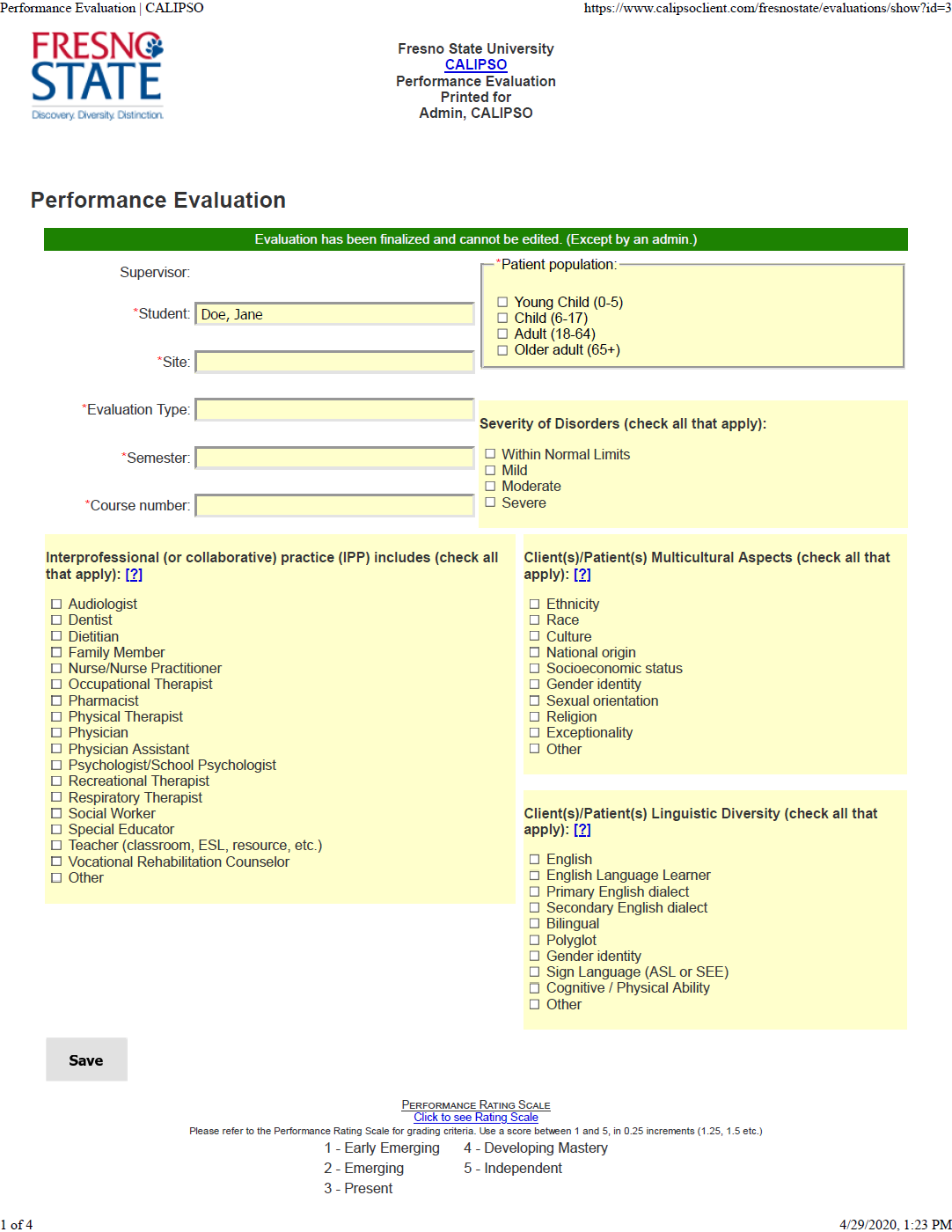
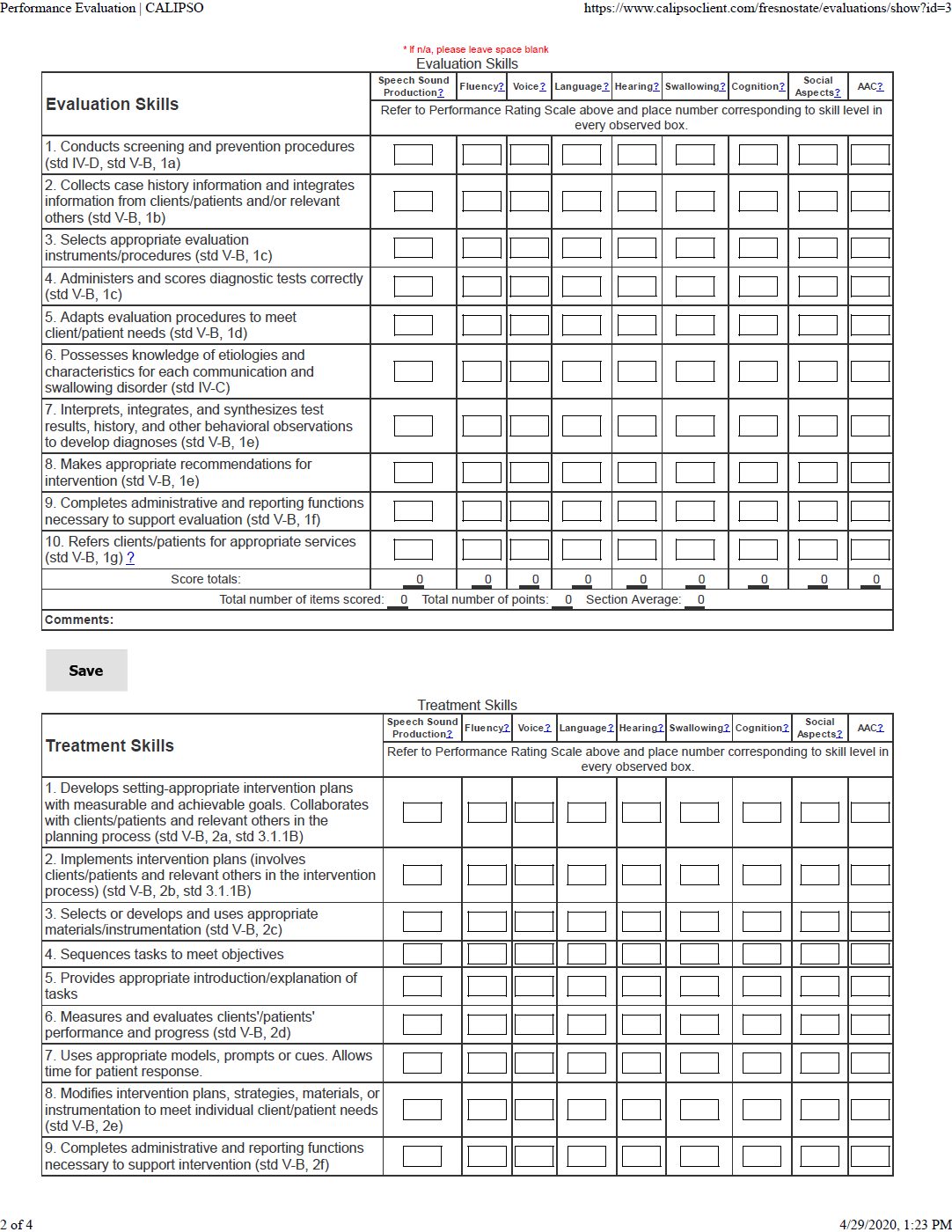
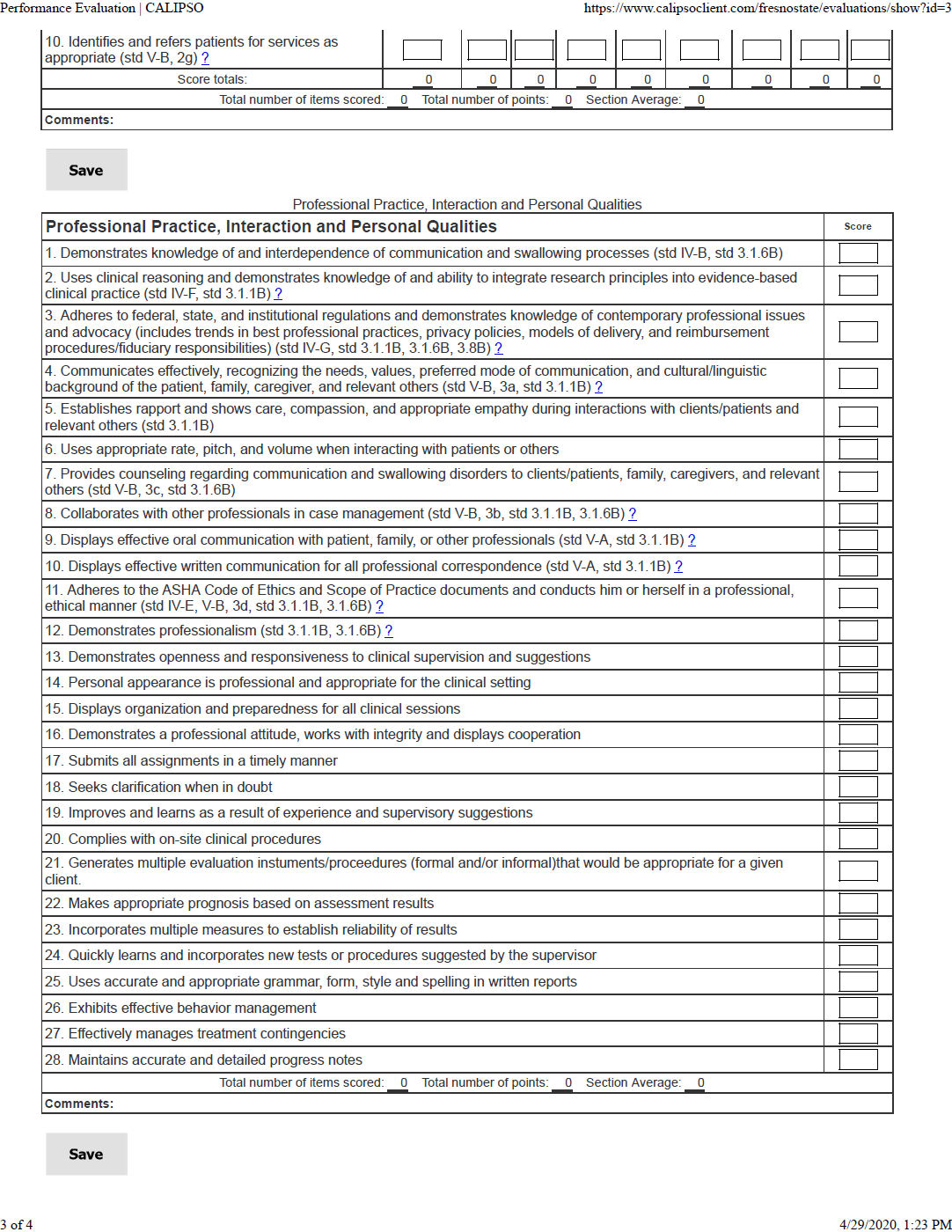
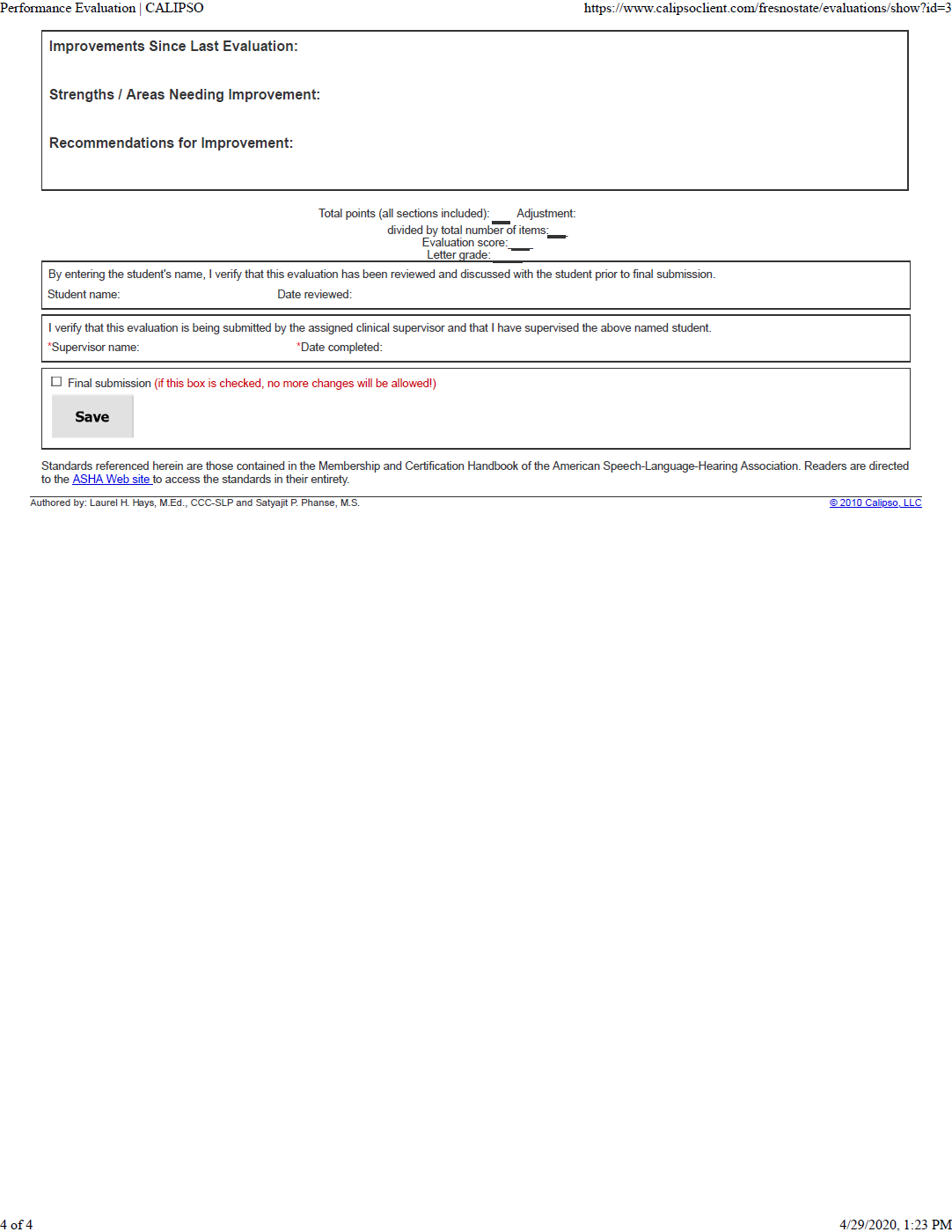
Policies and Procedures Manual
Fresno State University
Speech-Language-Hearing & Communicative Sciences and Deaf Studies (CSDS) Research
Clinics
Introduction
Goals
The goals of the Fresno State Speech-Language-Hearing & CSDS Research Clinics are:
• To provide high quality services for children and adults with disorders of speech,
language, or hearing.
• To provide training, education, and research opportunities for students in the Department
of Communicative Sciences and Deaf Studies.
• To serve as a community resource and advocate for individuals of all ages with communicative
disorders.
Ethical Standards
All individuals providing services in the Fresno State Speech-Language-Hearing & Communicative Sciences and Deaf Studies (CSDS) Research Clinics, or at affiliated off-campus clinical sites, are expected to abide by the highest ethical standards. All student clinicians and clinical supervisors are expected to adhere to the American Speech-Language-Hearing Association’s (ASHA) Code of Ethics. A copy of the current Code of Ethics may be obtained from the clinic office or located in the end of this manual.
Nondiscrimination Policy
The Fresno State Speech-Language-Hearing & Communicative Sciences and Deaf Studies (CSDS) Research Clinics, including the faculty, staff, and student clinicians, adheres to a policy of nondiscrimination. The Clinic does not discriminate against clients, student clinicians, or staff on the basis of race, religion, national origin, gender, age, sexual orientation, marital status, or disability.
CSDS 257/267 Policies and Procedures
Departmental Policy
It is anticipated that the student clinicians will begin their off-campus placement
during their 4th and 5th semester as graduate students in the CSDS program. This will
be anticipated and confirmed by the Clinic Director based on the Graduate Student
Practicum Master List.
The CSDS student clinicians will be placed with a Speech-Language Pathologist (state
licensed and with CCC’s) in a school district for CSDS 257. The student clinicians
will be required to register for a semester placement placement AND earn a suggested
100 hours in the school setting during the semester. The student will attend the placement
until the last day of instruction.
The CSDS student clinicians will be placed with a Speech-Language Pathologist (state
licensed and with CCC’s) in an acute care facility, skilled nursing facility, private
practice, inpatient rehabilitation, outpatient rehabilitation facility, early intervention
or county program for CSDS 267. The student clinicians will register for a full semester
placement. No minimum hour requirement for CSDS 267 needs to be met. The student will
attend the placement until the last day of instruction.
The student clinicians are required to inform the Clinic Director if he/she is employed
by the school district, private practice or medical facility in ANY capacity. In this
case, the student clinician will be required to be placed in a different school, school
district, population AND a different supervisor for the duration of the semester in
order to earn credit for CSDS 257 and CSDS 267. The graduate student clinician MAY
NOT earn an income from the district, private practice or medical facility for any
clinical hours and time spent with clients/patients as part of CSDS 257/267. The graduate
student clinician may not earn clinical hours related to CSDS 257 and CSDS 267 while
performing regular employment duties with the aforementioned employers. This requirement
will be clearly stated to the district, manager, supervisor and graduate student clinicians
and will be closely monitored by the Clinic Director. If, it is discovered that the
student clinician, supervisor, district and/or manager does not adhere to this policy,
the student will receive a NC for the semester and will be required to take the course
in the next semester.
Departmental Procedures
Clinical Placements
The following steps will be followed to place the graduate student clinicians in CSDS
257/267:
1. The Clinic Director will anticipate the student clinicians that are scheduled to
take CSDS 257 or 267 based on the Graduate Student Practicum Master List.
2. A survey will be sent to all student clinicians via Qualtrics to determine specific
placement/supervisor preferences and employment status that may conflict with their
placement during the semester prior to the anticipated off-campus placement.
a. The Clinic Director will make every attempt to honor the student clinicians request
but NO placement is guaranteed. Judgment based on space/supervisors available, student
clinician strengths, available contracts etc. Placements are ultimately made at the
discretions of the Clinic Director.
3. The Clinic Director will reach out to the various placements available and requested
by the student clinicians in order to secure placements.
4. The clinic Director will confirm that affiliation agreements/MOUs are valid for
all planned placements and initiate the process for renewal, if necessary.
5. Once a supervisor has been located, the Clinic Director will share all contact
information with the supervisor and the graduate student clinician. At this time,
an informational sheet regarding start/end dates, basic requirements as well as grading
criteria will be shared with both parties via email.
6. Vaccination information will be completed by the Clinic Director and the consortium
process will be initiated for students entering CSDS 267. Students entering CSDS 257
will be provided with the credentialing packet for completion prior to the start of
their placement. Also, the CSDS students will be informed of any district orientation
or medical clearance requirements that may be needed.
7. Prior to the start of the semester, the student clinicians will attend a mandatory
meeting with the Clinic Director to discuss all requirements for the placement, behavior
expectations, standards and grading. A packet with all forms, instructions as well
as the Student Practicum Evaluation Forms will be presented.
8. Following the start of the semester, the Clinic Director will schedule site visits
with some of the students/supervisors. More than one visit may be required and will
be assessed on a case-by-case basis. If scheduling/time constraints and/or distance
inhibits direct site visits, telephone, email and/or ZOOM visits may be conducted.
9. Following the conclusion of the semester, the graduate student clinician will submit
all clockhours to their supervisor for approval, and complete the supervisor evaluation
on CALIPSO. The clinical supervisor will approve hours and submit the Student Performance
Evaluation on CALIPSO by the designated date.
Grading
The clinical supervisor will complete a three week evaluation (at the supervisor’s
discretion), a midterm evaluation and a final evaluation on the Performance Evaluation
on CALIPSO during the semester. The student/supervisor must have the Performance Evaluation
and the Hours approved on CALIPSO by the last day of instruction.
The graduate student clinician and/or the supervisor must inform the Clinic Director
of any issues/deficiencies related to the graduate student clinician’s performance.
If the student clinician is in danger of failing or does not appear to have the skills
required to pass the CSDS 257/CSDS 267 course as indicated on the Performance Evaluation,
a Clinical Remediation Plan (CRP) plan will be initiated. The Clinic Director will
outline a basic plan for the supervisor to complete. The supervisor, graduate student
clinician and the Clinic Director will meet to discuss and initiate the plan. All
will sign the form and it will be placed in the graduate student clinician’s file.
See below for parameters:
Student clinicians receive a grade of credit or no-credit as a result of their performance
in their practicum assignment(s). The clinical supervisor and university supervisor
jointly confer with the student clinician as needed. A mid-term and final evaluation
are completed and presented to the student clinician by the on-site supervisor. Requirements
include:
• CSDS 257- Student Teaching or CSDS 267 Externship:
o MUST earn a 4.0 average out of 5.0 by final
o MUST earn a 3.0 or HIGHER on every item assessed by final
o May not receive a “FAIL” in any of the Professional Practice, Interaction, and Personal
Qualities section of the assessment
Overall Grading Policy for CSDS 230, 250, 257 & 267
Student clinicians receive a grade of credit or no-credit as a result of their performance
in their Student clinicians receive a grade of credit or no-credit as a result of
their performance in their practicum assignment(s). The clinical supervisor and university
supervisor jointly confer with the student clinician as needed. A mid-term and final
evaluation are completed and presented to the student clinician by the on-site supervisor.
Requirements include:
• 1st semester grads; CSDS CLINIC C1-First Experience:
o MUST earn a 3.0 average out of 5.0 by final
o MUST earn a 2.0 or HIGHER on every item assessed by final
o May not receive a “FAIL” in any of the Professional Practice, Interaction, and Personal
Qualities section of the assessment
• 2nd-3rd semester grads; CSDS CLINIC C2-Second and CSDS CLINIC C3-Third Experiences:
o MUST earn a 3.5 average out of 5.0 by final
o MUST earn a 3.0 or HIGHER on every item assessed by final
o May not receive a “FAIL” in any of the Professional Practice, Interaction, and Personal
Qualities section of the assessment
• CSDS 257- Student Teaching or CSDS 267 Externship:
o MUST earn a 4.0 average out of 5.0 by final
o MUST earn a 3.0 or HIGHER on every item assessed by final
o May not receive a “FAIL” in any of the Professional Practice, Interaction, and Personal
Qualities section of the assessment
When students are not successfully completing all practicum requirements, the steps
listed below in the Clinical Remediation Plan (CRP) will be followed and completed
within a three (3) week period:
Clinical Remediation Plan (CRP) Instructions
FRESNO STATE SPEECH-LANGUAGE-HEARING AND RESEARCH CLINICS
Department of Communicative Sciences and Deaf Studies
CLINICAL REMEDIATION PLAN (CRP) POLICY & PROCEDURE
I. Purpose of the Clinical Remediation Plan (CRP)
The purpose of a Clinical Remediation Plan (CRP) is to identify clinical concerns
beyond the typical development of skills, offer concrete feedback and recommendations,
and set clearly defined goals for student success.
II. Concern beyond typical development of clinical skills arises
1. Email the student and CC the clinic director with the following information:
a. Indicate the exact clinical concern and the situation that brought the issue to
light.
b. Offer specific feedback and suggestions for improvement.
III. Concern persists despite informal written feedback
1. Contact the clinic director to develop and initiate a Clinical Remediation Plan
(CRP)
a. The clinical supervisor completes the Performance Evaluation Form-midterm on CALIPSO
detailing the specific areas of concern.
b. The clinic director creates the actual CRP and sends it back to the clinical supervisor
for the development and addition of goals specific to the areas of concern.
c. The clinic director will observe a clinical session.
d. A meeting is scheduled between the student, clinical supervisor and clinic director.
(a) Discuss each area of concern and present goals that must be achieved to earn a
CREDIT for the clinic as outlined on the CRP.
(b) Offer concrete strategy and recommendations for improvement.
(c) Determine a follow-up date that all goals must be met in order for the CRP to
be discontinued.
e. Require weekly email updates to the clinic director on progress from the supervisor
and student.
2. If the student meets all goals by the determined date, the CRP is formally discontinued.
IV. Concern persists beyond the formal Clinical Remediation Plan (CRP) follow- up
date
1. Contact the clinic director to revise and update the Clinical Remediation Plan
(CRP).
a. The supervisor adds updated details of the persistent areas of concern on the CRP.
b. A meeting is scheduled between the student, clinical supervisor and clinic director
to discuss the updated CRP.
(a) Present the updated CRP and offer concrete strategy, recommendations and expectations
in order to earn a CREDIT for the clinic.
(b) Determine a follow-up date that all goals must be met for the CRP to be discontinued
and for the student to earn a CREDIT for the clinic.
2. If the student meets all goals by the determined date, the CRP is formally discontinued.
V. Goals are ultimately not met by the formal Clinical Remediation Plan (CRP) update
1. The clinical supervisor completes the Performance Evaluation Form-final on CALIPSO
reflecting all performance and highlighting the reason for the student earning NO
CREDIT.
a. The student does NOT earn a CREDIT for the clinical experience and will be rescheduled
for the next semester.
Clinical Remediation Plan (CRP) Summary
, 2019
Student:
On-Site Supervisor:
Site: CSU, Fresno Speech and Hearing Clinic
(Student and on-site supervisor present for conference)
The purpose of this conference was to discuss the student’s progress in his/her clinical
practicum during the ____ semester, and to clarify the required clinical practicum
performance necessary to receive credit at the end of the semester.
At this time, the student has not demonstrated the necessary level of skills to receive
a grade of Credit (CR) for the current clinical practicum as outlined in the course
syllabus. The following areas of difficulty must improve in order to receive a grade
of Credit (CR) by the end of the semester.
PERFORMANCE RATING SCALE
1 Early Emerging: Specific direction from supervisor does not alter unsatisfactory
performance.
2 Emerging: The clinical skill/behavior is beginning to emerge. Efforts to modify
may result in varying degrees of success. Maximum amount of direction from supervisor
needed to perform effectively.
3 Present: Inconsistently demonstrates clinical behavior/skill. Exhibits awareness
of the need to monitor and adjust and make changes. Modifications are generally effective.
Moderate amount of direction from supervisor needed to perform effectively.
4 Developing Mastery: Displays minor technical problems which do not hinder the therapeutic
process. Minimum amount of direction from supervisor needed to perform effectively.
5 Independent: Adequately and effectively implements the clinical skill/behavior.
Demonstrates independent and creative problem solving.
Specific areas of difficulty in clinic have included the following:
EVALUATION SKILLS
•
o CURRENTLY (1)
o GOAL: by midterm…
TREATMENT SKILLS
•
o Currently a
o GOAL: By midterm…
PROFESSIONAL PRACTICE, INTERACTION, AND PERSONAL QUALITIES
•
o Currently a
o GOAL: By midterm…
I have read and understand the above summary.
______________________________ ________________
, B.A., Student Date
______________________________ ________________
Date
Clinic Supervisor
________________________________ ________________
Sabrina Nii, M.S., CCC-SLP Date
Clinic Director
Clinical Incident Report Instructions
If a specific and concerning incident occurs within the clinic with a student not
related directly to clinical skills but rather ethical or other, a formal Clinical
Incident Report (CIR) will be initiated. See below for the steps of the CIR followed
by the form used.
FRESNO STATE SPEECH-LANGUAGE-HEARING AND RESEARCH CLINICS
Department of Communicative Sciences and Deaf Studies
CLINICAL INCIDENT REPORT POLICY & PROCEDURE
II. Purpose of the Clinical Incident Report (CIR)
The purpose of a Clinical Incident Report (CIR) is to thoroughly document a specific
clinical incident or concern, identify the standards impacted, offer concrete feedback,
and set a clearly defined intervention.
II. A specific clinical incident or concern arises
1. Email the student and CC the clinic director with the following information:
a. Indicate the exact incident or concern and the situation that brought the issue
to light.
b. Inform the student that a Clinical Incident Report (CIR) will be developed.
III. Development of the Clinical Incident Report (CIR)
Clinical Incident Report
1. Contact the clinic director to help develop and initiate a Clinical Incident Report
(CIR).
a. The clinical supervisor completes the Incident/Concerns and Intervention portions
of the Clinical Incident Report (CIR) and sends the document back to the clinic director.
b. The clinic director adds the specific Standards Impacted.
c. The clinical supervisor and clinic director schedule a meeting with the student
to discuss the incident and present the Clinical Incident Report (CIR).
(a) Discuss the specific incident that occurred and the standards impacted.
(b) Offer concrete intervention to remediate the situation.
(c) Determine a follow-up date that the intervention must completed and the issue
must be resolved in order for the CIR to be discontinued.
f. Require weekly email updates to the clinic director on progress from the supervisor
and student.
2. If the student meets all goals by the determined date, the CIR is formally discontinued.
IV. Clinical incident or concern persists beyond the specified Clinical Incident Report
(CIR) follow-up date
1. Contact the clinic director and report the persistent issues despite a clearly
defined intervention on the CIR.
a. The clinical supervisor and the clinic director schedule a meeting with the student
to discuss the persistent issues and the consequences of not following the CIR.
b. The clinical supervisor completes the Performance Evaluation-final on CALIPSO indicating
the standards in question were not met.
c. The student receives a NO CREDIT for the clinical experience.
Clinical Incident Report (CIR)
Incident/Concerns
Specific Standards Impacted Intervention
I have read and understand the above summary.
_______________________________ _________
Student Clinician Date
_______________________________ _________
Date
Clinical Supervisor
_______________________________ _________
Clinic Director Date
Grade Dispute Instructions
If the student clinician believes the NC grade has been assigned unfairly, information
may be obtained pertaining to the University’s policy and procedure for protesting
a final grade in the Office of Advising Services, Joyal Administration, Room 121.
If a student receives a grade for a clinic practicum he or she believes was assigned
incorrectly, unfairly, prejudicially, or capriciously, the following steps should
be taken:
1. The student should speak with the supervisor who assigned the grade by no later
than the end of the third week of the next semester. It may simply be that an error
has occurred, which can be easily corrected with a grade correction form signed by
the instructor and submitted to the records office.
2. If the student is not satisfied with the supervisor's explanation, he or she may
discuss the issue with the clinic director which may arrange a conference with the
student and supervisor in order to develop a resolution.
3. If the student is not satisfied with the clinic director’s intervention, the student
may appeal the grade and speak to the department chair about it immediately. The department
chair will discuss the allegation with the supervisor and give the student a response
within ten working days.
4. If the student is still not satisfied with the department chair's response, the
student may submit a written statement protesting the grade to the chair of the Student
Academic Petitions Committee (SAPC) within five working days.
5. The student should contact the Office of Advising Services , Joyal Administration
Building, Room 224, at 278-1787, and ask to make an appointment with the counselor
in charge of grade protests. The counselor will provide the student with the necessary
paperwork to be submitted to the Student Academic Petitions Committee and will help
guide the student through the grade protest process.
6. The chair of the SAPC will send the student's statement to the supervisor who is
required to respond in writing by a specified date. The student's statement and the
supervisor's statement will be reviewed by the SAPC committee at its next meeting.
7. Once a decision by the SAPC is reached, the student will be notified of it in writing
and will receive a copy of the supervisor's written response.
8. Further information on the University’s Dispute Policy can be found here:http://fresnostate.edu/academics/facultyaffairs/documents/apm/415.pdf
Speech-Language Pathology Complaint Procedure to CAA
A complaint about any accredited speech-language pathology program or program in candidacy
status may be submitted by any individual(s). Complaints about programs must meet
all of the following criteria:
a. be against an accredited graduate education program or program in candidacy status
in audiology orspeech-language pathology;
b. relate to the Standards for Accreditation of Entry-Level Graduate Education Programs
in Audiology and Speech-Language Pathology, including the relationship of the complaint
to the accreditation standards;
c. be clearly described, including the specific nature of the charge and the data
to support the charge;
d. be within the timelinesspecified below:
• if the complaint is being filed by a graduate or formerstudent, or a former faculty
or staff member, the complaint must be filed within one year ofseparation from the
program, even if the conduct occurred more than 4 years prior to the date of filing
the complaint;
• if the complaint is being filed by a current student or faculty member, the complaint
must be filed as soon as possible, but no longer than 4 years after the date the conduct
occurred;
• if the complaint is being filed by other complainants, the conduct must have occurred
at least in part within 4 years prior to the date the complaint is filed.
Complaints also must meet the following submission requirements:
a. include verification, ifthe complaint isfrom a student orfaculty/instructional
staff member, that the complainant exhausted all pertinent institutional grievance
and review mechanisms before submitting a complaint to the CAA;
b. include the complainant’s name, address, and telephone contact information and
the complainant’srelationship to the programin orderforthe AccreditationOffice staffto
verify the source of the information;
c. be signed and submitted in writing via U.S. mail, overnight courier, or hand delivery—not
via e-mail or as a facsimile—to:
Chair, Council on Academic Accreditation in Audiology and Speech-Language Pathology
American Speech-Language-HearingAssociation
2200 Research Boulevard, #310
Rockville, MD 20850
Clinic Services
Speech-language pathology and Audiology services are provided by student clinicians under the direct supervision of a California licensed and ASHA certified professional. Services are provided for children and adults. Speech-language pathology and Audiology services are provided during the fall, spring, and summer sessions.
Audiology
Audiological evaluation
Diagnostic follow-up
Immittance testing
Immittance re-check
Hearing screening
School hearing screening
Speech-language Pathology
Speech and/or language evaluation
Speech and/or language therapy- individual
Speech and/or language therapy- group
CSDS Research Clinics
Speech and/or language Evaluation
Speech and/or language therapy-individual
Speech and/or language therapy-group
Clinic Fees
The Fresno State Speech and Hearing Clinic office describes clinic fees to clients
when they first contact the clinic regarding services. All client fees are paid at
the beginning of the appointment/treatment period unless a payment plan has been approved.
With prior approval from the clinic director, fees may be paid on a weekly or monthly
plan. In a few instances, the Clinic Director may waive or reduce a fee when proven
financial hardships exist with a client. Student clinicians are not authorized to
discuss changes in clinic fees with clients. Clients requesting fee reductions should
be referred to the clinic director.
The fees are as follows:
o Individual clinic- $250 per semester
o Each additional sibling- $125 each
o Active students of CSU, Fresno- $125
o Children of active CSU, Fresno students- $125 each
o Diagnostics Clinic- No Charge.
o Audiological Evaluations- No Charge
o Aphasia Clinic- No Charge
o All Research Clinics (Parkinson’s, Neurological/Aphasia, Hearing)- No Charge
Clients who are Medicare Part B eligible and are chosen by faculty to participate
in the CSDS Research Clinics will receive all clinic services free of charge, if they
agree to participate as stated in the consent form.
Client Admission
Clients are admitted to the clinic based on the following guidelines:
• Availability and qualifications of supervisor.
• Needs for clinical hours and qualifications of student clinicians.
• Continuing enrollment from previous semester(s).
• Date the case history was received.
No individual is denied services because of his or her gender, race, national origin,
age, or disability. When an individual contacts the clinic concerning audiology or
speech-language pathology services, the clinic staff will do the following:
• Describe clinic services and fees. If requested, the clinic staff will mail a copy
of the fees and services to the individual.
• Describe procedures for applying for services. The clinic staff requests that the
person complete and return a case history form, and include copies of reports of any
related services. The clinic staff also states that an appointment cannot be guaranteed
and explains the criteria for admittance.
• Mail a case history form.
• Give names of other professionals or agencies. If the individual is not interested
in pursuing services at the clinic or requires services that are not available through
the clinic, he or she is given the names of other professionals or agencies in the
community.
Speech-Language Pathology
When a completed case history is returned, the clinic staff will:
1. Assemble the client file.
2. Number the folder.
3. Deliver client file to the clinic director to determine the best placement for
the client based on the information provided in the Case History Form.
4. Add the person’s name to the client list.
5. File the folder in the “waitlist” file.
6. If Medicare Part B eligible, and faculty approve, the client will be presented
with a consent form to participate in the research project and placed in the CSDS
Research Clinic appropriate for their needs.
If a client/parent requests an assessment, the clinic staff will place the case history
in the “diagnostics waitlist” folder. This file is reviewed at the beginning of each
semester to arrange appointments.
Making Appointments for Speech Therapy
Speech-language pathology clients are assigned by the clinic director, scheduled by
the clinic assistant and confirmed by student clinicians. Student clinicians are responsible
for completing the following prior to the first session of clinic:
1. Pick up your client file from the clinic office.
2. Phone the client to confirm appointment times.
3. Instruct the client to come to the clinic office before his or her first appointment
to pay the fee and obtain a parking permit. (Arriving about 15 minutes early should
be enough time)
4. Note phone communication with the client or caregiver on the Client Contact Record
(CCR).
5. Inform the clinic staff, or clinic director that the appointment is confirmed.
After clients are assigned and appointments confirmed, the clinic staff will:
1. Complete and file the billing invoice, if applicable.
2. File the folder alphabetically in the “diagnostics” file or “active speech therapy”
file.
3. Add the clients scheduled in the schedule for the appropriate clinic.
If clients cannot attend at the scheduled time, student clinicians are responsible
for completing the following:
1. Inform clients that other appointment times cannot be guaranteed. The clients’
“appointment time” will be assigned to other clients on our waiting list and the clinic
will attempt to reschedule them.
2. Tell clients that if the clinic is unable to reschedule their appointment, their
names will remain on the waiting list and the clinic will try and reschedule, as appointments
become available (including the next semester). Again, students must clearly inform
clients that if they turn down the proposed appointment, they may not receive services
during the current semester.
3. Note the communication on the Client Contact Record, including the times when the
client is available for an appointment.
4. Immediately inform the clinic staff, or clinic director that the client cannot
attend at the proposed time.
Audiology
When a completed case history form is returned, the clinic staff will:
1. Schedule clients based on pre-arranged scheduling guidelines. The clinic staff,
clinic director, and audiology supervisors review scheduling guidelines prior to beginning
clinic each semester.
2. Direct clients to wait in the room PHS 220
3. Assemble the clients’ folders.
4. Number the folders.
5. File the folders in the audiology clinic cabinet
If a competed case history is returned along with a recent audiological examination
report (within last 3 months), the clinic staff will discuss with the audiology supervisor
what appointments will be necessary before scheduling the client. Evaluating children
under the age of 3 years old must be approved in advanced by the audiology supervisor.
Client Policy and Procedures
California State University, Fresno
Speech, Language, and Hearing Clinic
Policies and Procedures
(Updated: October 19, 2018)
Clinic Scheduling Policy:
• Clients participating in the Fresno State Speech and Hearing Clinic MAY NOT be Medicare
Part B Eligible.
• If you are Medicare Part B eligible, please inform the office staff as you may be
eligible to participate in our NO cost CSDS Research Clinic.
• Returning clients have priority for clinic assignments:
o if a spot is available
o the client questionnaire is returned by the clinic registration deadline
o if the clients’ fees are paid in full
• Clients who participate in Diagnostics Clinic will receive priority placement the
next semester following current active clients.
• No clinic assignment is guaranteed.
• There is a 5 semester limit for clinic; after a client’s 5th semester, he/she can
request to return to the wait list after sitting out, at least, 1 semester.
• If siblings are participating in clinic, each sibling must adhere to the 5th semester
rule.
• Clients will be moved to the inactive waitlist if they have been contacted 2 consecutive
semesters and no reply is received.
• Clients who confirm a clinic placement and withdraw less than two weeks prior to
the start of clinic (including AFTER clinic starts), will be moved to the bottom of
the clinic waitlist.
• Clients may not request specific clinicians or request a “more advanced” clinician
in the program. This is a learning institution and the Clinic Director will match
clients with clinicians as appropriate.
Absence/Late Policy:
• Please initial on the lines below:
• Contact the clinic assistant at (559) 278-2422 if you will be absent from clinic.
The clinic assistant will notify the student clinician for you.
o _______ Clients are allowed up to 2 unexcused absences. An unexcused absence qualifies
as:
• no show/no call
• Vacation
• Other non-emergency
o _______ More than 2 unexcused absences will constitute withdrawal of the client
from clinic for that semester.
o _______ Clients are allowed up to 3 excused absences. An excused absence qualifies
as:
• illness
• family emergency
• an absence out the client’s control
• The clinic assistant MUST be notified 2 hours prior to the start of the session
to be considered excused.
o _______ More than 3 excused absences will constitute withdrawal of the client from
clinic for that semester.
o _______ A TOTAL combined excused/unexcused absence shall not exceed 3 absences.
Absences combined greater than 3 will constitute a withdrawal from the clinic.
o _______The client may request to be placed back on the waitlist after sitting out
for 2 semesters (including summer) following withdrawal for any of the above reasons.
o _______ Any client who is late (10 minutes or more) 3 times will be withdrawn from
clinic for that semester.
Client Dismissal
Clients will be dismissed if they meet any of the following criteria:
• Service completed.
• Treatment objectives met.
• No longer benefits from treatment.
• Repeated absences. It is suggested that after one unexplained or unexcused absence,
clients be counseled regarding the importance of regular attendance. If clients are
absent for unexcused reasons after counseling, they should be told that another unexcused
absence would result in their being dismissed from clinic. A client dismissed for
repeated absences should be given a letter of explanation and a copy of the letter
placed in his or her file. All client contacts should be noted on the Client Contact
Record (CCR). Supervisors may use their own judgment regarding attendance problems.
However, it is important to maintain documentation for future supervisors.
• Client moves to a different geographical location.
• Client chooses to discontinue services at the Speech, Language and Hearing Clinic.
The student clinician will do the following when dismissing a client from treatment:
• Write a discharge report on all clients who received treatment at the clinic.
• Obtain supervisor approval of the report and have the supervisor co-sign the report.
• Original report will be filed in the clients’ folder and one copy of the report
given to the client.
The clinic supervisor will do the following:
• Discharge clients according to dismissal policy.
• Counsel clients regarding reason for discharge, as needed.
• Review, approve, and sign all discharge reports.
On-going clients who are not able to attend during the current semester will be placed
on the client waiting list and contacted the following semester up to one year and
then will be placed in Inactive files.
Referral
Clients will be referred to other agencies if the clinic is unable to provide appropriate
services or if the client requests additional or alternate services. The clinic personnel
(staff or supervisors) making the referral should do the following:
1. Give the names of at least three providers or agencies. Lists of audiologists and
speech-language pathologists are available through the clinic staff.
2. Note the referral on the clinical report.
3. Note the referral on the Client Contact Record.
4. Place a copy of any referral letter in client’s files. (Make sure a signed release
of information is in the client’s file before releasing any information).
Clinic personnel shall not accept any type of compensation for referring clients to
other agencies for service.
Records
Client Records
The clinic maintains client records for a period of at least 5 years. Client files
are located in the clinic office and are divided into three sections: waiting for
assessment, waiting for treatment and active files. Inactive files are stored separately.
Each client folder initially contains the following:
• Client Contact Record (CCR). The clinic staff types the client’s name, file number,
birthdate, address, phone number, referral source, names of parents/spouse, and types
of problem on the CCR. The CCR also provides an area for notes on all client contracts
such as telephone calls to client, date of initial appointment, etc.
• Case history.
• Referral source.
• Release of information.
• Signed permission for observation.
• Signed/initialed Clinic Policy
• Client data sheet.
• Any reports, referral letters, or other pertinent information submitted by the client.
Files of clients who have had or are currently receiving service at the clinic also
contain the following:
Student Clinician Records
• Diagnostic reports.
• Reassessment reports, treatment plans, progress reports, treatment summary reports
daily progress notes, and lesson plans. At the end of the semester, lesson plans and
daily progress notes are removed form clients’ folders and stored separately.
• Test record forms, signed and dated.
• Copies of any letters sent to other professionals or agencies.
• Chronological log of services provided.
• Name(s) of the student clinician and supervising speech-language pathologist or
audiologist.
Student clinicians and their supervisors are responsible for maintaining complete
and orderly files. At the end of each semester, the supervisor reviews each current
client’s file with the student clinician.
Confidentiality of Student Clinician Records
The information in student clinicians’ folders is confidential. No information is to be placed in or removed from these folders without permission of the clinic director.
Assessments
General Information
Student clinicians evaluate clients under the supervision of licensed and certified audiologist or speech-language pathologist. At least 50% of each evaluation session must be supervised. Student clinicians must discuss evaluation plans in advance with their supervisors.
Diagnostic and Therapy Supplies
Tests available in the clinic are listed in the Assessment Inventory book. A copy of the inventory is located in the Media Center.
Client Data Sheet
A client data sheet is in each client folder. At the end of an evaluation, the examiner lists tests administered and results on the client data sheet.
Assessment Report
A report must be written following each evaluation. Supervisors will provide students
with the specific report format required. Student clinicians give the parent/client/caregiver
the approved completed reports (verified by clinic supervisor signature).
Each speech-language pathology evaluation will usually include a hearing screening.
The results of the screening should be documented in the report. If a hearing screening
was not possible, this should also be documented in the report. Clients failing the
hearing screening should be referred for an audiological evaluation, as appropriate.
Reports
Client Reports
Following is a list of the required written reports:
• Assessment report. The assessment report contains results of the initial assessment,
conclusions, and recommendation. All clients receiving treatment must have a diagnostic
report in their folders.
• Reassessment Report. Written for clients who have received previous diagnostic reports
through the clinic.
• Treatment plan. A treatment plan must be prepared for each client receiving therapy.
Supervisors may use different types of treatment plans. Each plan must contain brief
assessment information (including diagnosis), type of services recommended, and goal/objectives.
• Daily progress/SOAP notes. Client progress must be recorded in the client’s folder
at the end of each therapy session.
• Treatment summary report. At the end of the semester (or treatment period) a report
of progress must be written for each client who received treatment.
• Discharge report. A discharge report must be written when treatment is terminated.
• Audiological reports. A report will be written following each audiology appointment.
Refer to the audiology clinic manual for additional information.
With the exception of daily progress/SOAP notes, all clinic reports must be signed
by both the student clinician and the clinic supervisor.
Clinic Supervisors
Clinic supervisors are responsible for ensuring quality service delivery in the clinic.
Minimally, supervisors must:
• Possess a current Certificate of Clinical Competence in the subject area in which
supervision is provided.
• Possess a current California State License in the subject area in which supervision
is provided.
• Provide proof of completed 2- hours of professional development in the area of supervision.
• Possess knowledge of and experience in the subject area or areas in which supervision
is provided.
• Review and approve in advance all major clinical plans and decisions.
• Co-sign all clinical reports and letters.
• Observe a minimum of 25% of each clinical session taking into account the student’s
level of knowledge and experience.
• Provide student clinicians with information regarding clinic procedures, requirements,
and performance expectations.
• Give student clinicians clinical instruction and model specific procedures and techniques,
as necessary.
• Provide ongoing feedback to student clinicians regarding their performance.
• Give student clinicians midterm and final Performance Evaluations, and discuss the
evaluations with them.
The clinic staff will:
• Maintain a list of current supervisors and the expiration date of their CCC’s and
licenses.
• Validate the currency of the supervisors’ CCC’s and licenses regularly.
Quality Improvement
Clinic Meetings
Clinic procedures, policies, and short and long-term goals are given to each student
clinician via hard copy as well as emailed to all clinic supervisors (on and off campus)
each semester.
Clinic supervisors hold regular meetings with their student clinicians. These meetings
may include suggestions related to clinical performance, discussion of a specific
communicative disorder, or other information related to clinic.
The clinic director meets at least once per semester with student clinicians to review
clinic procedures, to discuss cases and to present information related to clinic and
clients.
Client Progress
Clinic supervisors must ensure that:
• Measurable treatment objectives are written for all clients receiving therapy.
• Progress towards these objectives is measured throughout the semester and documented
in the form of progress/SOAP notes.
• Modifications of objectives or procedures are made as needed.
• Treatment objectives and procedures, client progress, and recommendations are evaluated
and reported in a written final summary at the end of the semester (or treatment period).
Consumer Satisfaction
Consumer satisfaction is measured at the end of each semester for clients receiving
speech-language pathology services. Procedures are as follows:
• The clinic staff distributes the Client Questionnaires to the clients at the end
of each semester.
• The student clinicians collect the completed questionnaires or ask the clients to
complete the questionnaires and return them to the clinic office. (In person or by
mail)
• The clinic staff uploads the results in Google Drive by semester.
• The clinic director reviews and distributes the results of the questionnaires department
chairperson.
• The clinic director, supervisors, and department chairperson discuss any areas of
concern.
• The clinic director oversees any needed modifications.
Supervisor Qualifications and Evaluation
The clinic staff does the following:
• Maintains a list of all clinic supervisors, their CCC and license numbers, and the
expiration dates of the CCC’s and licenses.
• Verifies each clinic supervisor’s ASHA certification and state license on an annual
basis.
• Verify completion of 2-hours of professional development in the area of supervison.
• Notifies the clinic director if a supervisor has not maintained CCC or licensure.
Student clinicians evaluate their supervisors at the end of the semester. Procedures
are as follows:
• The clinic director instructs the student clinicians to complete the Supervisor
Evaluation on CALIPSO and the University mandated evaluation tool and pulls reports
directly from the site, addressing any issues that may be noted.
The Clinic Director does the following:
• Reviews all supervisor evaluations.
• Discusses any area of concern with the department chairperson and the supervisor.
• Makes changes, as needed.
Safety Precautions
To help ensure their health and safety of their clients, all individuals responsible
for providing services at the Fresno State Speech-Language-Hearing & Research Clinics
should adhere to the following guidelines:
• In an emergency (e.g., accident, sudden illness, campus fire), dial 911. Stay on
the line and given necessary information. The telephone report should include details
as to building, location in the building, and nature of the fire. There is a telephone,
fire extinguisher, and first aid kit in the audiology lab. The safety of the clinic
staff and clients are the first priority.
• Never leave a child unattended in the clinic.
• Do not allow children to stand on tables or chairs.
• Do not let children run in the clinic area.
• Unless used as a part of treatment, avoid giving clients food. Before using food
in clinic, check with the client (or client’s guardian) to assure that the client
is not allergic to the food or otherwise restricted from eating it.
• If clients in wheelchairs do not lock their brakes when they enter the clinic room,
advise them to do so. If clients are unable to independently operate their chairs,
clinicians should lock the brakes on their clients’ chairs.
• Do not smoke or allow smoking in the clinic.
• Wash your hand before and after each client. Antiseptic wipes are available in each
clinic room.
• Use gloves or finger cots when performing an oral peripheral examination, when there
is a possibility of your coming into contact with the client’s saliva or blood, or
during other types of invasive procedures.
• Avoid touching your face while wearing gloves.
• Use disposable equipment for examinations or in treatment whenever possible (e.g.,
tongue depressors, swabs, gauze, etc.).
• Wipe off the clinic table after each use with antiseptic wipes.
Research
All research involving the CSDS Research Clinic Clients must be in accordance with
California State University, Fresno Research Policy. All research involving clients
must comply with the provisions of the Policy and Procedures for Research with Human
Subjects at California State University, Fresno (October, 2001).
Faculty must notify the clinic director in advance of any client who is Medicare Part
B eligible and appropriate for the CSDS Research Clinic. Clients must be notified
that they are eligible for a research project and sign the appropriate consent form.
A client’s attendance for research sessions (but not necessarily the results of the
research itself) must be noted in the client’s folder. Dates of sessions and reasons
for attendance should be noted on the Client Contact Record. This documentation is
necessary in the event the client later questions his or her participation in those
sessions.
Student Access to Files After Graduation
Former students who require access to their Formative Assessment Files, Academic Files or Clinical Files must contact the Clinic Office staff or the Clinic Director for access during regular business hours.
ASHA Code of Ethics
For the ENTIRE ASHA Code of Ethics, please visit https://www.asha.org/code-of-ethics/ 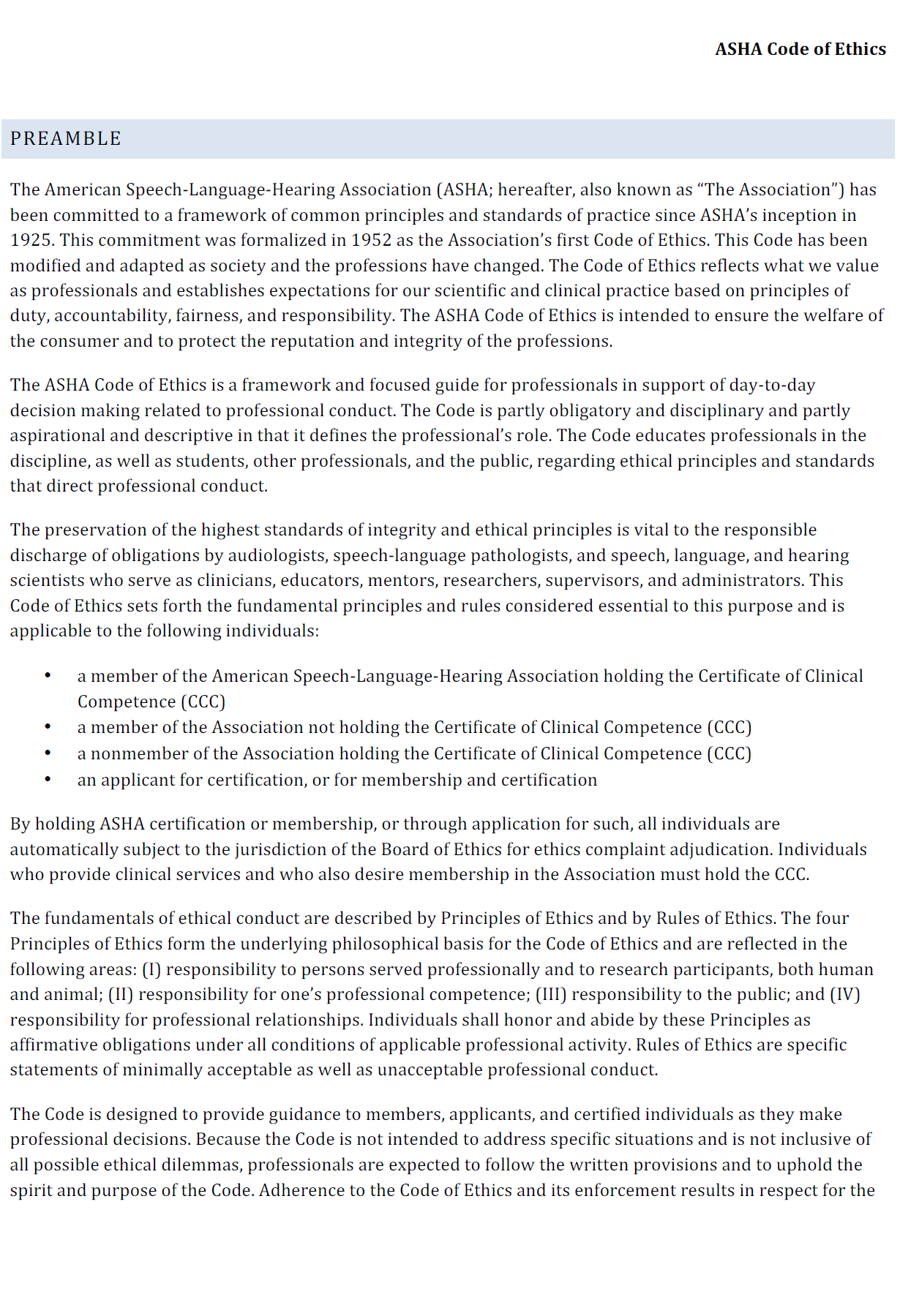
This HTML version was generated with AI assistance and may contain errors or omissions. The original approved PDF remains the official document of record. An alternative accessible format is available upon request from the document creator in accordance with Title II of the ADA.