Master of Social Work Graduate Handbook 2019-2020
Table of Contents
Tenure-Track/FERP Faculty ...............................................................................................................................
4
Full-Time Lecturers ..............................................................................................................................................
5
Part-Time Field Liasions .......................................................................................................................................
5
Department Support Staff ...................................................................................................................................
6
Title IV-E Support Staff .....................................................................................................................................
6
Where To Turn For Assistance: ..........................................................................................................................
7
Mission of the University, College, and the Department ..................................................................................
10
Program Goals .................................................................................................................................
11
The Graduate Program .................................................................................................................................
11
Accreditation .................................................................................................................................
12
Prerequisites for Admission to the MSW Program .......................................................................................
12
Graduate Curriculum .................................................................................................................................
14
Student’s Responsibilities .................................................................................................................................
14
Master of Social Work Degree Requirements ...................................................................................................
16
Course Schedule ...............................................................................................................................
17
Full-Time Graduate (2-year Program)..........................................................................................................
17
Part-Time Graduate (3-year Program) .........................................................................................................
17
Part-Time Graduate (4-year Program) ........................................................................................................
18
Field Internship .................................................................................................................................
19
Field Internship .................................................................................................................................
19
Academic Standing & Eligibility for Field ....................................................................................................
20
Field Work Placement ...........................................................................................................................
20
Graduate Program Information .........................................................................................................................
21
Academic Advisors .................................................................................................................................
21
Academic Policies .................................................................................................................................
21
Standards of Scholarship ..............................................................................................................................
21
Academic Probation & Disqualification .......................................................................................................
21
Declaring your Status ...........................................................................................................................
21
Graduate Writing Requirement Policy ..........................................................................................................
22
Advancement to Candidacy: .........................................................................................................................
22
SWRK 298 Project/SWRK 299 Thesis: ..........................................................................................................
22
Graduation: .................................................................................................................................
22
Time Limit/Extension of Time ........................................................................................................................
23
Continuous Enrollment .................................................................................................................................
23
Transfer of Credit .................................................................................................................................
23
Graduate Credit for Work Experience...........................................................................................................
24
Course Repetition .................................................................................................................................
24
Leaves of Absence .................................................................................................................................
24
Withdrawal from Courses .............................................................................................................................
25
Withdrawal from the Program ......................................................................................................................
25
Withdrawal from the University ....................................................................................................................
25
Readmission .................................................................................................................................
26
Performance That May Result in a Student Review ......................................................................................
26
Academic Grievances ...........................................................................................................................
26
Policies and Procedures for Review .............................................................................................................
26
Access to Student Records .............................................................................................................................
26
Plagiarism and Academic Cheating ..............................................................................................................
27
Pupil Personnel (PPS) Credential Program .................................................................................................
27
Title IV-E Child Welfare Stipend Program ....................................................................................................
28
Graduation Application Procedures ..................................................................................................................
28
Master’s Degree Clearance ..........................................................................................................................
28
University Facilities .................................................................................................................................
28
Henry Madden Library .................................................................................................................................
28
University Computer Labs ............................................................................................................................
28
Standards of Conduct .................................................................................................................................
29
Standards of Student Conduct .......................................................................................................................
29
Standards of Faculty Conduct .......................................................................................................................
29
Student Organizations .................................................................................................................................
30
Social Work Student Association ...................................................................................................................
30
African American Student Social Work Association ......................................................................................
30
Trabajadores de la Raza ...............................................................................................................................
30
Asian Social Work Student Organization ......................................................................................................
30
Chi Nu Honors Society .................................................................................................................................
30
Student Services .................................................................................................................................
31
Services for Students with Disabilities ..........................................................................................................
31
Employment & Career Services ....................................................................................................................
31
Health and Medical Care ..............................................................................................................................
31
Health Insurance .................................................................................................................................
31
Housing.................................................................................................................................
31
International Student Services and Programs ...............................................................................................
32
Graduate Writing Studio ..............................................................................................................................
32
Alumni Association ..............................................................................................................................
32
APPENDIX I .................................................................................................................................
33
Graduate Writing Requirement Policy..............................................................................................................
35
Introduction .................................................................................................................................
35
Exam Procedure ...........................................................................................................................
35
Grievance Procedure ............................................................................................................................
35
Guidelines for Enhancing Graduate Student Performance ...............................................................................
36
Scholarship .................................................................................................................................
36
Integrity .................................................................................................................................
37
Personal Responsibility/Self-Directed Learning ...........................................................................................
37
APPENDIX II ............................................................................................................................
39
Social Welfare Policy and Services ...............................................................................................................
39
Human Behavior and the Social Environment ..............................................................................................
39
Social Work Research ...........................................................................................................................
39
Social Work Practice .............................................................................................................................
40
Culminating Experience ...............................................................................................................................
40
Field Practicum ............................................................................................................................
41
2019-2020 Program Deadlines .........................................................................................................................
42
FALL SEMESTER ...............................................................................................................................
42
SPRING SEMESTER ..........................................................................................................................
43
Forms and the Signatures needed: ....................................................................................................................
44
EMERGENCY INFORMATION .....................................................................................................................
45
PLEASE NOTE: This handbook is updated regularly to best meet the needs of students,
faculty, and staff.
Tenure-Track/FERP Faculty
Martha Vungkhanching, Ph.D.
Department Chair
Professor
Room: PHS 128
Phone: 559.278.8741
Irán Barrera, Ph.D., L.C.S.W.
Graduate Coordinator
Professor
Room: PHS 149
Phone: 559.278.0398
Travis Cronin, Ph.D.
BA Program Coordinator
Assistant Professor
Room: PHS 138
Phone: 559.278.0064
Andrea Carlin, M.S.W., L.C.S.W.
Field Coordinator | PPS Coordinator
Room: PHS 128
Phone: 559.278.3039
Benita Washington
BA Field Coordinator
Room: PHS 128
Phone: 559.278.6151
Marcus Crawford, Ph.D.
Assistant Professor
Room: PHS 147
Phone: 559.278.6088
Nancy Delich, Ed.D, L.C.S.W.
Assistant Professor
Room: PHS 144
Phone: 559.472.9917
Betty Garcia, Ph.D., L.C.S.W.
Emerita Professor
Room: PHS 143
Phone: 559.278.2550
Debra Harris, Ph.D.
Emerita Professor
Room: PHS 146
Phone: 559.278.2966
Dheeshana Jayasundara, Ph.D.
Associate Professor
Room: PHS 142
Phone: 559.278.6109
Gyanesh K. Lama, Ph.D.
Associate Professor
Room: PHS 140
Phone: 559.278.0397
Sal Montana, Ph.D.
Associate Professor
Room: PHS 145
Phone: 559.278.8581
Randall Nedegaard, Ph.D.
Associate Professor
Room: PHS 148
Phone: 559.278.6129
Roger Simpson, Ph.D.
Associate Professor
Room: PHS 141
Phone: 559.278.5385
Helen Miltiades, Ph.D.
Gerontology Program Coordinator
Professor
Room: PHS 107A
Phone: 559.278.7253
Full-Time Lecturers
Cheryl Whittle, Ph.D., L.C.S.W.
Title IV-E Coordinator
Room: PHS 115
Phone: 559.278.8687
Maggie Armistead, M.S.W.
Title IV-E BA Coordinator
Field Liaison/Instructor
Room: PHS 115
Phone: 559.278.6851
Christopher Cole, M.S.W.
Field Liaison/Instructor
Room: PHS 115
Phone: 559.278.6698
Daniel Espinoza, M.S.W.
Field Liaison/Instructor
Room: PHS 115
Phone: 559.278.1663
Frankie Freitas, M.S.W.
Field Liaison/Instructor
Room: PHS 115
Phone: 559.278.1635
Estella Saldivar, M.S.W.
Field Liaison/Instructor
Room: PHS 115
Phone: 559.278.8494
Eleanor Speakes, M.S.W., P.P.S.C.
Field Liaison/Instructor
Room: PHS 115
Phone: 559.278.6485
Yeng Xiong, M.S.W.
Field Liaison/Instructor
Room: PHS 115
Phone: 559.278.6846
Bee Yang, M.S.W.
Field Liaison/Instructor
Room: PHS 115
Phone: 559.278.6489
Part-Time Field Liasions
Hao Ho, M.S.W.
Field Liaison/Instructor
Room: PHS 115
Phone: 559.278.3076
Teri Collet, MSW, LCSW
Field Liaison/Instructor
Phone: 209.681.5226
Monica Strambi
Field Liaison/Instructor
Phone: 559.375.2346
Department Support Staff
Claudia Ceja
Field Internship Office Administrative Assistant
Room: PHS 128
Phone: 559.278.5260
Michele Falk
Graduate Administrative Support Assistant
Room: PHS 128
Phone: 559.278.7076
Christi Smith
Administrative Support Coordinator
Room: PHS 128
Phone: (559)559. 278-8.6824
Title IV-E Support Staff
Pearl Fraijo
Administrative Support Assistant, Title IV-E
Room: PHS 115
Phone: 559.278.3076
Kayla Hurd
Clerical Assistant, Title IV-E
Room: PHS 115
Phone: 559.278.3076
Juan Rivera
Administrative Support Coordinator, Title IV-E
Room: PHS 115
Phone: 559.278.8166
Where To Turn For Assistance:
| For Help With: | Contact: |
|---|---|
| Academic Questions or Issues | Designated Department Academic Advisor |
| Address Change (notification of) | Graduate Administrative Assistant, (PHS-128) 559.278.3992; MyFresnoState Portal under “Personal Information” |
| Below is information on which faculty to contact regarding issues or concerns that you may have. The list shows who to contact first and who to contact after that, if needed. |
|
| Course Selection | Designated Department Academic Advisor |
| Educational Problems | 1) Course Instructor & Academic Advisor; 2) Graduate Coordinator; 3) Department Chairperson |
| Employment *Job Leads *Resume Preparation *Reference from School |
Career Services, Thomas Admin Bldg. 559.278.2381 Career Services, Thomas Admin Bldg. 559.278.2381 Your Academic Advisor |
| Field Instruction Issues | 1) Your Field Instructor &/or Faculty Liaison, 2) Academic Advisor; 3) Field Coordinator 559.278.3992 |
| Financial Aid | Financial Aid Office, Joyal Admin. North Lobby 559.278.2182 |
| Graduation Requirements and Deadlines | Dr. Irán Barrera, Graduate Coordinator PHS Room 149 Phone: 559.278.0398 irbarrera@csufresno.edu Michele Falk MSW Administrative Assistant PHS Room 128 Phone: 559.278.7076 |
| Division of Research & Graduate Studies, Thomas Building Room 132 www.fresnostate.edu/gradstudies 559.278.2448 |
|
| Grievances | 1) Course Instructor; 2) Academic Advisor; 3) Department Chair – 559.278.3992 |
| Health and Psychological Services | Student Health Center, 559.278.2734 http://www.fresnostate.edu/studentaffairs/issp |
| Housing | University Courtyard (Housing) Residence Atrium, 559.278.2345 |
| Leave of Absence Request | See page 23 for Information |
| Medical Emergencies and Concerns | Student Health Center, 559.278.2734 |
| Personal Challenges | Your Academic Advisor; Student Health Center 559.278.2734 |
| Special Services International Students |
International Student Services and Programs 5150 N. Maple Ave. M/S JA 56 Fresno, CA 93740 559.278.2409 International Student Services and Programs 5150 N. Maple Ave. M/S JA 56 Fresno, CA 93740 559.278.2782 |
| Students with Disabilities | Services for Students with Disabilities, 559.278.2811, Madden Library 1201 |
| Veterans | Veterans Certification, Joyal Admin., Rm. 106 559.278.7030 |
| Sexual Assault/Sexual Harassment | Campus Police, Public Safety Bldg. 559.278.8400 Human Resources, Rm. 211 Joyal Administration Building 559.278.2364 |
Mission of the University, College, and the Department
The university, as an urban and rural-regional institution, is dedicated to the development of competent students, citizens, and leaders through the provision of comprehensive Bachelor’s and Master’s degree programs. As a publicly supported institution, the university also has a special mission to serve students from groups that historically have not participated in university education, whether because of age, gender, ethnicity, socioeconomic background, physical disability, or geographic location. Similarly, the College of Health and Human Services seeks to provide professional education in health and human services for students pursuing either Bachelor’s or Master’s degrees and for those professionals in the community who have continuing education needs. The mission of both the university and the college includes the recognition of the unique service area within which they are located; thus, the primary institutional effort is directed to the higher education needs of the eight county region of the San Joaquin Valley. The Department of Social Work is specifically committed to the education of social workers at the bachelor’s and Master’s levels who will provide social welfare services and leadership within the central San Joaquin Valley. Graduates of both programs intervene with individuals, families, groups, and other small systems as well as with human service agencies, voluntary organizations, neighborhoods, and communities. The department is committed to enhancing both the quality of life in the region and the capacity of citizens to identify and address their own social welfare and social justice concerns and needs.
Departments Vision, Mission and Values Statement
Vision
We seek a society that is respectful, culturally inclusive, compassionate, and just.
Mission
To prepare our students for service and leadership in the Central Valley and globally
in order to dismantle systemic oppression through relationship building, dialogue,
advocacy, and empowered collective action.
Values
We commit to prioritizing and modeling the following values and have them guide our
interactions with our colleagues, students and communities, how we carry out our mission
and vision, make program decisions, and the curriculum we teach:
• Social Justice
• To engage in and promote fair and equitable treatment of all people, all the time,
in all places.
• Diversity
• To demonstrate respect for differences and practice inclusion.
• Empowerment
• To leverage shared resources to facilitate capacity building and promote human rights.
• Leadership
• To promote forms of leadership that practice the qualities of humility, integrity,
teamwork, respect, pro-action, critical thinking, and empathy.
• Dialogue
• To facilitate interactions in which individuals and communities are invited to listen
and speak authentically, respectfully, and boldly.
Program Goals
The goals of the program are:
1. To educate beginning level generalists (BA) and advanced (MSW) social work practitioners
to serve the surrounding region of the university, focusing primarily on the Central
San Joaquin Valley.
2. To educate generalist and advanced social work practitioners to practice with a
commitment to social justice. A commitment to social justice involves the ability
to:
a) Critically analyze social problems or conditions and existing or proposed policy
responses;
b) Recognize individual and institutionalized forms of oppression; and
c) Participate in social action to correct injustices, fight oppression, and promote
social welfare for all.
3. To educate generalist and advanced social work practitioners to practice with diversity
awareness and develop culturally competent practice skills. Diversity awareness and
culturally competent practice refers to the ability of a practitioner to:
a) Identify, understand, and celebrate differences that exist among individuals with
respect to race, ethnicity, religion/spirituality, sexual orientation, physical or
mental disability, age, gender, socioeconomic background, and other key features of
human experiences; and
b) Intervene with sensitivity to and respect for these differences, utilizing cardinal
social work values and specific diversity/cultural knowledge and skills.
4. Practice within an empowerment perspective. The empowerment perspective implies
active collaboration with the client system in an atmosphere of equality and mutuality.
The goals of the intervention include maximizing social support and a balance between
self-sufficiency and interdependency, which are premised on a strengths-based approach.
The undergraduate program prepares baccalaureate students for beginning generalist
social work practice in public and private agencies. The graduate program prepares
students for advanced autonomous social work practice with a special focus on multisystem
practice roles, skills and methods of intervention.
Both programs prepare graduates to provide social work services in a region characterized
by enormous social, cultural, and economic diversity. The widespread poverty, population
growth, and demographics characterized by many oppressed groups (e.g., persons with
disabilities, ethnic communities, refugees) in Central California create complex and
constantly shifting service needs. The context for this practice is a unique urban-rural
configuration of people, agribusiness, social-political institutions in transition,
and a host of social service needs. Accordingly, the Department educates advanced
Master’s level practitioners who can meet complex needs, perform a multiplicity of
social work roles, promote institutional change, and enhance the problem-solving capacities
of individuals, families, groups, organizations, and communities.
The Graduate Program
The profession of social work and the Department of Social Work Education is dedicated to meeting the social service needs of diverse and often marginalized populations of individuals, families, groups, organizations, and communities. The graduates of our program deal with social concerns that range from societal oppression to the emotional/behavioral problems of individuals. The social work practitioner who is educated in our program is taught to help at-risk populations which typically include people of color, women, people who are recent refugees, elders, poor and/or homeless, children and adults who are abused/neglected, and people who have chronic mental illness, developmental disabilities, physical illnesses or disabilities, substance use issues, or who engage in criminal activities. In focusing on marginalized groups, the student is educated in the use of an expansive repertoire of practice skills and methods to serve individuals, families, groups, communities, and organizations for the purpose of promoting well-being, personal growth, and social justice. These skills include policy advocacy, brokering, consultation, individual, family, and group work, mediation, research, supervision, and education.
Social work is deeply rooted in a rich, 100-year history of service; the role of the professional social worker is not limited or traditionally defined. The role of the social worker is constantly expanding into new and innovative service fields as a compassionate response to human need when indicated. Graduates of our program will typically find employment in several fields of practice that include, however are not limited to, the following: child welfare/protective services worker, alcohol/substance abuse counselor, school social worker, mental health/family services practitioner, medical/rehabilitation worker, juvenile/adult justice worker, program developer, agency manager/administrator, volunteer coordinator, employee assistance program coordinator/worker, grassroots community organizer, and/or legislative advocate.
The Master’s degree in social work (MSW) offered by our department is designed to prepare advanced social work practitioners for autonomous practice. They will obtain the values, knowledge and skills to meet complex client needs within diverse public and private human service settings and perform in a variety of roles using multiple social work practice methodologies. The goal of this course of study is to prepare the student learner for advanced social work practice at multiple levels of intervention as well as for possible doctoral study in social work and related human service professions.
Accreditation
California State University, Fresno is fully accredited by the California Board of Education, Western Association of Schools and Colleges (WASC), and the National Council for Accreditation of Teacher Education (NCATE). Both the undergraduate and graduate programs in social work are fully accredited by the Council on Social Work Education (CSWE).
Prerequisites for Admission to the MSW Program
The MSW applicant must have a four-year bachelor’s degree from an accredited college or university. The BA or BS degree may be in any major; the applicant’s overall academic record must show evidence of a liberal arts foundation. A student’s prior coursework in the liberal arts is expected to promote the development of an educational perspective, values, and abilities necessary for professional social work practice. This liberal arts underpinning provides theoretical perspectives that facilitate understanding of factors that influence human behavior such as human biology, psychology, sociology, political science, economics, history, and encompasses the natural and physical sciences, arts and humanities, and social sciences. Undergraduate general education requirements commonly provide much of this liberal arts base. Note this requirement DOES NOT require you to have a “Liberal Arts or Liberal Studies” major.
Applicants must have completed the general education requirements at Fresno State
or similar requirements at another institution and completed at least one course,
each, on:
1) Human development and health issues over the life span,
2) Research Methods/Data analysis (qualitative or quantitative), and
3) An upper division course in ethnic/cultural diversity systems or women’s studies.
Applicants to the MSW program do not have to complete all prerequisites during the application process. If an applicant is offered a conditional admission to the MSW program, all prerequisites must be met before the beginning of the Fall semester in which they are to enroll. Failure to complete the prerequisites before the Fall semester will result in admission being revoked.
To inquire whether a course you have already taken meets one of the requirements listed above, you should make your request to the MSW Graduate Coordinator at 559.278.3992. You will be asked to provide a copy of the course syllabus and transcripts. You may also verify your courses through www.assist.org.
Graduate Curriculum
The MSW curriculum in the Department of Social Work Education undergoes ongoing modification in response to changes in societal conditions and professional practice and to new developments in knowledge and theory. The course of study, whether full or part-time, focuses on a multisystem approach that includes advanced social work practice with individuals, families, groups, organizations and communities. This is organized and delivered on a semester basis with a concurrent classroom-field model of instruction. Thus, full and part-time students have specific days each week devoted to classroom instruction complemented by two to three days of the week exclusively designed for field/practicum instruction. Students must plan for two 9-month field/practicum internships scheduled during weekdays between 8 am – 5 pm over the course of the program. Courses ARE NOT offered online or at off-campus locations.
Our curriculum is designed to prepare social workers for agency and community-based practice; these social worker-citizens are informed, compassionate and proactive in response to human needs. Three important dimensions of our program’s mission include the development of 1) a commitment to social justice, 2) diversity awareness and culturally competent practice, and 3) an empowerment perspective. These three goals of social work education are equally important to practice at all levels of intervention, with individuals, families, small groups, organizations, and communities.
Student’s Responsibilities
It is the student’s responsibility to be informed about, and participate fully in,
their program. Your responsibilities include:
• Attend the mandatory orientation for incoming MSW students.
• Know and meet/complete all degree requirements and deadlines for the MSW program
and the University. Frequently used forms may be found at websites such as www.fresnostate.edu/chhs/social-work or Graduate Studies, www.fresnostate.edu/academics/gradstudies.
• Carefully plan and balance your schedule to accommodate courses, field internship
and personal commitments.
• Attend and participate in classes.
• Obtain hard copies or access electronically, and become familiar with all relevant
curriculum/advising materials (e.g., catalog, schedule of courses, Social Work Graduate
Handbook), and become familiar with University policies and University degree requirements
relevant to Graduate Division and the Master’s in Social Work program.
• Contact the academic advisor to review your academic program and progress at least
twice during each semester while attending CSU Fresno.
• Consult with your academic advisor whenever academic or personal concerns begin
to interfere with or impede your learning or performance in the classroom or field
placement; participate in the development of a plan of action to address the problems.
Any arrangements to address course and/or internship activities require communication
with the Graduate Coordinator.
• Come prepared to advising meetings. This means reviewing the relevant catalog, Division
of Graduate Studies information and/or MSW handbook. For meetings with your Advisor
it is highly recommended that you:
• Make an appointment
• Provide an unofficial transcript or other listing of course work completed to date
AND, once advanced to candidacy, provide a copy of the most recent approved advancement
petition, and any approved adjustments, which lists all courses the student proposes
to take in their “contract” for the MSW degree,
• Prepare a list of questions and tentative plans/solutions for discussion with the
advisor,
• When needed, complete forms for your advisor’s review/signature, and
• Actively engage in problem solving/planning on your academic program.
• Maintain personal records (i.e., copies of all relevant program documents/approved
petitions) and confirm that University Evaluations; Division of Research and Graduate
Studies (Thomas Building, Room 130) files contain all essential information/documentation.
• Consult Canvas for a current advisee/faculty list (this applies only to current
students).
NOTE: Personal counseling/therapy for the student is not within the scope of the student-advisor
relationship or the academic advisor’s role and responsibilities. The advisor will,
however, make recommendations and refer the student to appropriate services and providers
within the university.
Master of Social Work Degree Requirements
REQUIREMENTS
Note: Courses and field internships are offered in fall and spring semesters only.
All students are required to take the following SWRK courses (54 units) and two electives:
200: Social Welfare Policy I (3)
203: Social Welfare Policy II (3)
212: Human Behavior and Social Environment (3)
213: Human Behavior and Social Environment: Cultural Diversity and Oppression (3)
220: Social Work Practice I (4)
221: Social Work Practice II (4)
224: Advanced Practice with Individuals (3)
225: Advanced Practice with Groups (3)
227: Advanced Social Work Practice with Couples and Families (3)
246: Advanced Practice with Formal Organizations (2)
247: Advanced Practice with Communities (3)
260: Quantitative Research (3)
261: Qualitative Research (3)
280: Foundation Field Instructed Practice I (2)
281: Foundation Field Instructed Practice II (2)
282: Advanced Field Instructed Practice I (3)
283: Advanced Field Instructed Practice II (3)
292: Seminar in Thesis/Project (2)
298: Project or 299: Thesis (2)
To complete 60 units the remaining courses, totaling 6 units, must be selected from
graduate Social Work elective courses. These are the courses that will be listed on
Advancement to Candidacy forms. Offerings may vary between Fall and Spring semesters.
Course Schedule
Full-Time Graduate (2-year Program)
Semester 1 (15 units) Semester 2 (15 units)
SWRK 200 (3) SWRK 203 (3)
SWRK 212 (3) SWRK 213 (3)
SWRK 220 (4) *** SWRK 221 (4) ***
SWRK 260 (3) *** SWRK 261 (3)
SWRK 280 (2) (T, Th) * SWRK 281 (2) (T, Th)*
Semester 3 (16 units) Semester 4 (14 units)
SWRK 224 (3) *** SWRK 227 ***(3)
SWRK 225 (3) *** SWRK 247 ***(3)
SWRK 246 (2) SWRK 298/299 (2)
SWRK 292 9 (formerly 272T) (2) Elective (3)
Elective (3) SWRK 283 ***(3) (M,W,F)
SWRK 282 (3) (MWF)* *
*16 hours per week in field agency placement
**20 hours per week in field agency placement
***courses need to be taken concurrently with field internship
Part-Time Graduate (3-year Program)
Semester 1 (9 units) Semester 2 (9 units)
SWRK 200 (3) SWRK 203 (3)
SWRK 212 (3) SWRK 213 (3)
SWRK 260 (3) SWRK 261 (3)
Semester 3 (9 units) Semester 4 (9 units)
SWRK 220 (4) *** SWRK 221 (4) ***
Elective (3) Elective (3)
SWRK 280 (2) (T, Th) * SWRK (2) (T, Th) *
Semester 5 Semester 6
SWRK 224 (3) *** SWRK 227 (3)
SWRK 225 (3) *** SWRK 247 (3) ***
SWRK 246 (2) SWRK 298/299 (2)
SWRK 292 (2) SWRK 283 (3) (M, W, F)
SWRK 282 (3) (M, W, F) **
*16 hours per week in field agency placement
**20 hours per week in field agency placement
***courses need to be taken concurrently with field internship
Part-Time Graduate (4-year Program)
Semester 1 Semester 2
SWRK 200 (3) SWRK 203(3)
SWRK 212 (3) SWRK 213 (3)
Semester 3 Semester 4
SWRK 220 (4) SWRK 221 (4) ***
SWRK 260 (3) *** SWRK 261 (3) ***
SWRK 280 (2) (T, TH)* SWRK 281 (2) (T, TH)*
Semester 5 Semester 6
SWRK 246 (2)*** SWRK 227 (3)***
SWRK 224 (3)*** SWRK 247 (3)***
SWRK 225 (3)*** SWRK 283 (3) (MWF)**
SWRK 282 (3) (MWF)**
Semester 7 Semester 8
SWRK 292 (2) SWRK 298/299 (2)
Elective (3) Elective (3)
*16 hours per week in field agency placement
**20 hours per week in field agency placement
*** Courses need to be taken concurrently with field internship
Note: Part-time students enrolled in more than 6 units pay full-time fees. Refer to
the current schedule of courses for more specific information.
Field Internship
Field instruction (SWRK 280, 281, 282, & 283) and practice classes are organized into a concurrent model (see example below). In the first year, full-time students are in the field two days a week, (i.e., 16 hrs/wk) and three days a week in the second year, i.e., 20 hrs/wk (see sample programs, above). Part-time students enter field during the second year of graduate study. Students complete a total of 1000 hours of internship in the field. This requires a minimum of 400 hours in the first year and 600 hours in the second year of field). Students are placed in a variety of human service agencies approved by the Department of Social Work Education and are located throughout the Fresno metropolitan area and the central San Joaquin Valley. All students are supervised in their practicum experience by a social worker who has a Master of Social Work degree. Included in these placements are federal, state, county and private agencies in fields of practice that include Children and Family services, Adult Services, Corrections, Health and Mental Health Programs, Gerontology, Disability Services, and Student Support Services.
Required malpractice insurance when enrolled in field internship is included in student fees. Please note that students are expected to take responsibility for arranging transportation to their field internship and for meeting any costs involved. Most field sites are within a 90 mile radius of the campus. Unless prevented by law or agency policy, agencies are encouraged to support or reimburse student travel expenses for assigned service activities undertaken during the field internship hours.
Internships are scheduled almost exclusively on weekdays between 8 a.m. to 5 p.m. for both full and part-time students. Weekends and evening placements are rarely available or feasible. Students need to plan to adjust their work schedules accordingly.
Practice courses must be taken concurrently with field internship SWRK 280/281/282/283
and in the following sequence:
Full-Time Schedule
1st semester, SWRK 280 SWRK 220
2nd semester, SWRK 281 SWRK 221
3rd semester, SWRK 282 SWRK 224, 225, 246
4th semester, SWRK 283 SWRK 227, 247
Part-Time Schedule
Schedule: Options 3 & 4 Year
3rd semester, SWRK 280 SWRK 220
4th semester, SWRK 281 SWRK 221
5th semester, SWRK 282 SWRK 224, 225, 246
6th semester, SWRK 283 SWRK 227, 247
Academic Standing & Eligibility for Field
All graduate students are required to maintain a minimum GPA of “B” (3.0). Any MSW student whose GPA drops below a 3.0 will not be permitted to enroll in field placement (SWRK 280/281/282/283) or the concurrent practice classes (SWRK 220, 221, 224, 225, 227, 246, 247) until they have established an academic plan to return to good standing. Students who do not maintain a 3.0 GPA will be notified of their academic standing (i.e., academic probation) and will be referred to their faculty advisor for academic planning. If you know your GPA has fallen below a 3.0, or will do so at the end of the semester, you should immediately contact your advisor to develop a plan to return to good academic standing. A Cumulative GPA, or program GPA once advanced to candidacy, below 3.0 in any 2 semesters will result in disqualification from the Program and the University.
Field Work Placement
Placements are made by the Field Coordinator and Assistant Field Coordinator after consideration of student preferences, educational needs, and agency capacity.
All related field agency placement information, forms and policies can be accessed by following the link to our department website: http://www.fresnostate.edu/chhs/social-work/
Graduate Program Information
Academic Advisors
Each student in the Graduate Program is assigned an academic advisor who assists with course selection and general educational planning. Advisors also meet with their advisees periodically to monitor and assess academic progress, professional development, and the field practice experience. You can find your advisor’s name and contact information on your Fresno State Portal at my.fresnostate.edu and in Canvas.
Academic Policies
The chief consultative body responsible for formulating and recommending policies, standards, and procedures is the University’s Graduate Committee. This committee is composed of eight faculty members elected by the faculty, one graduate student member, and the Graduate Dean.
Standards of Scholarship
All graduate students will be held to the scholarship standards listed in the Academic
Regulations (http://fresnostate.edu/catalog/academic-regulations/index.html in the University catalog). The following provisions also apply to Master’s degree
programs:
• A student admitted to a Master’s degree program in conditionally classified or classified
graduate standing is required to maintain a minimum grade point average of B (3.0)
on all work taken subsequent to admission to the program.
• No course with a grade below C may apply to an approved program for the Master’s
degree. With the exception of field internship, all courses (on an approved MSW program
must be taken for a letter grade.
Academic Probation & Disqualification
According to University policy, an MSW (graduate) student is immediately disqualified from the University and program when his/her GPA falls below 2.0. A student whose GPA falls below 3.0, but is above 2.0, is placed on academic probation. A student who is placed on academic probation for any 2 semesters) will be disqualified from the University and program; the two semesters need not be consecutive. A disqualified student who wishes to re-enroll in the university and program MUST file a Petition for Re-Admission with the MSW program in the Department of Social Work Education. Upon being placed on academic probation or disqualification, you MUST consult your academic advisor. For further information, refer to the Department of Social Work Education Policy on Academic Probation and Disqualification in the Handbook appendices.
Declaring your Status
Once admitted into the MSW program, you must declare your status and return your MSW Letter of Intent. Please take into consideration that once you have declared your status in your application, you may not change your Full Time/Part Time status. If there is an outstanding reason as to why you would like to change your status, the change will have to be reviewed by both the MSW Coordinator and the Department Chair. You must submit your request in writing along with any supporting documentation to the MSW Coordinator. Keep in mind that regardless of the rationale for your request to change your status, the Department may not be able to respond to your request, based on administrative factors. DO NOT make any changes to your status without prior MSW Coordinator/Chair approval.
Graduate Writing Requirement Policy
Upon entering the program, ALL graduate students must meet the University graduate
writing requirement. A writing exam will be administered early in the Fall semester
of the MSW program. Refer to the Department’s Graduate Writing Requirement policy
in the Handbook appendices.
http://fresnostate.edu/academics/gradstudies/documents/forms/gwr.pdf
Advancement to Candidacy:
After completing 9 units in the program, a student must petition to advance to candidacy.
To be eligible for advancement to candidacy, a student must have:
1. Achieved classified standing (cleared any conditions of admission)
2. Earned at least a B average at the California State University, Fresno MSW program.
This refers to all coursework completed after the date of embarking on the first course
to be included in the Master’s degree program, and
3. Passed the graduate writing requirement.
The Advancement to Candidacy form requires that you list by name/number/semester/year
for all courses you have taken or plan to take to fulfill the requirements of the
MSW. This is your contract. If you subsequently decide to take different courses or
take the courses in different semesters, you will need to file a “Program Adjustment”
form. To be granted your degree, the plan approved on the “Advancement to Candidacy”
and your transcript must match exactly. You must type your Advancement to Candidacy
petition; The Graduate Studies office will reject any handwritten or incomplete petitions.
The template can be found here: http://www.fresnostate.edu/academics/gradstudies/forms/atc.html.
SWRK 298 Project/SWRK 299 Thesis:
To be eligible for enrollment in the thesis or project, a student must have been advanced to candidacy and maintained a minimum overall Fresno State and program grade point average of B (3.0). In the MSW program, you must also have successfully completed Social Work 292.
Graduation:
To be eligible for the granting of the Master’s degree, a student must have submitted
an Advancement to Candidacy form and maintained a B (3.0) average in all courses,
beginning with the first term listed on the Petition of Advancement to Candidacy.
In addition, grades must be posted in all courses taken, including those that are
not part of the student’s approved program, beginning with the earliest semester or
summer term listed on the Petition of Advancement to Candidacy. Students may not graduate
with an “I,” “RD,” or “RP” in any course on their records, beginning with the earliest
semester/term listed on the advancement petition.
To be eligible to receive the Master’s degree with distinction, a student must have
earned at least a 3.9 grade point average on all coursework taken from the first semester
of the approved Master’s degree program. A minimum GPA of 3.9 must also be attained
on the approved program to qualify. This honor appears on the graduate’s diploma and
is determined after the final semester grades are posted; this information is not
available at graduation.
University graduation registration is completed online at:
http://fresnostate.edu/commencement/students/graduation-application.html.
Time Limit/Extension of Time
Exclusive of prerequisite coursework, a period of five years is allowed for the completion
of all requirements for the Master’s degree. This time limit is indicated for each
student on the approved advancement to candidacy petition. A student whose program
has been interrupted by military service should consult the dean of the Division of
Research and Graduate Studies about provisions for military extensions. Outdated coursework
will not be approved for inclusion on the Petition of Advancement to Candidacy at
the time formal approval of the petition is granted. Those courses completed more
than five years before the date for completion of all requirements for the master’s
degree cannot be used to meet total unit requirements except through validation as
follows:
Out-of-date coursework may be validated only if such work was taken at California
State University, Fresno, and has been approved previously on this Petition of Advancement
to Candidacy. A maximum of one-third of required degree units may be validated, by
such means as are recommended by the Department and approved by the Graduate Dean.
Coursework from other institutions are not eligible for validation.
For more information on current validation, please check the Department of Research
and Graduate Studies website at: http://fresnostate.edu/academics/gradstudies/prospectivestudents.
Continuous Enrollment
University policy requires graduate students to be continuously enrolled at the university: (1) while completing a grade of RP in either thesis or project, or a grade of RP or I in any other course; (2) while preparing to take a comprehensive examination; or (3) during the semester in which an application for the degree to be granted is filed. This policy does not apply to students who are either enrolled in a course for a letter grade (regular registration) or who have been officially granted a planned educational leave of absence. All students must maintain continuous enrollment during all fall and spring semesters, and during any summer term in which they apply to graduate. To maintain the required enrollment, students must enroll SWRK 298C (Project) or SWRK 299C (Thesis) in Graduate Studies Continuation through regular university enrollment.
Transfer of Credit
Transfer credit may be used toward a California State University, Fresno MSW degree
only if the institution offering the work is accredited by the Council on Social Work
Education and would accept the work for a comparable MSW degree program. The transfer
credit institution must also have listed the units as post-baccalaureate graduate
units on the student’s transcript. Credit at California State University, Fresno will
be granted if it is judged by appropriate University authorities to be particularly
relevant to the individual student’s program. If you feel you are eligible for a transfer
of credit, please email the graduate coordinator (copy the graduate administrative
assistant) and follow these directions in writing. Please recognize that any missing
information will cause a delay or jeopardize this review process.
In detail please describe/identify the following:
1. Course(s) you are wanting transferred
a. Provide transcripts
b. Course syllabus
c. Any other relevant materials to make your case
2. Course you think it waives from our DSWE (Fresno State-MSW)
3. Evidence that the course(s) may be used toward a graduate degree at that institution
4. Course numbering and grading systems
5. Identify if the school is on the quarter or semester system
6. Any other materials that will support the transfer of credits
Graduate Credit for Work Experience
The Department does not award graduate credit for work experience or life experience.
Course Repetition
A post-baccalaureate student pursuing a graduate degree may repeat a course for academic credit regardless of what grade was originally earned in the course. However, such a student is not eligible to petition for grade substitution. All coursework taken, beginning with the first term of the student’s Master’s degree program, is used in determining the student’s grade point average and graduation eligibility.
Leaves of Absence
A student may request a leave of absence by completing and submitting to the DSWE the “Intent to Withdraw from the MSW Program” form and a letter that outlines the reason for requesting a leave and the student’s plan for returning to the program to complete his/her degree. The request needs to be approved by the Graduate Coordinator and the Department Chair. The leave may not exceed two semesters. Such a leave DOES NOT change the five-year time limit for completion of the degree. Students must reapply for admission to the university after a break in enrollment.
The University leave of absence request can be found at:
http://www.fresnostate.edu/studentaffairs/registrar/documents/forms/records/Planned_Educational_Leave_Request.pdf.
The Department form for intent to withdraw can be found at:
http://fresnostate.edu/chhs/social-work/documents/IntentWithdraw.pdf
NOTE: Students are subjected to the 5 year term limit. Please check with University
Graduate Admissions for further details: http://fresnostate.edu/academics/gradstudies/faculty/fachandbook.html.
A student who fails to maintain continuous enrollment in the MSW program and who has
not filed a formal request for a leave from the program and Plan for Completion is
automatically (administratively) dismissed from the program for discontinuous enrollment.
They must apply for reinstatement to the program; see readmission, below.
University: A planned educational leave for graduate students must be recommended
by the Dean, Division of Graduate Studies. Information is available at the Division
of Research and Graduate Studies, Thomas Building, Room 130.
http://www.fresnostate.edu/studentaffairs/registrar/documents/forms/records/Planned_Educational_Leave_Request.pdf
Withdrawal from Courses
Through the fourth week of instruction, a student may drop courses without a serious and compelling reason. After the fourth week of instruction, a student may drop a course only for a serious and compelling reason that makes it impossible for the student to complete course requirements. A serious and compelling reason is defined as a medical, emotional, or other condition acceptable to and verified by the Dean of the college/school in which the course is offered. During the final three weeks of instruction, dropping an individual course is not permitted unless special approval is given by the registrar in cases such as accident or illness where the cause of the drop is due to circumstances beyond the student’s control. If the student has completed a significant portion, that is two thirds of the required coursework, incomplete grades can be assigned.
Withdrawal from the Program
A student may formally withdraw from the program by submitting a memo to this effect to the graduate coordinator; they must also withdraw from the university. A student is administratively withdrawn from the program if they is dismissed for discontinuous enrollment. In order to return to the program, the student must file a new application for readmission with the program and the university (see next item). The Department form for intent to withdraw can be found at: http://fresnostate.edu/chhs/social-work/documents/IntentWithdraw.pdf
Withdrawal from the University
A student may completely withdraw from all courses up to the last three weeks of instruction.
Complete withdrawal is only permitted during the last three weeks of instruction in
cases such as accident or serious illness, where the cause of withdrawal is due to
circumstances clearly beyond the student’s control. If a student withdraws through
the first four weeks of instruction, only the date of withdrawal is posted on the
permanent record. If the student withdraws after the first four weeks, a “W” is posted
for each class as well as the official date of withdrawal. For purposes of subsequent
registration and catalog determination, students are considered as having been enrolled
for that semester. Consult the current Schedule of Courses for specific withdrawal
instructions, procedures and deadlines. When a student withdraws from the university,
they must also withdraw from the program. The University form for withdrawal can be
found at:
http://www.fresnostate.edu/studentaffairs/registrar/documents/forms/records/Drop_Withdrawal_Form.pdf
Readmission
A student who has withdrawn from the Master of Social Work Program or who has been dismissed for discontinuous enrollment must file a new application for admission to the program and the university. Under this new application review, readmission is not guaranteed. Contact the MSW Graduate Coordinator, who is also the Admissions Chair for details.
Performance That May Result in a Student Review
Student reviews can occur under any of the following circumstances:
• Failure to meet or maintain academic requirements
• Scholastic dishonesty, including cheating, lying, plagiarism, collusion, falsifying
academic records, or any act designed to give unfair advantage to the student. (Faculty
must adhere to university guidelines on reporting such incidents. For complete University
policy and procedures, see the California State University, Fresno General Catalog,
Policies and Regulations).
• Behavior judged to be in violation of the current NASW Code of Ethics
• Behavior judged to be in violation of the university Policies and Regulations (see
University catalog)
• Any threat or attempt to harm oneself or someone else
• Commission of a criminal act that is contrary to professional practice
Academic Grievances
The student must first make a good faith effort to resolve the matter informally by talking directly with the individual concerned (e.g., the course instructor, teaching assistant, field supervisor, liaison); the matter should then be discussed with the academic advisor and then may be brought to the Department chair, and the College/school dean. The student must make a written request presenting the details of the issue and provide any supporting documentation. If resolution is not reached through Departmental procedures, students should contact the Office of the Vice President for Student Affairs and Dean of Students. Grievances must be filed no later than the semester following the incident(s) in question. See also University policies/Student affairs, 278.2541.
Policies and Procedures for Review
Information disclosed during student meetings with faculty, program coordinators, or school administrators will be shared with other appropriate personnel if the information raises concerns about professional performance. Faculty and program administrators will share pertinent information with each other for the professional purpose of identifying student issues and enhancing problem solving about the concerns. They will follow University procedures related to student performance issues.
Access to Student Records
Statute and regulations govern access to student records maintained by the campus and the release of such records. The law provides that the campus must give students access to records directly related to the student, and must also provide opportunity for a hearing to challenge the records if the student claims they are inaccurate, misleading, or otherwise inappropriate. The right to a hearing under this law does not include any right to challenge the appropriateness of a grade determined by the instructor (see academic grievance, above, for details). The law generally requires the institution to receive a student’s written consent before releasing personal identifiable data about the student. The institution has adopted a set of policies and procedures governing implementation of the statute and the regulations. Copies of these policies and procedures may be obtained at the Office of the Vice President for Student Affairs and Dean of Students. The vice president for Student Affairs and dean of students is the custodian of all student records maintained by the university. Students may inspect the contents of their academic records in the Department by making an appointment with the Graduate Coordinator.
Plagiarism and Academic Cheating
Plagiarism is the unacknowledged use of another person’s labor, ideas, words, or assistance. Normally, all work done for courses—papers, examinations, homework assignments, oral presentations is expected to be the individual effort of the student presenting the work. Any assistance must be reported to the instructor. If the work has entailed consulting other resources—journals, books, or other media—these resources must be cited in a manner appropriate to the course. It is the instructor’s responsibility to indicate the appropriate manner of citation. Everything used from other sources, including suggestions for organization of ideas, ideas themselves, or actual language, must be cited. Failure to cite borrowed material constitutes plagiarism. Academic cheating is generally, the thwarting or breaking of the general rules of academic work or the specific rules of individual courses. It includes falsifying data; submitting, without the instructor’s approval, work in one course which was done for another; helping others to plagiarize or cheat from one’s own or another’s work; or actually doing the work of another person. (See General Catalog, Policies and Regulations, Code of Academic Integrity/Honor Code.)
Financial Aid
You may access the Graduate Studies Financial Aid website for the most up-to-date
information on scholarships, fellowships, grants, and awards.
http://www.fresnostate.edu/academics/gradstudies/financial/typesoffinancialaid.html
Department of Social Work Education Programs
Pupil Personnel (PPS) Credential Program
The PPS credential program prepares social workers to "perform services to children, parents, school personnel and community agencies to promote a school environment responsive to the needs of children and to plan educational programs which will prepare children to function in a culturally diversified society" (CA Ed Code 44046). The program is designed to maximize the integration of theory and classroom knowledge with field instructed practice in the schools. This curriculum model ensures that students experience the breadth and depth necessary to be prepared for social work practice in the public schools. The Department of Social Work Education, in conjunction with the Kremen School of Education and Human Development, recommends candidates for a PPS credential who have met all of the requirements of the MSW and PPS credential programs. This credential authorizes the holder to provide school social work and child welfare and attendance services as an employee of a K-12 public school in the state of California. http://fresnostate.edu/chhs/social-work/degrees-programs/graduate/pps.html
Title IV-E Child Welfare Stipend Program
The CalSWEC Title IV-E Child Welfare Program provides a two-year stipend of $18,500
per year to full-time MSW students who are preparing for professional social work
careers in public child welfare. Students incur a “two year” pay back commitment.
http://fresnostate.edu/chhs/social-work/title-ive/index.html/
Graduation Application Procedures
Before filing a “Master’s Degree Graduation Application,” a student must have achieved
classified standing and have:
1. An approved “Petition of Advancement to Candidacy” on file in the Division of Graduate
Studies.
2. A minimum grade point average of 3.0 on all work applied to their MSW program.
3. Completion or in process of completing all courses as listed on your final plan
on the petition of “Advancement to Candidacy.” If you have deviated from this plan
you must file a “Program Adjustment” petition.
4. No outstanding incompletes (I) in coursework or missing grades (e.g., RP, RD).
5. No outstanding fees/charges.
All procedures related to graduation will be performed online, including payment.
Students will receive an email regarding these procedures. All requirements must be
met or the student will not graduate and will need to reapply.
Master’s Degree Clearance
The form is submitted to the Department office once all courses and requirement are completed. You will first get signatures from your advisor and your Project/Thesis Chair, who will also include your grade for your Project/Thesis. Subsequently, you submit this form to the Graduate Coordinator for their signature. The Graduate Coordination/Department staff will forward all Master’s Degree Clearance forms to the Division of Research and Graduate Studies.
University Facilities
Henry Madden Library
The Library is a center for study, learning, and scholarship at Fresno State. Its collections and services are central to undergraduate and graduate instructional programs and to research of all kinds. It is recommended that you check with the designated Social Work librarian. More detailed information is available from the website: https://library.fresnostate.edu.
University Computer Labs
Check the website: https://help.fresnostate.edu/students/computerlabs/index.php for current lab schedules.
Standards of Conduct
Standards of Student Conduct
The Department of Social Work Education maintains an obligation to hold students accountable not only for the mastery of academic content but also for the development of professional behaviors generally expected of those within the social work profession. These behaviors are consistent with high standards of honesty and integrity and are reflected in the National Association of Social Workers (NASW) Code of Ethics and in the University Policy and Regulations to which all students are subject. They are evident in responsible social interaction with faculty and peers on campus and in professional interaction with clients and staff in the field work setting. Professional interactions are based upon respect for the rights and needs of clients, and regard for the ethical standards of the social work profession.
Students should familiarize themselves with the University Policy and Regulations
and particularly with the behaviors that constitute violations of the policies.
http://fresnostate.edu/catalog/academic-regulations/policies.html#anchor283323
Students should also become familiar with the Code of Ethics of the National Association
of Social Workers (www.socialworkers.org) which is considered by the department to embody the ethical standards of the social
work profession.
The Department is responsible to its students, to the social work profession, to the
social work clientele, and to society to promote these standards and to take action
when students depart from them.
Standards of Faculty Conduct
The University is committed to providing a learning and teaching environment free
from discriminatory, inappropriate, or disrespectful conduct and communication. Accordingly,
university policies require fair and equal treatment of all students regardless of
gender, age, ethnic background, religious preference, or sexual orientation.
Sexual harassment of students also threatens this environment and is expressly prohibited
of all persons engaged in teaching at the university, including full-time and part-time
faculty as well as teaching assistants. With reference to behavior between an instructor
and students of that instructor, no instructor may make a sexually suggestive or intimating
remark, ask a student for a date or sexual favor, or in other ways make a sexual advance
to the student. In situations where faculty members are not directly responsible for
a student but in a position to influence that student’s academic career, an instructor
must desist from expressions of sexual or romantic interest if there is any indication
that such interest is unwelcome by the student. No instructor may indicate, either
explicitly or implicitly, that an academic reward or punishment could result from
a student’s reaction to an instructor’s sexual or romantic advances.
Students who believe they have been the victim of sexual harassment should bring this
to the attention of the College Associate Dean. Complaints of this nature are treated
in strict confidence. Threats or other forms of intimidation or retaliation against
students initiating a complaint of sexual harassment in good faith are also strictly
prohibited within the university, and may themselves be cause for disciplinary action.
Student Organizations
Social Work Student Association
The Social Work Student Association (SWSA) is an organization composed of undergraduate and graduate social work students. The organization has been recognized by Associated Students Inc. (ASI) since 1981. The purpose of the organization is to provide the social work student with a forum to facilitate interaction with the administration and faculty of the Department of Social Work Education, with the community outside of the university, and with each other to instill the desire for self-improvement, scholastic excellence, betterment of the profession of social work, and social action in the community.
African American Student Social Work Association
The African American Social Work Student Association (AASSWA) is a student group composed of graduate and undergraduate social work students. The members of the organization have committed themselves collectively to the interest of improving social conditions and developing an awareness of the African American individual lifestyle, the African American family, and the African American community. The student group also provides academic and other supportive services to its fellow students enrolled in the department.
Trabajadores de la Raza
Trabajadores de la Raza (TR) is an organization composed of undergraduate and graduate social work students. Founded in 1969, T.R.’s two-fold purpose is to encourage and promote involvement of Hispanic social work students in academic, community, and social work issues, and to serve as a support system for the Hispanic students enrolled in the social work program at Fresno State.
Asian Social Work Student Organization
The Asian Social Work Student Organization (ASWSO) is a group comprised of undergraduate and graduate students enrolled in the social work program at Fresno State. Founded in 1989, the group’s purpose is to promote the involvement of its members in academic and community-related social work issues. Additionally, the group serves as a positive educational and social support system for group members.
Note: All students, regardless of race/ethnicity, are welcome to join any of the above mentioned student groups.
Chi Nu Honors Society
CHI NU Social Work Honors Society is a Chapter of Phi Alpha National Honors Society composed of undergraduate and graduate social work students. The purpose of this organization is to promote a closer bond among students of social work and to enter into more intimate fellowship with those dedicated to the promotion of humanitarian goals and ideals by a professional group in which quality education preparation is deemed imperative and resolve to sponsor a chapter of Phi Alpha National Honor Society, thereby to foster high standards of education for social work and to invite into membership those who have attained excellence of scholarship and distinction of achievement as students of social work. Membership in the organization shall be open only to social work students enrolled in California State University, Fresno. There shall be other requirements for admission to regular membership as deemed by the CHI NU Executive Committee. Each regular member has equal rights and privileges.
Student Services
Services for Students with Disabilities
The office of Services for Students with Disabilities is located in the Madden Library, Room 1202 (278. 2811). The office provides specialized resources that help students with physical, psychological, and learning disabilities to achieve maximum independence while pursuing educational goals. Students who have temporary or permanent disabilities affecting academic functioning may be eligible for a variety of support services. The website for Service for Students with Disabilities can be found on the link provided: http://www.fresnostate.edu/studentaffairs/ssd.
Employment & Career Services
The university offers a variety of career counseling and job referral services to all students and alumni. The Career Services office is located in the Thomas Building, Room 103. The office helps you to develop and implement your career plan. Services include career counseling, part-time employment, cooperative education, job search workshops, full-time job interviews (held on campus), and career information. This service is free to enrolled students and is available to alumni for a nominal fee. To receive assistance, telephone 559.278.2381 for an appointment or see a counselor for consultation on a walk-in basis. The website for Employment & Career Services can be found on the link provided: http://www.fresnostate.edu/studentaffairs/careers.
Health and Medical Care
The University Health and Psychological Services provides outpatient clinical medical
care and, separately, psychological counseling services to university students in
accordance with policies set by the board of trustees of The California State University.
The university underwrites a portion of the costs of operating the center. Students,
on a cost-sharing basis, contribute to the operation of the center by paying at the
time of registration each semester a mandatory health fee, which may be used only
to support the student health program.
Thereafter, the student pays nothing further for most services provided within the
Health Center. The Health Center has prepared a brochure that gives more details regarding
services available and charges, if any, for such services. The brochure is available
at the center or at various locations on campus. The website for the University Health
and Psychological Services can be found on the link provided: http://www.fresnostate.edu/studentaffairs/health/
Health Insurance
You may purchase an insurance protection plan for emergency illness and accidental injury during hours that the Health Center is closed. Sponsored by the Associated Students, this program provides coverage for hospital benefits, medical, surgical, and related services for any illness or accident. For more information, contact the Health and Psychological Services at 559.278.2734.
Housing
Students have the choice to live at University Courtyard, Fresno State’s on-campus
living. Residents have the opportunity to become part of a community of students who
share experiences and support each other in achieving academic success. For more information,
call the Housing office at 800.555.0482 or 559.278.2345.
http://www.fresnostate.edu/catoffice/current/housing.html
International Student Services and Programs
The office is located in the Joyal Administration Room 256. The international admission
staff members process your application for admission and evaluate your courses for
transfer credit. The program sends international students information regarding arrival
in the United States, visa and immigration, housing in the Fresno area, and registration
after students are admitted. After arrival, the staff guides students through several
mandatory pre-registration workshops, post-admission English testing, and registration.
International students may need to enroll in English as a Second Language course during
their first semester or a course in American culture and society. The website for
the University Health and Psychological Services can be found here: http://www.fresnostate.edu/studentaffairs/issp/ or call 278.2782 for further information.
Graduate Writing Studio
Graduate Writing Studio
Madden Library, Room 2119
Monday & Tuesday 10:00am-7:00pm
Wednesday & Thursday 10:00am-5:00pm
Friday 10:00am-4:00pm
Phone: 559.278.2450
Consultations by Appointment only
For Appointments: fresnostategws@gmail.com
Studio Email: fresnostategws@gmail.com; cradke@csufresno.edu
http://www.fresnostate.edu/academics/gradstudies/graduatewritingstudio.html
The Department of Social Work Education may be able to refer you to additional writing-related
resources. Contact the Graduate Coordinator, Dr. Irán Barrera, at 559.278.0398.
Alumni Association
The Fresno State Alumni Association was incorporated in 1940 to promote higher education; encourage communication among alumni, friends, and former students; and support bilateral exchange and participation between community and university. More than 180,000 Fresno State graduates have migrated to every state in the nation. Additional graduates have settled abroad. The university maintains database records of more than 200,000 alumni and friends of the university. Annual members number approximately 3,500 and life members number approximately 1,600. The Alumni Association is governed by a 30-member board of volunteers who represent all schools and colleges of the university as well as students, staff, and faculty. The university president, the vice president for University Advancement, and Associated Students Incorporated (ASI) President each have a position on the Board of Directors.
APPENDIX I
GRADUATE STUDENT ADVISING FORM Date:________
Student’s Name:________________________________________ ID#________________________
Advisor’s Name:__________________________________________ Cum GPA________________
Term GPA_______________
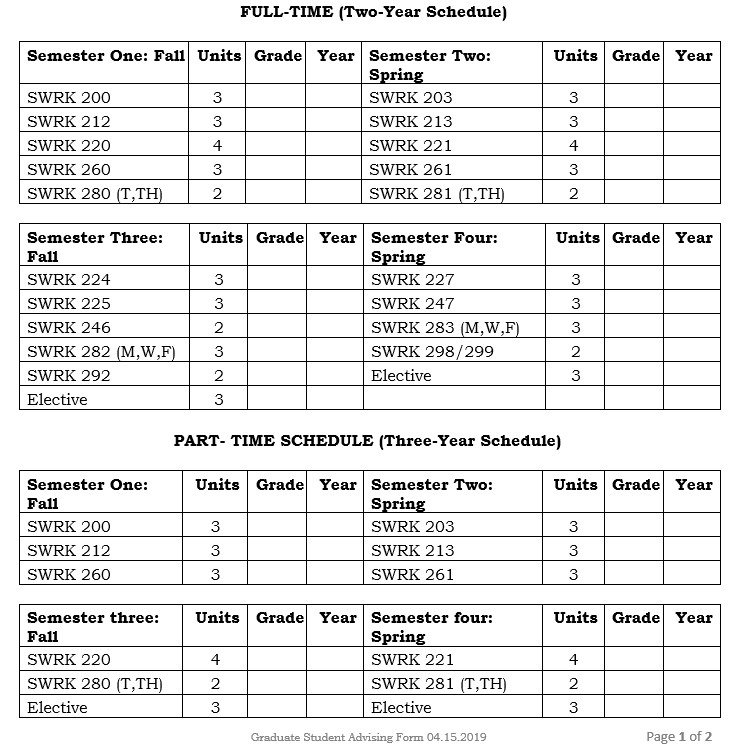
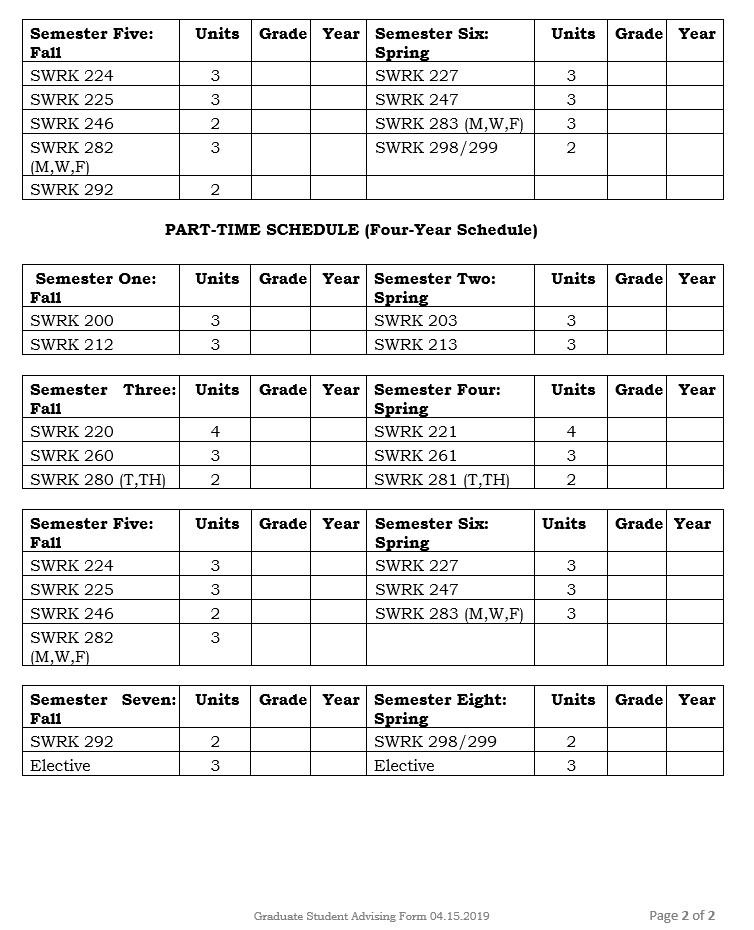
Graduate Writing Requirement Policy
California State University, Fresno
Department of Social Work Education
Introduction
Graduate Writing Requirement. All Fresno State graduate degree students must demonstrate
their competence in written English prior to Advancement to Candidacy. The date the
student meets the writing skills requirement must be noted on the Petition of Advancement
and verified by the Department Graduate Coordinator. Refer to approved program requirements.
The policy and procedures for the administration and evaluation of graduate writing
competency at the graduate level outlined below are designed specifically for the
MSW degree program. They address the requirement that the advanced social work practitioner
demonstrate competence in reading, writing and analytical/critical thinking.
http://www.fresnostate.edu/academics/gradstudies/requirements/advancement.html
Exam Procedure
Newly admitted MSW students participate in a mandatory student orientation prior to the beginning of the academic year. At this meeting, students will be provided information regarding the Graduate Writing Requirement Policy and procedures. The Writing Exam will be administered online through Canvas beginning Tuesday, August 13, 2019 at 12:30 am, and end on Friday, August 16, 2019 at 11:59 pm. Students will be provided an article from a refereed/peer reviewed journal to review. The article will be chosen for its relevancy to current social work issues. Students will write a four to five-page essay on the article that focus on provided questions.
The essay will be submitted through Canvas and be evaluated with a rubric. A Fresno State Writing Studio professional with credentials in writing proficiency will read all of the submissions in consultation with the MSW Graduate Coordinator. The rubric indicates 70% as a passing, C, grade. The results will be made available to students on Canvas the week of September 2, 2019. Students must pass the exam to be able to petition for Advancement to Candidacy. Students passing the Writing Requirement will receive notification that they have passed. Students who do not pass the Writing Requirement will be given an additional attempt to pass the exam, and if needed, under consultation with the Graduate Coordinator, a third and final attempt.
Grievance Procedure
Upon failing the exam a third time, students may appeal the findings and request a
meeting to discuss the MSW writing requirement. They must submit the request in writing
to the MSW Graduate Coordinator their desire to appeal the evaluation of the exam.
The specific reasons(s) for their appeal must be clearly stated. The MSW Graduate
Coordinator will render a decision within a month of receiving the appeal. If the
MSW Graduate Coordinator’s decision is to deny the student’s grievance, the student
has the option of the University appeal procedure. The University procedure is outlined
in the California State University, Fresno Dispute Resolution Policy located in the
Academic Policy Manual 415.
http://fresnostate.edu/academics/facultyaffairs/documents/apm/415.pdf
Guidelines for Enhancing Graduate Student Performance
C alifornia S tat e U niversity , F res n o
Department of Social Work Education
Welcome to Graduate Social Work Education at California State University, Fresno. As entering students, you no doubt have questions and perhaps some impressions about what to expect from your graduate education. Graduate Social Work Education has a long, honored tradition in the United States and in California. There are nearly one hundred accredited MSW programs in the United States, and twenty three in California, all of which are operating under specific Council on Social Work Education (CSWE) principles and guidelines. The MSW program you have been admitted into shares the adherence to CSWE principles and guidelines, and also emphasizes characteristics unique to the San Joaquin Valley and the Programs Mission and Vision. Faculty are recruited based on their expertise, program missioned and emphasis on diversity, social justice and empowerment. The three central and distinguishing dimensions of our graduate program are emphases on cross-cultural diversity, social justice, and an empowerment perspective.
A more in-depth discussion of these Mission Goals is found in the course outlines in the five curricular areas: practice, social policy, research, human behavior and the social environment, and field practicum. The graduate program’s unified “Advanced Multi-Systems Social Work Practice” concentration embodies coursework and practicum emphasis on traditional “methods” of social work practice, including work with individuals, couples and families, groups, and communities, while embracing an approach to professional education relevant to current practice realities.
The most important goal at the forefront that permeates the curriculum and field components, is that you are being prepared for the autonomous practice of advanced social work.
The Department is committed to the above and which is the basis for development of guidelines for student performance. The achievement of the Department mission and vision involves your thoughtful consideration and fullest commitment of time, energy, and intellectual capacity to the tasks that lie before you. The course of study is very demanding, and will undoubtedly lead to unexpected coping. Your commitment to this program must be based on commitment to these expectations of student performance. These expectations include scholarship, integrity, personal responsibility and self-directed learning. Below are definitions of these expectations.
Scholarship
Students must be committed to a weekly completion of a significant amount of reading for each course, careful preparation of all written work required for each course, as well as for the master’s project/thesis. The minimum standard of class preparation is 3 hours of reading/preparation for every 1 hour of classroom work. Most graduate course content will require time spent beyond this minimum expectation. Students must be thoroughly be familiar with the resources of the library, and have full access to the internet for the purposes of course preparation and graduate study. There must be a commitment to perform “quality” work which involves critical thinking, seeking content appropriate to graduate education, organizing verbal and written communication in a logical, coherent fashion, and presenting all products in a professionally acceptable format that is free of spelling, grammar, and structural errors. The American Psychological Association’s (APA) standard guidelines for reference citations are adopted by the Department of Social Work Education. The APA Publications Manual is a recommended purchase for all incoming MSW students.
Faculties are here to promote scholarship befitting graduate education, and are available for academic advising. They will provide multiple d modalities for instruction/pedagogy that involve lecture as well as experiential activities in the service of learning course concepts. Faculty will provide continuous feedback regarding student performance remain current in their respective social work curriculum areas for the purpose of enhancing student learning of social work knowledge values and skills.
Integrity
Integrity in the profession is guided by the National Association of Social Workers (NASW) Code of Ethics in the field practicum manual. This code contains prescriptive and proscriptive value statements that underscore the commitment of all social workers to personal and professional standards of conduct, that include our work with clients, agencies, the larger society, and colleagues. Explicit among these standards is the commitment requiring honesty and fairness in all transactions with instructors and students, as well as other members of the academic community. As a community of scholars, it is incumbent on each of us to respect the views of others, while preserving the right to disagree, even vehemently, when cherished social work values conflict with competing perspectives. It is essential that the creative work produced during your course of study accurately reflect and attribute authorship/ copyright/ownership. Students must conscientiously utilize all forms of attribution/citation when drawing from another’s work. This applies to direct quotations, paraphrases, and the representation of ideas which are not one’s own. Copying another’s work whether published author or student peer, is unacceptable, constituting plagiarism (a form of fraud). Students also need to become familiar with the emerging doctrine applying to “Fair Use” of electronic communications (internet) and rules applying to the duplication of copyrighted material. (See General Catalog, Policies and Regulations.)
Personal Responsibility/Self-Directed Learning
An equally important component of integrity is personal responsibility. When this value is applied to our context, it is essential that students fully understand the ramifications of their choice to enroll in the MSW program. It is a choice that requires a reordering of personal priorities for the duration of the program. Time management, which also involves choice and the acceptance of self-responsibility, becomes an essential dimension of success as a graduate student and ultimately as a professional social worker. The Department recognizes, for its part, the difficulties faced by students who must balance family and employment obligations with the enormous demands of graduate study. Each of you will make great sacrifices in pursuit of the MSW degree. We support your choice to be here and we seek to be sensitive to the struggles you may encounter.
Student responsibility also includes recognition of your commitment to be present and to learn what it takes to be an effective, competent social worker. Anything less diminishes your command of knowledge, learning at the expense of the clients that we serve. A major expectation is that you recognize the significance of your learning by your attendance and participation in all teaching-learning transactions. Accordingly, all students are expected to attend every class session and field placement obligation from beginning to end. Unexcused absence or tardiness from classes or field placement may result in sanctions just as they would in any employment situation. Similarly, all written work and reading assignments should be completed by the due dates. This is part of the student’s contract with the University and instructors. Instructional faculty and field instructors bear equal responsibility for the clear delineation of assignments, for providing timely and explicit feedback and opportunities for improvement of performance, and for promoting a learning environment that deepens your knowledge, skill and appreciation for social work values.
Adequate class and field preparation, along with consistently high levels of participation in one’s own learning is a central element of the Master’s program. Student initiative and peer group learning are essential elements of graduate education. Faculty are a resource that can be utilized to promote the fullest development and expression of student learning. Synthesis of theory and practice most easily occurs in the context of a fully engaged, participatory environment that stresses cooperation and collaboration between peers and faculty.
The ideal classroom environment respects and nurtures curiosity, inquiry and the process of discovery. This requires mutual support as well as critical analysis of ideas and ideologies. Critical thinking is an essential aspect of this process. Students and faculty must come to each class prepared to participate fully and freely. The Department seeks your active engagement in a discussion of this document and equally commits itself to ongoing dialogue and support during your period of study. With great respect and enthusiasm, we welcome you all in this adventure of graduate social work.
In accordance with the Americans with Disabilities Act (1990), if you have, or expect you have, a condition or that may impact your performance in class, it is necessary to contact the Students with Disabilities office. Consult with the instructor within the first week of the semester to implement the specific accommodations to enhance your success. They can be contacted at ML 1202, 559.278.2811.
APPENDIX II
Social Welfare Policy and Services
SWRK 200 Social Welfare Policy I
• Philosophical/historical foundations of social work profession
• Federally-sponsored social policies/programs
• Relationship between social problems and programmatic responses
SWRK 203 Social Welfare Policy II
• Analysis of social welfare policies
• Linkage of social, economic, cultural, political, legislative administration and
legal domains
• Review of policy analysis frameworks
Human Behavior and the Social Environment
SWRK 212 Human Behavior in the Social Environment
• Bio-psychosocial System’s perspective
• Transactional view of behavior (Person x Environment)
• Adaptive, coping view of human development over the life span
• Theories of small groups, organizational, and community behavior
• System’s perspective
SWRK 213 Cultural Diversity and Oppression
• Theoretical base for practice with diverse populations
• Understanding the “Ism’s” (racism, sexism, ableism, etc.)
• Social power as a dimension of social identity
Social Work Research
SWRK 260 Quantitative Social Work Research
• Logic of empirical inquiry
• Quantitative methods (research designs) of empirical inquiry
• Understanding and utilizing the research literature
SWRK 261 Qualitative Social Work Research
• Logic of empirical inquiry
• Qualitative methods (research designs) of empirical inquiry
• Understanding and utilizing the research literature
SWRK 292 Thesis/Project Seminar
• Critical analysis of empirical reports/literature
• Identification and development of a study question
• Development of a written research plan (study design) for the thesis/project
Social Work Practice
SWRK 220 Foundations of Social Work Practice I
• Generalist Practice – Problem Solving Model
• Assessment
• Interviewing
• Crisis Intervention
• Practice with individuals, families, groups, organizations
SWRK 221 Foundations of Social Work Practice II
• Generalist Practice – Problem Solving Model
• Assessment
• Interviewing
• Crisis Intervention
• Practice with individuals, families, groups, organizations
SWRK 224 Advanced Social Work Practice with Individuals
• Theories and principles of clinical social work practice (micro)
• Diagnostic Statistical Manual IV – understanding and working with Mental Disorders
• Enhancement of assessment, intervention, evaluation of practice
SWRK 225 Advanced Social Work Practice with Task and Treatment
• Theory and Practice with treatment groups
SWRK 227 Advanced Clinical Social Work Practice with Couples and Families
• Family systems theory
• Sociocultural constructions of Family
• Family dynamics (beliefs, rules, secrets)
• Assessment (Genograms, ecomaps, intergenerational dynamics)
• Intervention
• Couples work
SWRK 246 Social Work Practice with Formal Organizations
• Theory and Practice of administration of formal human services organizations
SWRK 247 Social Work Practice with Communities
• Theory and practice of social work intervention with communities
Culminating Experience
SWRK 298 (Project) / SW 299 (Thesis)
• Implement study design development in SW 292
• Procedure written report of the study and its results
Field Practicum
Full Time Students Year 1: SWRK 280, 281
Year 2: SWRK 282, 283
3 Year Part-Time Option Year 1: (Classroom only)
Year 2: SWRK 280, 281
Year 3: SWRK 282, 283
4 Year Part-Time Option Year 1: (Classroom only)
Year 2 SWRK 280, 281
Year 3: SWRK 282, 283
Year 4: (Classroom only)
*Please note that part-time students enrolled in more than 6 units pay full-time fees.
See the current schedule of courses for more specific information.
2019-2020 Program Deadlines
You are responsible for knowing about and meeting all deadlines. They are posted in the various documents you receive and can be can accessed at the DSWE Graduate Student Handbook, www.csufresno.edu/socialwork, and the Graduate Studies section at the end of the University Catalog. Here are some of the “essential” deadlines that affect whether you graduate on time. In most instances the student needs to petition the university (not the department) for any exceptions.
FALL SEMESTER
| Date | Item | Comment |
|---|---|---|
| August 19, 2019 | First day of semester | You may not enroll in or continue in courses without a valid BA/BS degree, passing the Graduate Writing Requirement, and transcripts on file. |
| August 21, 2019 | First day of Instruction | |
| September 4, 2019 | Last Day To: Add Class without Permission Number |
|
| September 6, 2019 | Last Day To: File for Master’s Degree for December 2019 |
Deadline for students graduating in Fall 2019 |
| September 16, 2019 | Last Day To: Apply for Advancement to Candidacy to be eligible to graduate in May 2020 |
You may apply for Advancement to Candidacy when you have completed the following: *Achieve Classified Standing (complete all conditions of admission) *Completed 9 units with GPA of 3.0. * Pass graduate writing requirement (exam) Revise your petition/file a program adjustment if your course plans (e.g., electives offered) change. You will receive a copy of your advancement petition approved by the Dean of Grad Studies. |
| September 18, 2019 | Census Date | Last day to add class with permission number |
| September 20, 2019 | Deadline for Conditional Admits to Submit Transcripts of prerequisite completion. | You need Classified Standing before you can Advance to Candidacy. If you delay, units earned after the first 20 may not count toward graduation. |
| December 20, 2019 | Last day of Fall 2019 semester | |
| December 20, 2019 | ● Register for SW298/299 with your SW 292 instructor ● SW292: Complete your committee assignment form. If you are doing a thesis, your form is filed with Division of Research & Graduate Studies |
Permission number to register for 298/299 in Spring 2020 semester issued by your 292 professor. |
SPRING SEMESTER
| Date | Item | Comment |
|---|---|---|
| January 17, 2020 | First day of Spring 2020 semester | |
| Jan. 17-Jan. 31, 2020 | MSW Graduation Application Period | The filing period for the graduate degree to be granted is approximately the first two weeks of each semester or summer. Applications are available in the Division of Graduate Studies office, Frank W. Thomas Building, Room 130, or online at www.fresnostate.edu/gradstudies, under the “Forms” link. A $35.00 non- refundable graduation application fee is required. |
| March 27, 2020 April 3, 2020 |
Thesis Students: Complete Graduate Division requested editing and submit final copy
of Thesis, MSW Degree Clearance form, and Clearance and Reproduction form to the Graduate
Coordinator. Note: A copy of your abstract is required where permission is NOT given to reproduce your thesis. Final Thesis (299) Submission Deadline to Graduate Studies Division. |
Date by which approved final thesis and forms must be submitted to the Graduate Coordinator. Date by which final thesis, fully edited and approved, must be submitted to the Dissertation/Thesis Office. |
| May 4, 2020 (tentative) | PROJECT DUE TO YOUR PROJECT CHAIR AND TO THE GRADUATE COORDINATOR. Submit MSW Degree Clearance form and Clearance and Reproduction form to the Graduate Coordinator. A copy of your abstract is required with this form. |
Your 292 instructor is your project/thesis chair. The project/thesis chair is also
your advisor. They will: 1. Verify that you completed all required academic work 2. Give you a grade for your project/thesis |
| May 4, 2020 | Graduate Degree Clearance forms are due to the Social Work office | Project/thesis chair/advisor and Graduate Coordinator sign the Degree Clearance form;
Department staff secure Department Chair signature. 3. To be cleared for graduation, the transcript needs to match your advancement to candidacy petition on file. |
| May 11-14, 2020 | Spring 2020 SEMESTER FINALS | Forms must have final grade and have all needed signatures except for Graduate Coordinator and DRGS approval. |
| May 15, 2020 | Departmental Clearance Deadline | Graduate Degree Clearance forms are due in the Division of Graduate Studies, on behalf of all graduating students. Grade reports for all "I", "RD", and "RP" graded courses (other than thesis and project) must be on file with the Academic Records Office. Last day to submit paperwork to the Division of Graduate Studies for graduating students. |
Forms and the Signatures needed:
After obtaining signatures, submit to the department office (some need the chair’s signature as well). Office will make a copy for your file and send forward.
| FORM | Advisor Signs | GNS Graduate Coordinator |
|---|---|---|
| Change from conditional to classified standing | √ | |
| Advancement to Candidacy petition | √ | √ |
| Program adjustment (to approved program on advancement to candidacy petition) | √ | √ |
| Overload Petition | √ | √ |
| Graduate Clearance Form | √ | |
| Master’s Clearance Form* | √ | √ |
*also needs signature of Project/Thesis Chair who issues the letter grade for 298/299
PLEASE NOTE: This handbook is updated regularly to best meet the needs of students,
faculty, and staff.
EMERGENCY INFORMATION
Professional Human Services Building
FOR EMERGENCY ASSISTANCE:
• DIAL 911 from a campus phone line.
• DIAL 278.8400 from a cell phone.
• Utilize emergency blue phones located in various locations outside the building.
IN THE EVENT OF AN EMERGENCY REQUIRING EVACUATION:
• Quickly exit the building utilizing the nearest and safest marked EXIT.
• Proceed to the following building evacuation assembly point and wait for further
instructions:
• PEACE GARDEN, GRASSY AREA BETWEEN THE PHS BUILDING AND THE LIBRARY
• Report the location of individuals unable to exit the building.
• DO NOT LEAVE the assembly point without notifying the building safety coordinator
or emergency response personnel
• Tune radios to 1040 AM for campus emergency information.
EVACUATION OF PERSONS WITH DISABILITIES
Persons with mobility difficulties should observe the following procedures:
• All persons shall move towards the nearest marked EXIT.
• When the physically challenged reach an obstruction such as a staircase, they should
request assistance from others in the area.
• LIFE SLIDER is available for trained individuals to provide assistance to those
unable to exit via stairwells.
LOCATION OF LIFE SLIDER: FFS building, third Floor-west side stairs-by men’s restrooms,
room 300
This HTML version was generated with AI assistance and may contain errors or omissions. The original approved PDF remains the official document of record. An alternative accessible format is available upon request from the document creator in accordance with Title II of the ADA.