Student Outcomes Assessment Plan (SOAP)
California State University, Fresno
Kremen School of Education and Human Development
MS in Marriage, Family and Child Counseling
MS in Clinical Rehabilitation and Mental Health Counseling
Department/Program Assessment Coordinator:
Student Outcomes Assessment Plan (SOAP)
I. Mission Statement
The faculty in the Department of Counselor Education and Rehabilitation has the responsibility for providing quality graduate programs in the counseling professions. The Department of Counselor Education and Rehabilitation two accredited programs: 1) MS in Marriage, Family, and Child Counseling (MFCC) and 2) Clinical Rehabilitation and Mental Health Counseling (CRMHC). Our mission is to provide quality instruction and to contribute to our community through research, technical assistance, partnerships, training and other related public service activities. Our primary service areas include Fresno, Madera, Kings, and Tulare counties.
II. Institutional Learning Outcomes, Program Learning Outcomes/Goals, and SLO’s
[a,b,c]
A. Institutional Learning Outcomes. Fresno State ILO’s are posted on the following webpage: http://fresnostate.edu/academics/oie/assessment/fresno-state-assessment.html
- Acquiring Specialized Knowledge
- Improving Intellectual Skills
- Applying Knowledge
B. Program Learning Outcomes (Also known as Goals) and related SLO’s
PLO (Goal): Prepare professional counselors with the knowledge to meet the needs of an increasingly diverse and changing society.
SLO 1.1 Demonstrate a theoretical base and rationale for counseling
SLO 1.2 Identify the needs of people in a changing society related to human development,
cultural identity, social justice, and human sexuality over the life span
SLO 1.3 Articulate orally and in written form a theoretical base and rationale for
career development and describe the importance of career choice in a changing society
SLO 1.4 Demonstrate awareness to the existence of cultural diversity and develop sensitivity
to people of diverse backgrounds
SLO 1.5 Identify counseling, legal, and ethical concerns related to the needs of people
who are living and developing in a pluralistic society
SLO 1.6 Adhere to the legal statutes of the State of California and ethical standards
of the American Counseling Association.
SLO 1.7 Demonstrate knowledge of the research in advancing the counseling profession,
including how to critique research to inform counseling practice
PLO (Goal): Prepare professional counselors to practice effectively in collaborative and interdisciplinary environments.
SLO 2.1 Maintain effective working relationships with members of the community.
SLO 2.2 Articulates and conduct effective crisis, trauma and emergency response management
SLO 2.3 Apply knowledge to conduct effective counseling
SLO 2.4 Accurately conduct diagnoses and apply measurement and evaluation in the field
of counseling including treatment planning.
SLO 2.5 Apply professional counseling expertise under direct supervision
SLO 2.6 Demonstrate essential interviewing, counseling, including group work, and
case conceptualization skills as well as evaluation of interventions
PLO (Goal): Prepare qualified counselors who are proficient in written and verbal communications.
SLO 3.1 Use writing skills to communicate in a style and format (e.g., treatment planning,
documentation) consistent with the American Psychological Association Publication
Manual, 6th Edition.
SLO 3.2 Communicate with peers, professors, and supervisors in a manner that is consistent
with appropriate terminology and consultative practices.
PLO (MFCC GOAL): Prepare graduates to provide couples, marriage, family, child, and counseling through the combination of classroom instruction and supervised clinical experiences
SLO 4.1 Demonstrate skills in assessment, evaluation, and case management when working
with individuals, couples, and families from a systems perspective.
SLO 4.2 Apply conceptualization and implementation of treatment, planning, and intervention
strategies in marriage, couple, and family counseling
PLO (CRMHC Goal): Prepare graduate to provide high-quality counseling services through the integration of academic instruction and supervised clinical experiences that promote skills development, reflexive practice and ethical decision-making and competent service provision for people with disabilities.
SLO 5.1 Demonstrate professional engagement in the rehabilitation and mental health
counseling fields through consultation, education, advocacy, and leadership activities.
SLO 5.2 Apply research and scholarly inquiry related to rehabilitation, mental health,
and promotion of independence of people with disabilities informed by field experiences.
SLO 5.3 Apply understanding of historical, cultural, ethical and legal considerations
relevant to the practice of rehabilitation and mental health counseling to provide
high quality service provision to people with disabilities
III. Curriculum Map [d]: Courses in which SLO’s are addressed and evaluated
Courses 1.1 1.2 1.3 1.4 1.5 1.6 1.7 2.1 2.2 2.3 2.4 2.5 2.6 3.1 3.2
Courses for both Options:
COUN 200 I I I I I I I I I I I I I
COUN 201 I I I I I I I I I I
COUN 202 I I I I I I I D I I
COUN 203 I I I I I I
COUN 206 I I I I I I I
ERE 220 I I I
COUN 220 I I I I I I M
MFCC Option Courses 1.1 1.2 1.3 1.4 1.5 1.6 1.7 2.1 2.2 2.3 2.4 2.5 2.6 3.1 3.2 4.1
4.2
COUN 230 I I I I I I I I I I I I
COUN 208 D D D D D D D D D D D D D D D D
COUN 231 I I I I I I I I I
COUN 232 I I I I I I I I I I I I
COUN 233 I I I I I I I I I I I I
COUN 234a I I I I I I I I I I
COUN 234b I I I I I I I I I I I I I
COUN 234c I I I I I I I I I I I
COUN 234d I I I I I
COUN 234e I I I I I I D D
COUN 235 I I I I I I I I M M
COUN 238 M M M M M M M M M M M M M M M M
COUN 239 M M M M M M M M M M M M M M M M
COUN 298 M M M
COUN 299 M M M
CRMHC Option Courses 1.1 1.2 1.3 1.4 1.5 1.6 1.7 2.1 2.2 2.3 2.4 2.5 2.6 3.1 3.2 5.1
5.2 5.3
REHAB 201 I I I I D I D I I I I I
REHAB 204 D D D D I D I
REHAB 211 D D D D D D D I D I D D
REHAB 237 D D I D D D D I D
REHAB 238 D D D D D D D D D D D I D D D D
REHAB 245 D D D D D D
REHAB 250 D D D D D D
REHAB 262 D D D D D D
REHAB 265 D I D D D D D D
REHAB 268 M D D D D D D D D D D D
REHAB 239 M M M M M M M M M M M M M M M
REHAB 298 M M M M M M M M
REHAB 299 M M M M M M M M
For courses in the major, using the abbreviations below, indicate which outcomes are
introduced, which are developed, and which are mastered in that particular course.
I = Introduced D = Developed M=Mastered
IV. SLO’s Mapped to Assessment Measures and Methods [e]
| Assessment Measure | Evaluation Method | 1.1 | 1.2 | 1.3 | 1.4 | 1.5 | 1.6 | 1.7 | 2.1 | 2.2 | 2.3 | 2.4 | 2.5 | 2.6 | 3.1 | 3.2 | 4.1 | 4.2 | 5.1 | 5.2 | 5.3 |
|---|---|---|---|---|---|---|---|---|---|---|---|---|---|---|---|---|---|---|---|---|---|
| Clinical Review | Rubric | X | X | X | X | X | X | X | X | X | X | X | X | ||||||||
| Professional Dispositions | Rating Calculations | X | X | X | X | X | X | X | X | X | X | X | X | X | X | X | X | X | X | X | |
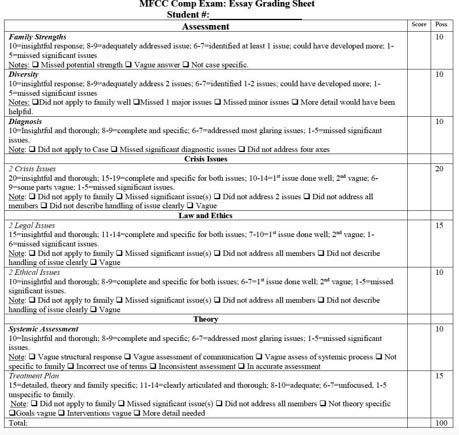
| Comp Exam | Rating - Rubric | X | X | X | X | X | X | X | X | X | X | X | X | X | |||||||
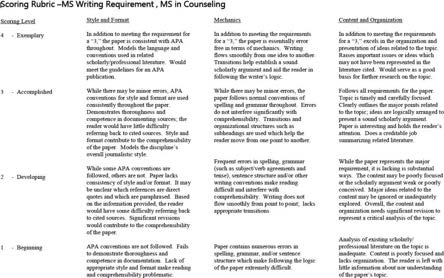
| Graduate Writing Requirement | Rubric | X | X | X | X | ||||||||||||||||
| Field Placement Surveys | Rating calculations | X | X | X | X | X | X | X | X | X | X | X | X | X | X | X | X | ||||
| Comp Exam Project Thesis | Rubric | X | X | X | X | X | X | X | X | X | X | X | X | X | |||||||
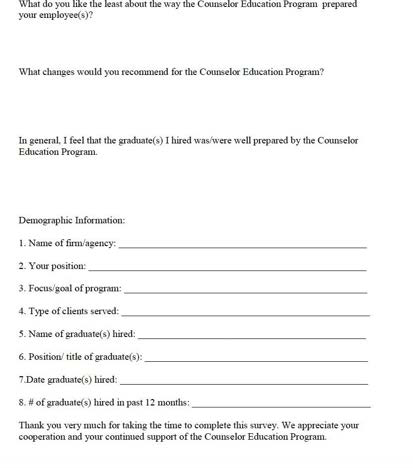
| Employer Survey | Rating calculation | X | X | X | X | X | |||||||||||||||
| Exit Survey | Rating calculation | X | |||||||||||||||||||
| Alumni Survey | Rating calculation | X | X |
V. Assessment Measures: Description of Assignment and Method (rubric, criteria, etc.) used to evaluate the assignment [f]
A. Direct Measures (Department/Program must use a minimum of three different direct
measures)
1. Clinical Review -- conducted in Rehab 201 (preliminary) for CRMHC students and
Counseling Practicum (COUN 208 and REHAB 238) for both programs
a. The Clinical Review is a required assessment of all students that examines counseling
dispositions, skill level and appropriateness for the counseling profession.
2. Graduate Writing Requirement – Writing competency evaluated by reviewing a writing
sample prior to advancement to candidacy.
3. Professional Counseling Dispositions – Conducted in all Practicum and Field-placement/Internship
courses
a. Counseling Dispositions measure the student personal characteristics, attributes
and qualities an ideal counselor might possess)
4. Field Placement – Practicum Evaluation on Counseling Competencies and Professional
Dispositions.
5. Comprehensive Exams or Master’s Project/Thesis
B. Indirect Measures (Department/Program must use a minimum of one indirect measure)
1. Employer Survey
2. Site Supervisor Survey
3. Exit Survey
4. Alumni Survey
5. Advisory Board feedback
| Assessment Activity | Responsible Faculty | Timeline |
|---|---|---|
| Graduate Writing Requirement | COUN 206 instructors | Semester |
| Field Site Evaluations | COUN/REHAB 239 instructors | Semester |
| Comprehensive Exam | Chair, Comp Exam Committee | Semester |
| Advisory Board | Program Coordinators | Biannually |
| Clinical Review | COUN 208 instructor and Department Clinical Review Committee | Semester |
| Alumni Survey | Program Coordinator | Annually |
| Exit Survey | KSOEHD | Semester |
| Employer Survey | COUN 239 instructor/ Program Coordinator | Semester |
VI. Assessment Schedule/Timeline [g]
| Academic Year | Measure | 1.1 | 1.2 | 1.3 | 1.4 | 1.5 | 1.6 | 1.7 | 2.1 | 2.2 | 2.3 | 2.4 | 2.5 | 2.6 | 3.1 | 3.2 | 4.1 | 4.2 | 5.1 | 5.2 | 5.3 | |
|---|---|---|---|---|---|---|---|---|---|---|---|---|---|---|---|---|---|---|---|---|---|---|
| 2024-2025 | Clinical Review | X | X | X | X | X | X | X | X | X | X | X | ||||||||||
| 2025-2026 | Professional Dispositions | X | X | X | X | X | X | X | X | X | X | X | X | X | X | X | X | X | X | X | X | |
| 2026-2027 | Graduate Writing | X | X | X | X | |||||||||||||||||
| 2027-2028 | Employer Survey | X | X | X | ||||||||||||||||||
| 2028-2029 | Field Placement | X | X | X | X | X | X | X | X | X | X | X | X | X | X | X | X | |||||
| 2029-2030 | Comp Project | X | X | X | X | X | X | X | X | X | X | |||||||||||
| 2030-2031 | ||||||||||||||||||||||
| 2031-2032 | ||||||||||||||||||||||
VII. Closing the Loop [h,j,k]
Fresno State Closing the Loop process is described immediately below.
A major assessment report, which focuses on assessment activities carried out the previous academic year, is submitted in September of each academic year and evaluated by the Learning Assessment Team and Director of Assessment at Fresno State.
MARRIAGE, FAMILY AND CHILD COUNSELING APPENDICES
COUNSELOR EDUCATION PROGRAM
CALIFORNIA STATE UNIVERSITY, FRESNO
CLINICAL REVIEW OF PROFESSIONAL PERFORMANCE
Student Name Semester/Year
Instructor Date Pass / No Pass
Professional Performance Standards 1 2 3 4 5 Comments
Professional Behaviors
1. Attention to Ethical and Legal Considerations
Interpersonal Indicators
2. Cooperativeness with Others
3. Awareness of Own Impact on Others
4. Ability to Deal with Conflict
Personal Dispositions
5. Openness to New Ideas
6. Tolerates Ambiguity
7. Willingness to Accept and Use Feedback
8. Ability to Accept Personal Responsibility
9. Ability to Express Feelings Effectively and Appropriately
10. Initiative and Motivation
Rubric for Rating the Professional Performance Standards
Professional Standards
1. Attention to Ethical and Legal Considerations
Rated from Inattentive (1) to Attentive (5)
Engaged in dual relationships with clients Was responsive to supervision for occasional
personal-professional boundary confusion in verbal interactions with clients Maintained
clear personal-professional boundaries with clients
Acted with prejudice toward those of different race, culture, gender or sexual orientation
or other diversity than self Was responsive to supervision for occasional insensitivity
to diversity in professional interactions Demonstrated consistent sensitivity to diversity
Endangered the safety and the well-being of clients Used judgment that could have
put client safety and well-being at risk Satisfactorily ensured client safety and
well-being
Breached established rules for protecting client confidentiality including safeguards
in technology used Used judgment that could have put client confidentiality at risk
including not used safeguards for any technology utilized Appropriately safeguarded
the confidentiality of clients including any technology used
Demonstrated insensitivity to role differences and power dynamics that may exist in
relationship and settings, and does not manage them appropriately Sometimes maintained
sensitivity to role differences and power dynamics that may exist in relationships
and settings, and manages them appropriately Always maintained sensitivity to role
differences and power dynamics that may exist in relationships and settings, and manages
them appropriately
2. Cooperativeness with Others
Rated from Uncooperative (1) to Cooperative (5)
Demonstrated little or no engagement in collaborative activities Engaged in collaborative
activities but with minimum input Worked actively toward reaching consensus in collaborative
activities
Demonstrated unwillingness to compromise in collaborative activities Accepted but
rarely initiated compromise in collaborative activities Demonstrated willingness to
initiate compromise in order to reach group consensus
Undermined goal achievement in collaborative activities Was concerned mainly with
own part in collaborative activities Showed concern for group as well as Individual
goals in collaborative activities
3. Awareness of Own Impact on Others
Rated from Unaware (1) to Aware (5)
Words and actions reflected little or no concern for how others were impacted by them
Effort to determine how own words and actions impacted others was evident but sometimes
inaccurate Effort toward recognition of how own words and actions impacted others
was accurate
Ignored supervisory feedback about how words and actions were negatively impacting
others Responded as necessary to feedback regarding negative impact of words and actions
but at times, with resentment Initiated feedback from others regarding impact of own
words and behaviors; regularly incorporated feedback to effect positive change
4. Ability to Deal with Conflict
Rated from Unable (1) to Able (5)
Was unable or unwilling to consider others’ points of view Attempted but sometimes
had difficulty grasping conflicting points of view Demonstrated willingness and ability
to consider others’ points of view
Did not demonstrate willingness to examine own role in a conflict Examined own role
in a conflict only when directed to do so Displayed willingness to examine own role
in conflict consistently
Ignored supervisory advisement if not in agreement with own position Was responsive
to supervision in a conflict if it was offered Was consistently open to supervisory
critique about own role in a conflict
Did not show any effort a problem solving Participated in problem solving when directed
Initiated problem solving efforts in conflicts
Displayed hostility when conflicts were addressed Actively participated in problem
solving efforts
5. Openness to New Ideas
Rated from Closed (1) to Open (5)
Was dogmatic about own perspective and ideas Was amenable to discussion of perspectives
other than own Solicited others’ opinions and perspectives about own work
Ignored or was defensive about constructive feedback Accepted constructive feedback
without defensiveness Invited constructive feedback and demonstrated interest in others’
perspectiv
Showed little or no evidence of incorporating constructive feedback received to change
own behavior Demonstrated some evidence of effort to incorporate relevant feedback
received to change own behavior Demonstrated strong evidence of incorporation of feedback
received to change own behavior
6. Tolerates Ambiguity
Rated from Intolerant (1) to Tolerant (5)
Showed little or no effort to recognize changing demands in the professional expectations
and interpersonal contexts of professional counseling Made some effort to recognize
changing demands in the professional expectations and interpersonal contexts of professional
counseling but was sometimes inaccurate Showed accurate effort to recognize changing
demands in the professional expectations and interpersonal contexts of professional
counseling
Showed little or no effort to flex own response to changing demands in the professional
expectations and interpersonal contexts of professional counseling Effort of flex
own response to changing demands in the professional expectations and interpersonal
contexts of professional counseling was evident but sometimes inaccurate Demonstrated
accurate effort to flex own response to changing demands in the professional expectations
and interpersonal contexts of professional counseling as needed
Refused to flex own response to changing demands in the professional expectations
and interpersonal contexts of professional counseling despite the knowledge of the
need for change Effort to flex own response to changing demands in the professional
expectations and interpersonal contexts of professional counseling when directed to
do so Independently monitored the professional expectations and interpersonal contexts
of professional counseling and flexed own response accordingly
Was intolerant of unforeseeable or necessary changes in established schedule or protocol
Accepted necessary changes in established schedule or protocol, but without effort
to understand the reason for them Accepted necessary changes in established schedule
and attempted to understand nee for them
7. Willingness to Accept and Use Feedback
1 2 3 4 5
Discouraged feedback from others through defensiveness and anger Was generally receptive
to supervisory feedback Invited feedback by direct request and positive acknowledgement
when received
Showed little or no evidence of incorporating supervisory feedback received Showed
some evidence of incorporating supervisory feedback into own views and behaviors Showed
evidence of active incorporation of supervisory feedback received into own views and
behaviors
Perceived feedback contrary to his/her own position as a personal affront Showed some
defensiveness to critique through “over-explanation” of actions but without anger
Openly accepted constructive feedback as a opportunity to grow and become a better
service provider
Demonstrated greater willingness to give feedback than to receive it Demonstrated
greater willingness to receive feedback than to give it Demonstrated a balanced willingness
to give and receive supervisory feedback
8. Ability to Accept Personal Responsibility
Rated from Unable (1) to Able (5)
Refused to admit mistakes or examine own contribution to problems Was willing to examine
own role in problems when informed of the need to do so Monitored own level of responsibility
in professional performance
Lied, minimized or embellished the truth to extricate self from problems Was accurate
and honest in describing own and others’ roles in problems Invited constructive critique
from others and applied it toward professional growth
Consistently blamed others for problems without self- examination Potential to blame
others initially, but later was open to self-examination about own role in problems
Accepted own mistakes and responded to them as opportunity for self-improvement, avoided
blame in favor of self-examination
9. Ability to Express Feelings Effectively and Appropriately
Rated from Unable (1) to Able (5)
Showed no evidence of willingness and ability to articulate own feelings Showed some
evidence of willingness and ability to articulate own feelings, but with limited range
Was consistently willing and able to articulate the full range of own feelings
Showed no evidence of willingness and ability to recognize and acknowledge the feelings
of others Showed some evidence of willingness and ability to acknowledge others’ feelings—
sometimes inaccurate Showed willingness and ability to acknowledge others’ feelings
Acted out negative feelings (through negative behaviors) rather than articulating
them Expressions of feelings were inappropriate to the setting Expressions of feelings
usually appropriate to the setting and was responsive to supervision when not Expression
of own feelings was consistently appropriate to the setting
Was resistant to discussion of own personal feelings in supervision Willing to discuss
own feelings in supervision when directed Initiated discussion of own feelings in
supervision
Lack of awareness of use of humor inappropriate to the setting Expression of humor
inappropriate to setting but willing to explore and increase awareness when prompted
Use of positive humor to promote resiliency and wellness
10. Initiative and Motivation
Rated from Poor (1) to Good (5)
Often missed deadlines and classes Missed the maximum allowable classes and deadlines
Met all attendance requirements and deadlines
Rarely participated in class activities Usually participated in class activities Regularly
participated in class activities
Often failed to meet minimal expectations in assignments Met only the minimal expectations
in assigned work Met or exceeded expectations in assigned work
Displayed little or no initiative and creativity in assignments Showed some initiative
and creativity in assignments Consistently displayed initiative and creativity in
assigned work
Comments:
DATE
Signature of FACULTY SUPERVISOR
DATE
Signature of STUDENT
Professional Counselor Disposition Assessment
Name of Candidate:
To be completed by Practicum and Field-Placement/Internship (COUN 208, COUN 238, REHAB
238 and REHAB 239) Faculty
Name of Faculty Member: Date:
(Circle one) COUN 208 COUN 238 COUN 239 COUN 249 COUN 219 REHAB 238 REHAB 239
Descriptors are listed as evaluation guidelines for each of the dispositions. Included
with each disposition are examples of behavioral indicators. Each indicator is offered
as a suggested behavior, and not as a conclusive determining factor. Please check
the appropriate box for each of the dispositions.
Rating scales
0 = not observed 1 = inadequate 2 = meet expectations 3 =exceeds expectations
DISPOSITION 0 1 2 3
Reflection. Examples of behavioral indicators include, but are not limited to:
Continually evaluates the effects of his/her choices and actions on others (e.g.,
students, clients, families, and other professionals in the learning community).
Applies, assesses, reflects upon, and adjusts counseling strategies to different needs
of clients
Accepts and incorporates suggestions in subsequent practice.
Demonstrates accurate self-analysis regarding one’s own strengths and weaknesses.
Collects accurate data and incorporates it into the reflective process.
Is open to corrective feedback.
Critical thinking. Examples of behavioral indicators include, but are not limited
to:
Utilizes assessment data to adjust counseling approaches, consultation practices,
or program implementation.
Counselor work (e.g., case studies, group process evaluations, article critiques)
indicates an ability to identify problems and solutions.
Professional ethics. Examples of behavioral indicators include, but are not limited
to:
Recognizes the importance of research to inform counseling for students and clients
with diverse needs.
Shows commitment to ethical conduct.
Actively advocates for students, clients, and families and encourages self- advocacy.
Works within the system to meet the needs of students/clients and their families.
Respects confidentially.
Solicits and gives thoughtful consideration to alternative and contradictory opinions.
Maintains a positive working relationship with peers in practicum/field placement
with school/agency personnel.
Views families as partners in the educational and counseling process.
Exhibits care for quality in the preparation and implementation of work responsibilities.
Adheres to ethical standards for counselors.
Valuing diversity. Examples of behavioral indicators include, but are not limited
to:
Diagnose clients’ needs by interpreting data from diverse sources (e.g., formal/informal
assessments, student/client behavior and feedback, and collateral responses)
Develop intervention plans compatible with diverse needs of clients.
(Field placement) Accommodates all clients, including those from diverse backgrounds,
experiences, and cultures.
Respects clients/students as individuals with differing personal and family backgrounds
and various skills, talents, and interests and is sensitive to community and cultural
mores.
Collaboration. Examples of behavioral indicators include, but are not limited to:
Demonstrates the ability to work creatively and collaboratively with colleagues, clients,
families, and the community.
Values families as full partners in the counseling/educational process
(Field Placement) Collaborates with school personnel, agencies, and families in all
phases of intervention when possible.
Works well with others to develop opportunities for peer and student learning.
Plans and collaborates to ensure that appropriate supports for smooth transitions
are in place.
Life-long learning. Examples of behavioral indicators include, but are not limited
to:
Seeks out opportunities for professional development (e.g., attendance at workshops,
in-service trainings, conferences) using the information learned to improve counseling
practice.
Seeks out opportunities to serve the school, students and community (e.g., extracurricular
activities, Big Brothers, Big Sisters).
Demonstrates a positive attitude toward learning.
Demonstrates intellectual and academic curiosity.
Maintains membership in professional organizations.
Personal philosophy statement includes goals for professional development.
Presents on an area of expertise or interest to teachers, community, profession, and/or
parents at local, state, national or international conferences or trainings.
Counseling 238 Supervisor Evaluation Form
Semester Supervisor
(Indicate whether Instructor, Intern or Field Supervisor)
Strongly Somewhat Strongly Disagree Agree Agree
1. Provides trainees with useful feedback regarding counseling behavior
2. Helps trainees feel at ease with the supervision process.
3. Makes supervision a constructive learning process.
4. Helps trainees develop counseling strategies that can be used with clients.
5. Helps trainees focus on how their counseling behavior influences the client.
6. Encourages trainees to consider alternative counseling skills and approaches.
7. Structures supervision appropriately.
8. Adequately recognizes the development of strengths and capabilities.
9. Allows trainees to brainstorm solutions, responses, and techniques.
10. Enables trainees to become actively involved in the supervision process.
11. Helps trainees feel accepted and respected.
12. Conveys competence.
13. Is helpful in critiquing report writing.
14. Appropriately addresses interpersonal dynamics between self and counselor.
15. Can accept feedback from counselor trainees.
16. Helps reduce defensiveness in supervision.
17. Allows trainees to express opinions, questions and concerns about counseling.
18. Prepares trainees adequately for future
19. Provides trainees with the opportunity to adequately discuss major difficulties
with clients.
20. Helps trainees to assess and conceptualize cases.
21. Is flexible enough for trainees to be spontaneous and creative.
22. Focuses on the implications and consequences of specific behaviors in the counseling
process.
23. Allows trainees to use new and different techniques when appropriate.
24. Helps trainees to define and achieve specific concrete goals for myself during
the practicum experience.
25. Helps trainees organize relevant case data in planning goals and strategies with
clients.
26. Explains the criteria for evaluation clearly and in behavioral terms.
27. Applies criteria fairly in evaluating counseling performance.
Additional comments:
*This form was adapted from Janine M. Bernard (1976- revised, 1981).
ALUMNI EVALUATION
Date Year M.S. completed
Type of current occupational assignment
Based on the counseling work being done in your present assignment, please rate the
degree to which you feel the counselor education program at CSUF is related to your
performance on the job. The higher the number circled, the greater your degree of
satisfaction.
Category Satisfaction
Low High
1. Knowledge and understanding of human behavior 1 2 3 4 5 N/A *
2. Ability to counsel individuals 1 2 3 4 5 N/A *
3. Ability to counsel in groups 1 2 3 4 5 N/A *
4. Ability to counsel with families 1 2 3 4 5 N/A *
5. Knowledge and understanding of laws related to the counseling profession 1 2 3
4 5 N/A *
6. Knowledge and understanding of learning theory 1 2 3 4 5 N/A *
7. Ability to counsel with culturally different clients 1 2 3 4 5 N/A *
8. Ability to counsel with clients of different ages 1 2 3 4 5 N/A *
9. Ability to counsel with members of the opposite sex 1 2 3 4 5 N/A *
10. Ability to utilize effective clinical judgment in the assessment of client needs
1 2 3 4 5 N/A *
11. Knowledge and understanding of the limitations of tests, including age, cultural
and sex differences 1 2 3 4 5 N/A *
12. Knowledge and understanding of different life styles 1 2 3 4 5 N/A *
13. Knowledge and understanding of occupational and career trends 1 2 3 4 5 N/A *
14. Ability to understand and complete research studies 1 2 3 4 5 N/A *
15. Knowledge and understanding of preventative or developmental counseling 1 2 3
4 5 N/A *
16. Ability to assess needs and develop programs to meet the needs of organizations
1 2 3 4 5 N/A *
17. Ability to consult with other professionals to meet the needs of organizations
and/ or individuals 1 2 3 4 5 N/A *
18. Understanding of and ability to follow professional ethics in the field 1 2 3
4 5 N/A *
19. The counselor education program at CSUF provided the type of experiences needed
for effectiveness as a counselor 1 2 3 4 5 N/A *
* The N/A (not applicable) response is appropriate for categories that are not included
in your professional work assignment.
Please turn to back page for additional questionnaire items.
1. Please list the major strengths of the Counselor Education programs at CSUF:
2. Please list the major weaknesses of the Counselor Education program at CSUF:
3. List the areas you suggest for change or that need strengthening:
4. Other comments and/ or recommendations:
Comprehensive Exam Scoring Rubric
Graduate Writing Requirement
CLINICAL REHABILITATION AND MENTAL HEALTH COUNSELING APPENDICES
A. Clinical Review Snapshot
B. Graduate Writing Requirement
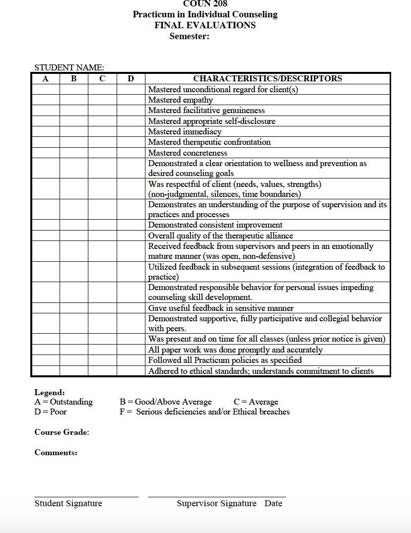
C. Professional Counseling Dispositions
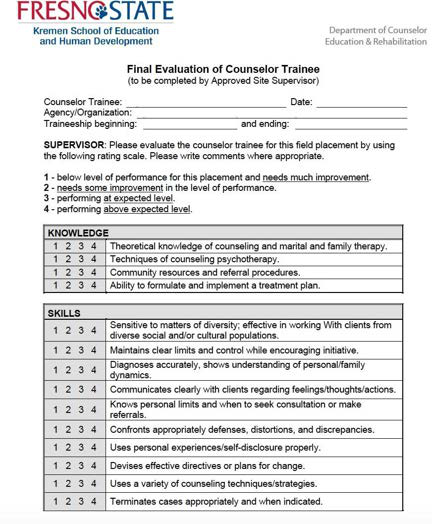
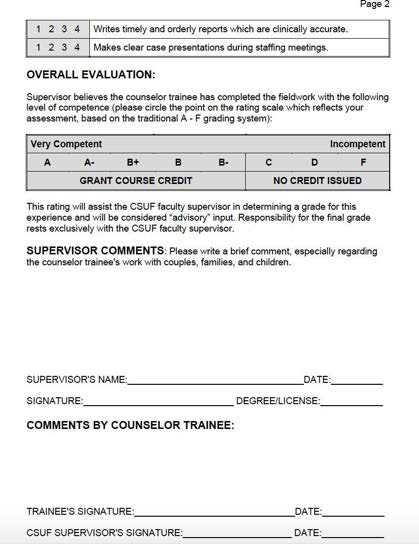
D. Field Placement Evaluations Snapshot
E. Comprehensive Exam Essay Scoring Rubric
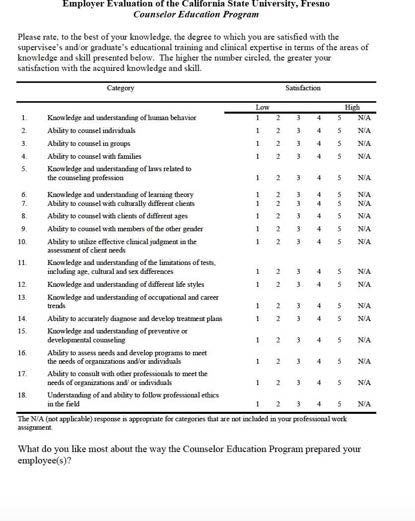
F. Employer Survey Snapshot
G. Site Supervisor Survey Snapshot
H. Exit Survey Snapshot
I. Alumni Survey Snapshot


















This PDF is provided as a print-only reference document and may not be fully accessible to users of assistive technology. For more information, please visit Title II Rule on Digital Accessibility page.