Field Experience Manual Updated 2019
TABLE OF CONTENTS
CLINICAL REHABILITATION & MENTAL HEALTH COUNSELING PROGRAM ...........1
MISSION AND GOALS...........................................................................................................1
FIELD EXPERIENCE STANDARDS AND REQUIREMENTS ...............................................2
ACCREDITATION REQUIREMENTS FOR FIELD EXPERIENCE....................................2
CORE Standards..................................................................................................................2
CACREP Standards.............................................................................................................4
Practicum........................................................................................................................4
Internship........................................................................................................................4
Supervisor Qualifications...............................................................................................5
Practicum And Internship Course Loads .......................................................................5
LIABILITY INSURANCE .......................................................................................................6
FIELD EXPERIENCE SITES...................................................................................................6
Selecting a Field Experience Site ..........................................................................................6
Field Experience Sites & Placement Procedures...................................................................7
HEALTH CARE WORKER BACKGROUND CHECK ACT ................................................7
SUPERVISORRESPONSIBILITIES.......................................................................................8
University or Faculty Supervisor Qualifications & Responsibilities ....................................8
Site Supervisor Qualifications & Responsibilities ................................................................8
Intern/Trainee Qualifications & Responsibilities..................................................................9
CREDIT AND CONTACT HOURS ........................................................................................9
Grades....................................................................................................................................9
INTRODUCTORY SESSION WITH THECLIENT.................................................................10
Recording Guidelines for Practicum REHAB 238..............................................................11
Equipment/Supplies Needed................................................................................................11
Analysis of Recording Review ............................................................................................11
Counselor Trainee Supervision Preparation............................................................................12
Examining CounselorResponses ............................................................................................12
In Examining Client Responses, the Counselor MightAsk.................................................12
DUE PROCESS AND APPEAL PROCEDURES .....................................................................13
RIGHTS AND RESPONSIBILITIES OF COUNSELOR TRAINEES .................................13
EXPECTATIONS OF COUNSELOR TRAINEES................................................................13
Skills and Competencies......................................................................................................13
Professional Standards/Personal Functioning ......................................................................13
EVALUATION PROCEDURES FOR COUNSELOR TRAINEES......................................14
GENERAL GUIDELINES FOR DUE PROCESS .................................................................15
PROCEDURES.......................................................................................................................16
Recommended Actions............................................................................................................16
Implementation of Recommended Actions.............................................................................17
Procedures for Appeal.............................................................................................................19
CREDENTIALING ....................................................................................................................19
CERTIFICATION ...................................................................................................................19
LICENSURE...........................................................................................................................19
PROFESSIONAL ASSOCIATIONS .........................................................................................21
APPENDIX A.............................................................................................................................22
Field Experience Information Sheet ..................................................................................22
APPENDIX B.............................................................................................................................24
Informed Consent Form(s).................................................................................................24
APPENDIX C.............................................................................................................................28
WEEKLY LOGS ...............................................................................................................28
APPENDIX D.............................................................................................................................30
Counselor Trainee Evaluation Form..................................................................................30
APPENDIX E .............................................................................................................................38
Site Evaluation Form.........................................................................................................38
APPENDIX F ............................................................................................................................41
Learning Contract................................................................................................................42
APPENDIX G.............................................................................................................................43
University Risk Management Agreement ...........................................................................44
APPENDIX H.............................................................................................................................38
Conflict of Interest Policy....................................................................................................48
APPENDIX I ..............................................................................................................................50
Practicum/Internship Supervision Contracts (General & Licensure Path)..........................51
APPENDIX J ..............................................................................................................................60
Consultation Log .................................................................................................................61
APPENDIX K
Manual Receipt Confirmation & Ethics Acknowledgement……………………………..63
APPENDIX L
State of California Supervisor Responsibility Statement …………..………………….65
THE CLINICAL REHABILITATION AND MENTAL HEALTH COUNSELING PROGRAM
The Clinical Rehabilitation and Mental Health Counseling Program (CRMHC) Program is fully accredited by the Council on Rehabilitation Education (CORE), and is a 60-semester hour clinical program. The completion of the RMHC program involves mastery of core requirements, electives, a comprehensive examination, research requirements, and a clinical field experience and internship. It is expected that in addition to performing well academically, students will also demonstrate competency in counseling skills, appropriate judgment and maturity in his/her clinical work, abide by the Code of Ethics for Rehabilitation Counselors, and develop professional identity through affiliation and involvement with professional rehabilitation counseling organizations such as the American Rehabilitation Counseling Association (ARCA) or the National Rehabilitation Counseling Association (NRCA).
MISSION AND GOALS
The overall mission of the Master of Science in Clinical Rehabilitation and Mental Health Counseling Program at California State University, Fresno is to serve people with disabilities by doing an outstanding job of training warm, empathic, trustworthy and competent Qualified Rehabilitation Professionals who will make a real difference in the lives of persons with disabilities and transform the practice of rehabilitation counseling in California and beyond.
Our overall mission is implemented with four goals in mind:
1. Prepare professional counselors with the knowledge to meet the needs of an increasingly
diverse and changing society.
2. Prepare professional counselors to practice effectively in collaborative and interdisciplinary
environments.
3. Prepare qualified counselors who are proficient in written and verbal communications.
4. Provide students a high-quality graduate educational program that combines classroom
instruction and supervised clinical experiences aimed at the acquisition of skills,
reflexive practice and the development of competencies related to the provision of
services to people with disabilities.
FIELD EXPERIENCE STANDARDS AND REQUIREMENTS
Clinical training is designed to enable Rehabilitation Counseling students to apply information, concepts, and skills they have learned in their academic courses. Courses that are prerequisite to beginning field experience are:
- COUN 200: Seminar in Counseling Techniques
- REHAB 201: Seminar in Rehabilitation Counseling
- REHAB 204: Medical Aspects of Physical and Neurological Disabilities
- REHAB 205: Career Placement in Rehab Process
- REHAB 237: Case Practices in Rehabilitation Counseling (Pre-Field Experience)
The purpose of field experience is to enable Rehabilitation Counseling students to practice the skills that they have learned in prerequisite courses in an applied, real world, clinical setting and to move to a more advanced level of counseling skill development. The focus of field experience is on the development of Rehabilitation Counseling skills and to give students the opportunity to advance those skills so that they are ready for more independent counseling functions after graduation.
Consequently, despite the number of hours spent at a field experience site, students must reach a level of competency in counseling and must have had sufficient counseling experience with clients who have worked within a continuing counseling relationship over time to enable the university supervisor to make a decision regarding the students’ readiness for more independent functions in counseling.
Counselor Trainees who have successfully met two thirds of course requirements are able to qualify for an Incomplete (I). In the event that Counselor Trainees are deficient in counseling skills or personal/professional disposition, they will be subject to due process (e.g., clinical review, remediation plans, program dismissal).
ACCREDITATION REQUIREMENTS FOR FIELD EXPERIENCE
CORE Standards
According to Section D of the Council on Rehabilitation Education (CORE) Standards:
D.1. Students shall have a minimum of 100 clock hours of supervised rehabilitation
counseling field experience in practicum, which fosters personal growth and introduces
students to counseling approaches and rehabilitation issues that affect service delivery.
D.1.1. The field experience shall include on-campus experiences (audio-video recordings
and individual and group interaction) dealing with rehabilitation counseling concerns,and
clinical experiences (on or off-campus) that facilitate the development of basic rehabilitation
counseling skills.
D.1.2. Written expectations, procedures, and policies for field experience shall be
available to students and include the policy that the field experience is a pre-requisite
to the supervised rehabilitation counseling clinical internship experience.
CACREP Standards
According to Section 3 of the Council for Accreditation of Counseling and Related Educational Programs (CACREP) Standards:
ENTRY-LEVEL PROFESSIONAL PRACTICE
A. Students are covered by individual professional counseling liability insurance
policies while enrolled in practicum and internship.
B. Supervision of practicum and internship students includes program-appropriate audio/video
recordings and/or live supervision of students’ interactions with clients.
C. Formative and summative evaluations of the student’s counseling performance and
ability to integrate and apply knowledge are conducted as part of the student’s practicum
and internship.
D. Students have the opportunity to become familiar with a variety of professional
activities and resources, including technological resources, during their practicum
and internship.
E. In addition to the development of individual counseling skills, during either the
practicum or internship, students must lead or co-lead a counseling or psychoeducational
group.
Practicum
A. Students complete supervised counseling practicum experiences that total a minimum
of 100 clock hours over a full academic term that is a minimum of 10 weeks.
B. Practicum students complete at least 40 clock hours of direct service with actual
clients that contributes to the development of counseling skills.
C. Practicum students have weekly interaction with supervisors that averages one hour
per week of individual and/or triadic supervision throughout the practicum by (1)
a counselor education program faculty member, (2) a student supervisor who is under
the supervision of a counselor education program faculty member, or (3) a site supervisor
who is working in consultation on a regular schedule with a counselor education program
faculty member in accordance with the supervision agreement.
D. Practicum students participate in an average of 1½ hours per week of group supervision
on a regular schedule throughout the practicum. Group supervision must be provided
by a counselor education program faculty member or a student supervisor who is under
the supervision of a counselor education program faculty member.
Internship
E. After successful completion of the practicum, students complete 600 clock hours
of supervised counseling internship in roles and settings with clients relevant to
their specialty area.
F. Internship students complete at least 240 clock hours of direct service.
G. Internship students have weekly interaction with supervisors that averages one
hour per week of individual and/or triadic supervision throughout the internship,
provided by (1) the site supervisor, (2) counselor education program faculty, or (3)
a student supervisor who is under the supervision of a counselor education program
faculty member.
H. Internship students participate in an average of 1½ hours per week of group supervision
on a regular schedule throughout the internship. Group supervision must be provided
by a counselor education program faculty member or a student supervisor who is under
the supervision of a counselor education program faculty member.
Supervisor Qualifications
I. Counselor education program faculty members serving as individual/triadic or group
practicum/internship supervisors for students in entry-level programs have (1) relevant
experience, (2) professional credentials, and (3) counseling supervision training
and experience.
J. Students serving as individual/triadic or group practicum/internship supervisors
for students in entry-level programs must (1) have completed CACREP entry-level counseling
degree requirements, (2) have completed or are receiving preparation in counseling
supervision, and (3) be under supervision from counselor education program faculty.
K. Site supervisors have (1) a minimum of a master’s degree, preferably in counseling,
or a related profession; (2) relevant certifications and/or licenses; (3) a minimum
of two years of pertinent professional experience in the specialty area in which the
student is enrolled; (4) knowledge of the program’s expectations, requirements, and
evaluation procedures for students; and (5) relevant training in counseling supervision.
L. Orientation, consultation, and professional development opportunities are provided
by counselor education program faculty to site supervisors.
M. Written supervision agreements define the roles and responsibilities of the faculty
supervisor, site supervisor, and student during practicum and internship. When individual/triadic
practicum supervision is conducted by a site supervisor in consultation with counselor
education program faculty, the supervision agreement must detail the format and frequency
of consultation to monitor student learning.
Practicum And Internship Course Loads
N. When individual/triadic supervision is provided by the counselor education program
faculty or a student under supervision, practicum and internship courses should not
exceed a 1:6 faculty: student ratio. This is equivalent to the teaching of one 3-semester
credit hour or equivalent quarter credit hour course of a faculty member’s teaching
load assignment.
O. When individual/triadic supervision is provided solely by a site supervisor, and
the counselor education program faculty or student under supervision only provides
group supervision, practicum and internship courses should not exceed a 1:12 faculty:
student ratio. This is equivalent to the teaching of one 3-semester credit hour or
equivalent quarter credit hour course of a faculty member’s teaching load assignment.
P. Group supervision of practicum and internship students should not exceed a 1:12
faculty: student ratio.
Q. When counselor education program faculty provide supervision of students providing
supervision, a 1:6 faculty: student ratio should not be exceeded. This is equivalent
to the teaching of one 3-semester or equivalent quarter credit hours of a faculty
member’s teaching load assignment.
LIABILITY INSURANCE
Professional liability insurance is required of all students, prior to registering for field experience. The University provides liability insurance but the University insurance is minimal, therefore students will need to obtain their own liability insurance prior to enrolling in REHAB 238 and 239. Counselor Trainees can obtain liability insurance through the Health Providers Service Organization (HPSO). Additionally, Counselor Trainees can obtain liability insurance relatively inexpensively through professional Rehabilitation Counseling organizations, such as the American Rehabilitation Counseling Association or National Rehabilitation Counseling Association.
FIELD EXPERIENCE SITES
Field experience sites must offer the opportunity for students to be directly involved in counseling persons/clients with disabilities. All sites for Rehabilitation Counseling field experience must be pre-approved by the Rehabilitation Counseling faculty. In order to be eligible as a field experience site, the site must:
A. Be a pre-approved site;
B. Serve individuals with disabilities (e.g., mental health, substance abuse); and
C. Must have a person at the site with a Master’s Degree in Counseling (CRC preferred)
or closely related field of counseling, who is willing to serve as the student’s on-site
supervisor.
Selecting a Field Experience Site
1. See Faculty Advisor for approved field experience sites, if a site has not been
identified. The Counselor Trainees should familiarize themselves with the various
choices available prior to entering fieldwork. Sites and documents should be submitted
four weeks prior to the first day of the semester. Any student submitting paperwork
after the fourth week prior to the semester of fieldwork is subject to a full Rehabilitation
Counseling program faculty review.
2. Students may be expected to interview at the potential field experience site. When
interviewing at a site, students should gather the following information:
A. Population served at the site
B. Services provided
C. General agency philosophy
D. Specific requirements of site prior to beginning field experience (background check;
drug screen; etc)
E. Requirements of site regarding orientation; length of orientation if required
F. Verify that audio or video taping of client interactions is permitted
G. Availability of site supervisor with Master’s Degree or higher in Rehabilitation
Counseling (preferably CRC) or closely related counseling field who is willing to
serve as student’s site supervisor
H. Time required by site from date of application for field experience until beginning
field experience. (Sites that require FBI background checks, or other clearances will
require longer times from application to entry.)
I. Does the site require both field experience and internship be conducted at the
site?
Field Experience Sites & Placement Procedures
A. Students must express to the faculty fieldwork supervisor in writing, their intention
to register for fieldwork by the fourth week of the preceding semester. Students who
have an interest in a particular setting or organization for their placement should
also express that interest at that time.
B. Intern Information Meeting: A meeting will be held with prospective intern students
the semester prior to placement either as a group or between the student and student’s
University Field Experience Supervisor.
C. Student-Site Supervisor Meeting - Each student will call and arrange an appointment
with the site supervisor during the semester prior to placement.
D. If the placement is not mutually acceptable, the student will repeat the placement
process with an alternate site assignment.
E. For students wishing to conduct field experience where they are presently employed,
see Conflict of Interest Policy provided with course syllabus.
HEALTH CARE WORKER BACKGROUND CHECK ACT
The Health Care Worker Background Check Act {225 ILCS 46} was enacted to protect individuals from possible harm. This Act requires criminal background check of certain health care workers. Health care employers are prohibited from hiring or employing a person who has been convicted of committing or attempting to commit one of the following offenses: murder, homicide, manslaughter or concealment of homicidal death; kidnapping or child abduction; unlawful restraint or forcible detention; assault, battery or infliction of great bodily harm, sexual assault or sexual abuse; abuse of gross neglect of a long-term care facility resident; criminal neglect of an elderly or disabled person; theft, financial exploitation of an elderly or disabled person, robbery or burglary; criminal trespass, arson, unlawful use of weapons or aggravated discharge of a firearm; manufacture, delivery or trafficking of cannabis; manufacture, delivery or trafficking of controlled substances.
Individuals who have been convicted of any of the above listed offenses should be aware that such a conviction may preclude placement for Rehabilitation Counseling field experience or internship, both of which are clinical requirements for completion of the Rehabilitation Counselor Training Program. THE REHABILITATION & MENTAL HEALTH COUNSELING PROGRAM IS NOT HELD RESPONSIBLE FOR FINDING FIELD EXPERIENCE SITES FOR INDIVIDUALS UNDER THESE CIRCUMSTANCES. Individuals convicted of any of the above offenses may consider obtaining a waiver under the Health Care Worker Background Check Act. It should be noted, however, that a health care employer is not obligated to hire or retain a person convicted of the specified offenses even if that person is granted a waiver. Additional
information about the Health Care Worker Background Check Act or about obtaining a waiver may be obtained from the Office of Health Care Regulation in Fresno, California.
SUPERVISOR RESPONSIBILITIES
University or Faculty Supervisor Qualifications & Responsibilities
University of Faculty must meet the following qualifications and responsibility requirements:
· Full-time faculty member in the CSU Fresno, Rehabilitation Counseling program and
is a CRC.
·Serve as a liaison between the program and the fieldwork site.
· Collaborate with the trainee and site supervisor to assist with the development
and refinement of the fieldwork site contract experiences.
· Review progress of trainees’ fieldwork progress on a regular basis.
· Provide direct and periodic communication throughout the semester with the site
supervisor.
· Structure and facilitate weekly group supervision meetings (1½ hours).
· Support trainees’ understanding and application of the Code of Professional Ethics
for Rehabilitation Counselors and American Counseling Association Code of Ethics.
· Address concerns, in collaboration with the student and site supervisor, related
to unsatisfactory performance.
Site Supervisor Qualifications & Responsibilities
Supervisors must meet the following qualifications and responsibility requirements:
· Possess appropriate education, experience, and credentials. A minimum of a Master’s
degree in a helping profession is required. Preferably, the supervisor will possess
a CRC credential. For students seeking to satisfy LPCC requirement, supervisors must
be a Licensed Professional Clinical Counselor, Licensed Marriage and Family Therapist,
Licensed Clinical Social Worker, Licensed Psychologist, or Psychiatrist for at least
two (2) years in good standing.
· Supervisors cannot be a spouse or relative by blood or marriage or someone with
whom the trainee/intern has a personal relationship, which would undermine the authority
or effectiveness of the supervision.
· Provide regularly scheduled individual supervision for a minimum of 1 hour per week
and also complete evaluations regarding the trainee’s progress at the middle and end
of the internship. For LPCC supervision, supervisors shall provide at least 1 hour
of direct supervision to the trainee/intern per week. Counselor Trainees will receive
1 ½ hours per week of group supervision on a regular schedule throughout the field
experience. For more information about supervision requirements, refer to the "Rules
and Regulations" manual of the Board of Behavioral Science (BBS) and 2016 CACREP Standards.
· Provide trainees with an orientation to staff, procedures, agency structure, and
required report writing within the internship site. It is also suggested that community
field visits be available with referral resources and contacts.
· Provide meaningful experiences/tasks with individuals who have a broad range of
disabilities, from referral through plan development to closure. Preferably the intern
will interact with at least 8 - 10 clients at a time throughout the semester. Closed
cases should be replaced with new referrals.
· Help obtain necessary permissions and releases for working with clients.
· Provide access to staff meetings and client staffing and other relevant conferences
as required.
Intern/Trainee Qualifications & Responsibilities
Interns/Trainees must meet the following qualifications and responsibility requirements:
P Satisfy all pre-requisites prior to engaging in the field experience
P Demonstrate appropriate progress based on clinical reviews
PAdhere to all agency policies, schedules, and dress codes
PConform to ethical standards, especially in regard to confidentiality
P Conduct themselves with a professional attitude and professional discretion
PSubmit applications for employment early in the internship while demonstrating an
ethical obligation to complete the field experience
PProactively communicate with university and site supervisors if a leave of absence
is desired for personal/professional reasons
PMaintain a daily log of field experience learning activities on the form provided
(see Appendix C)
PEngage in weekly site and university-based supervision as outlined
CREDIT AND CONTACT HOURS
A total of 100 practicum site contact hours and 600 internship hour contact hours are required, in addition to the minimum of 1 hour of supervision per week by a Rehabilitation Counseling faculty member or person working under the faculty member’s supervision. These contact and supervision hours are equivalent to four practicum credit hours and twelve internship contact hours. Students must be registered for (REHAB 238) or internship (REHAB 239) at the time they are involved with their field experience. They must be registered under the section number of the Rehabilitation Counseling faculty member who is responsible for supervising practicum and internship. Practicum is a total of four (4) contact hours during a semester. Internship is a total of 12 contact hours.
Grades
The faculty and site supervisors jointly determine student fieldwork evaluations. The site supervisor will complete mid-term and final student evaluations. Other evaluations may be conducted at the request of any of these three parties.
The Practicum experience is graded with a letter grade. The internship experience is graded as credit or no credit (C/NC) based on completion of the required hours of supervised experience and satisfactory performance evaluations in addition to group supervision attendance and participation. If the requisite number of fieldwork hours and related requirements has not been recorded by the end of the semester, an incomplete (I) will be assigned and removed upon completion of all the course requirements.
INTRODUCTORY SESSION WITH THE CLIENT
Clients entering into a counseling relationship have a right to know the professional background and preparation of the individual providing counseling services and the parameter of rehabilitation counseling. They also have the right to know the parameters of clinical supervision and the fact that audio/recording and/or observation of counseling sessions will occur (Practicum ONLY). For this reason, at the introductory session with the client the following issues must be discussed and the client’s Informed Consent (Appendix B) signed prior to beginning the counseling session:
1. Introduce yourself. Explaining that you are a Master’s degree student in the Rehabilitation
& Mental Health Counseling Program at California State University, Fresno (Fresno
State).
2. Explain that as a Rehabilitation Counseling student you are held to the Scope and
Standards of Practice of Rehabilitation Counselors and Code of Ethics for Rehabilitation
Counselors (also American Counseling Association Code of Ethics) as defined by the
national accrediting body, the Council on Rehabilitation Education (CORE).
3. Let the client know how long you will be available to see them for counseling and
related services (for the semester).
4. Explain to the client that as a student you are required to audio/video record
all counseling sessions for Practicum ( REHAB 238). To aid in this process, Practicum
(REHAB 238) sessions are monitored by faculty and/or clinical supervisor through review
of audio/video recordings and/or actual observations of counseling sessions. Explain
that information from the client’s clinical case file may also be reviewed by the
faculty supervisor or clinical supervisor.
5. Assure the client all information will remain confidential within the parameters
of the Code of Ethics for Rehabilitation Counselors (also American Counseling Association
Code of Ethics) and within the parameters of the agency in which the client is receiving
the counseling services.
6. Describe the limits of confidentiality and matters concerning the following issues
you are obligated to report these acts or intended acts to appropriate individuals:
a. suicide
b. harm or threat to harm another person
c. illegal activity resulting in a court order
d. physical/sexual abuse or neglect of minors, persons with disabilities, and the
elderly
e. anything else required under the law
7. Assure the client that their participation in counseling is voluntary.
8. Have client sign the informed consent for counseling and consent for observation
and audio/video recording.
9. Have the client sign the informed consent for rights and limits of confidentiality.
10. Copies of both signed consent forms should remain in the client’s file at the
agency and the department.
Recording Guidelines for Practicum REHAB 238
1. Recordings should be of good quality and should be audible. Check to see that the
session is being properly recorded and that what is being said can be heard.
2. Recordings should never be made without the prior permission of the client. All
individuals should have a clear statement in advance of the uses of the recording.
The recording should not be used for any other purpose. Consent to recording forms
should be signed by clients and placed in the client’s file (Appendix J).
3. The client should be aware of his/her right to stop the recording at any time.
4. Always protect the identity of the client. Assign each client a code to identify
the client recording.
5. Cue recordings to the beginning of the session before review.
6. Make sure that the whole session is recorded.
7. Store recordings in a safe place where the client’s confidentiality is assured.
Do not place any marks on the recording through which the client could be identified.
8. Review the recordings privately – Note on the counter any segment of recording
you would like to review with your university field experience supervisor. Write what
you perceive to be your strengths and weaknesses in the session on the second sheet
of the Consumer Counseling Plan (Appendix B). Also, complete the first sheet of the
Consumer Counseling Plan. Both sheets of the consumer-counseling plan must be turned
in with the recording to your university supervisor.
9. Do not discuss confidential information outside structured/class supervision time.
10. Erase recordings following the review session with the university supervisor.
Equipment/Supplies Needed
1. Digital Recorders are required. (NO MINI MICRO RECORDERS OR CASSETTE TAPES)
2. Students are required to purchase recorders.
a. The RMHC program will not provide recorders for Counselor Trainees.
b. Audio recorder
Analysis of Recording Review
To help you in reviewing your digital recording, try to identify:
1. The most productive part of your session.
2. The part of the session, which you are struggling with the most.
3. Specific content issues and recurring themes.
4. Specific areas where you felt you need help.
Do not forget to:
1. Use the counter on your recorder player to “mark” the above areas for discussion.
2. Take personal notes with areas “marked” for discussion with your supervisor.
Counselor Trainee Supervision Preparation
One of the main reasons for recording counseling sessions is to permit you to listen to the recording at a later time and analyze your responses and your reactions to the client. No one can do an adequate job of counseling unless and until they understand themselves and their prejudices. The following is a list of suggested questions taken from Brammer’s Therapeutic Counseling, which offers a guide to counselor self-criticism and recording analysis.
Examining Counselor Responses
• Why did I make this particular response to this client’s remark? What was behind
it?
• What was I reacting to when I make this remark?
• What was I endeavoring to convey to this client?
• Why did I ask that question?
• Was the question really asked for purposes related to helping the client?
• Was I being merely curious?
• Why did I feel impelled at this point to give advice?
• Was it because I felt the client expected me to have all the answers?
• And did I respond being all-wise?
• Why did I become so emotionally involved with this client?
• Why did his feelings reflect my own feelings?
• Why did I want (or not want) to bring the parents or spouse into counseling?
• Did I over identify with the client?
• Why did I talk so much rather than let the client tell his story?
• Did I feel I had to impress this client with my knowledge so that the client would
return?
• Why does it upset me when appointments are broken?
• Why am I so reluctant to let go when the counseling seems to have reached an appropriate
termination point or when the client should be referred for a different kind of help?
• Am I using the client for my own needs or am I letting the client use me?
• Why did I shift topics at this point? Was I afraid of getting in over my head? Was
I uncomfortable with the topic?
• Am I avoiding handling the client’s real problems?
In Examining Client Responses, the Counselor Might Ask
• Why did the client shift topics at this point? Was the material “too hot to handle”?
• Are signs of resistance are present? If so, to what is the client responding through
his resistance?
• How does the client see him/herself in relation to the counselor?
• Is the client “with the counselor”?
• What is the client saying about him/herself at this point?
• Why did the client reject, clarify, or ignore the counselor’s remark at this point?
• What is the client’s characteristic mode of verbal interaction with the counselor?
DUE PROCESS AND APPEAL PROCEDURES
RIGHTS AND RESPONSIBILITIES OF COUNSELOR TRAINEES
Counselor Trainees are expected to learn counseling skills and the ethics of practice, as well as to do much self-examination, focusing on their intra- and interpersonal processes. At all stages of training, the RMHC faculty and supervisors are responsible for assessment and continual feedback to students in order to improve skills, remediate problem areas, and/or to prevent individuals, unsuited in either skills or interpersonal difficulties, from entering the field. University faculty/on-campus supervisors, then, are responsible for monitoring supervisee/student progress to benefit and protect the public and the profession, as well as the student.
The Counselor Trainees have access to clear statements of the standards and expectations by which they are evaluated at mid-semester and the end of the semester. Throughout the semester, students receive one hour of clinical supervision weekly when they will be given informal verbal feedback on their performance. They have the opportunity to ameliorate deficiencies or misconduct prior to the semester evaluation and/or special review, unless continuation of service delivery would be to the detriment of clients. Counselor Trainees are free to provide input and suggest changes and modifications regarding the RMHC field experience to their RMHC field experience supervisor.
Counselor Trainees have the right to activate an appeal when they believe that their rights have been infringed upon. When the evaluation process is completed mid-semester and at the end of the semester, students have the right to contest criticisms, to disagree with the supervisor’s summary evaluation, and to request an appeal.
EXPECTATIONS OF COUNSELOR TRAINEES
Skills and Competencies
In order to help students plan goals and structure training activities, information regarding expected tasks, anticipated competency levels and optional experiences are provided to them. Given the diversity and breadth of this information, individual supervisors will be responsible for sharing this information with the supervisee prior to or at the onset of training. Supervisees are expected to assess their own skill levels and training needs, and set specific goals in cooperation with their individual supervisors. Specific skills and competencies are clearly stated in the evaluation forms and throughout the field experience manual.
In that the CRMHC program is designed to produce competent Rehabilitation Counselors, counseling deficits, impairments, or inadequacies identified in field experience, that are unable to be resolved through remediation efforts may result in termination from the Rehabilitation & Mental Health Counseling Program.
Professional Standards/Personal Functioning
With regard to student behavior and performance during the field experience, the general expectations of the RMHC program are that the student will:
- Practice within the bounds of the CRC Code of Professional Ethics for Rehabilitation Counselors;
- Practice within the bounds of the RMHC field experience manual.
- Practice within the bounds of the laws and regulations of the state of California;
- Practice in a manner that conforms to the professional standards of the California State University, Fresno Counseling Center.
- Being punctual, accounting for absences, and meeting obligations to clients,the field experience site and university supervisors.
Functioning in a professional manner includes (but is not limited to):
- Balancing agency needs with personal needs;
- Managing personal stress and monitoring commitments;
- Making appropriate use of supervision; i.e., being on time and prepared to take full advantage of learning opportunities, as well as maintaining an openness to learning and being able to accept and use constructive feedback;
- Maintaining appropriate interaction with peers, colleagues, field experience site staff, university faculty/on-campus supervisors, and other Counselor Trainees;
- Being alert to personal adjustment problems or emotional responses that may interfere with professional functioning.
In addition, students are expected to exhibit ethical professional behavior, which includes adherence to the CRC Code of Professional Ethics for Rehabilitation Counselors.
Depending on the degree of the violation, and the amenability of the individual toward change, violations may be classified as either "problems" or "impairments" and subject to remediation according to due process procedures discussed in the next section.
EVALUATION PROCEDURES FOR COUNSELOR TRAINEES
Evaluation is an ongoing formal and informal process. The field experience faculty instructor expects the site supervisor to provide ongoing feedback to students.
The Counselor Trainees’ Evaluation form (Appendix C) is shared with Counselor Trainees by field experience faculty instructors. Students meet with a supervisor on a weekly basis and are given ongoing feedback about their performance at that time. At mid-semester, students are given a written and verbal evaluation of their performance by both the RMHC supervisors and the field experience site supervisors. The purpose of this is to identify any problem areas or areas in need of greater focus. By providing this feedback at mid-semester, the student is given time to make needed corrections. If problems of major concern exist, remedial plans can be devised. Remedial plans will be developed in conjunction with student, site supervisor and faculty supervisor input. It should be noted that in addition to remediation plans, counselor trainees might undergo Clinical Reviews (See Student Handbook). At the end of the semester, students are again provided with written and verbal evaluation of their performance by both the RMHC supervisors and the field experience site supervisors. Students provide ongoing verbal feedback to their supervisors regarding their experiences.
GENERAL GUIDELINES FOR DUE PROCESS
Due process insures that judgments or decisions made by the RMHC program about a student are not arbitrary or personally biased. The RMHC program has adopted specific evaluation procedures that are applied to all students. The appeals procedures presented below are available to the student so that he/she may challenge the program’s actions.
General due process guidelines include:
- presenting to students, in writing, the program’s expectations in regards to professional functioning at the outset of training;
- stipulating the procedures for evaluation, including when, how, and by whom evaluations will be conducted;
- articulating the various procedures and actions involved in making decisions regarding impairment;
- communicating, as deemed appropriate, with the student’s field experience site about any difficulties with students;
- instituting a remediation plan for identified inadequacies, including a time frame for expected remediation and consequences of not rectifying the inadequacies;
- providing the student with a written statement of procedural policy describing how the student may appeal the program’s actions or decisions which is included in the field experience manual.
- insuring that students have a reasonable amount of time to respond to any
PROCEDURES
The following procedures are followed in cases of inadequate or impaired student performance:
I. A Problem is Recognized. A problem affecting student performance may be identified
either through formal evaluation procedures or through the interactions of on-site
and on-campus supervisors and other university faculty working with a student. Such
problems can usually be categorized as issues of (1) competence/skill deficit, (2)
professional/ethical behavior, and (3) psychological maladjustment.
The Problem is Brought to the Attention of the Field experience Faculty Instructor.
If the field experience faculty instructor does not already have knowledge of the
student’s problematic behavior as a result of evaluation procedures, the supervisor
(s) recognizing the problem will bring it to the attention of the field experience
faculty instructor. At this time, the student will be notified that a problem has
been identified which will be reviewed by the field experience faculty instructor,
who may elect to consult with the on-site supervisor, the RMHC program coordinator,
and/or other staff as appropriate. The field experience faculty instructor will meet
with the student to receive any information or statements from the student related
to the identified concern.
II. The Problem is Defined and Reviewed by the Field experience Faculty Instructor.
The field experience faculty instructor will work with the university supervisor to
define the student’s problem as concretely and behaviorally as possible. At this point,
the field experience faculty instructor and on-campus supervisor will discuss the
problem, decide on the severity, and assess the potential for remediation. Based upon
this discussion, the field experience faculty instructor will either recommend termination
of the student, place the student on probationary status with a remediation plan in
mind, generate a remediation plan without probation, or determine that the problem
is not severe enough to warrant remediation, in which case no further action is taken.
III. The Recommendations are Reviewed by the RMHC Program Faculty and Coordinator.
In the case of remediation, probation or termination the recommendations will be reviewed
by the RMHC program faculty as a whole, including the program coordinator. Following
the review the student will be notified in writing of the recommendations.
Recommended Actions
Possible recommended courses of action from the field experience faculty instructor are as follows:
I. Termination From RMHC Program Recommended. Termination at this point would be recommended only in extreme circumstances. Examples of such circumstances are acts of physical aggression against an on-site staff member, a faculty member, or a client, or serious ethical misconduct. After the student is notified in writing of the field experience faculty instructor’s recommendations, he/she may choose to appeal the decision.
II. The Student is placed on Probation with a Remediation Plan. Probationary status is defined as a situation where the student is actively and systematically monitored by supervisors and the field experience faculty instructor for a specific length of time, in regard to the necessary and expected changes in the problematic behavior. The student is given a written statement notifying him/her of the probationary status and specifying:
- the behaviors which need to be changed,
- the recommendations for remediating the problem,
- the time period of the probation during which the problem is expected to be ameliorated, and
- the procedures designed to ascertain whether or not the problem has been appropriately rectified.
Following the student’s notification of his/her probationary status, the University field experience faculty instructor will then meet with the student to review the probationary conditions. The student may then choose to accept the conditions of the probation or to challenge the action. (The procedures for appealing the action are presented in a subsequent section.) If the student does not challenge the action, the remediation plan (see below) is put into action.
III. Remediation Plan is Generated Without Probation. If termination or probation is not deemed appropriate, the field experience faculty instructor will generate an appropriate plan of remediation. Several possible, and perhaps concurrent, courses of action designed to remediate deficiencies or impairments may include (but are not limited to):
- increasing supervision or changing primary supervisor;
- changing the format, emphasis and/or focus of supervision;
- recommending a change in field experience sites (which may extend field experience into a second semester);
- recommending or requiring personal therapy, and clarifying to all parties involved whether or not the therapy contacts will be used in the student evaluation process, and if so, how they will be used;
- reducing or limiting the type of direct client contact or other training responsibilities, which may require an extension of field experience into a second semester;
- recommending, when appropriate, a leave of absence or a second field experience.
Implementation of Recommended Actions
I. Remediation Plan is put into Action. The student’s supervisor(s) and the field
experience faculty instructor work with the student to facilitate and monitor change.
Those monitoring the student (on-site supervisors, on-site staff, University supervisor)
should communicate frequently with the field experience faculty instructor and the
on-campus supervisor throughout the probationary period.
A. Sufficient Positive Change. Both the monitors and the field experience faculty
instructor are satisfied that sufficient positive change has taken place.
1. End of Probation. The student is formally notified, in writing, that satisfactory
change has been accomplished and the probationary period is ended.
B. Insufficient Positive Change. At the end of the probationary period, the monitors
and the field experience faculty instructor determine that insufficient positive change
has taken place. The field experience faculty instructor then reviews the situation
and may recommend one of the following:
1. Termination From the RMHC Program Is Recommended. The field experience faculty
instructor, after reviewing the problem, concludes that it is both serious and resistant
to change; on this basis, termination is recommended. The student is notified in writing
of the decision. Again, at this point the student may choose to challenge the decision
according to the appeal procedures outlined below.
2. New Plan Generated. The field experience faculty instructor does not feel that
a recommendation of termination is appropriate at this time. A new plan for remediation
is generated in another effort to promote change. This plan would likely include psychological/psychiatric
treatment, careful screening of on-site clients, closer and more intense supervision,
suspension of certain activities,etc.
3. Student Remains on Probation. The student remains on probation with a new time
period specified. The student may challenge this recommendation or may accept the
new remediation plan.
II. New Remediation Plan is put into Action. The student’s supervisors and the field
experience faculty instructor work with the student to facilitate and monitor change.
Communication by those monitoring the student to the field experience faculty instructor
will be frequent and on a regular basis throughout the probationary time period specified.
A. Sufficient Positive Change. Both the monitors and the field experience faculty
instructor are satisfied that sufficient positive change has taken place.
B. End of Probation. The student as well as the field experience site supervisors
are formally notified, in writing, that satisfactory change has been accomplished
and the probationary period is ended.
C. Insufficient Positive Change. At the end of the probationary period, the monitors
and the field experience faculty instructor determine that insufficient positive change
has taken place. The RMHC faculty then reviews the situation and may recommend one
of the following:
1. communicating to the student and the field experience site supervisor that the
field experience has not been successfully completed, and recommending a leave of
absence or a second field experience at a later date;
2. assigning the student an unsatisfactory grade for field experience
3. recommending and helping to implement a career change for the student
and/or
4. terminating the student from the RMHC program.
All of the above actions need to be appropriately documented and implemented in a
manner consistent with due process procedures. The student is notified of the final
decision and, again, at this point may appeal the decision. If the student chooses
to appeal, these individuals will be notified of the final decision at the conclusion
of the appeal process.
Procedures for Appeal
Students may appeal the decisions of the field experience faculty instructor, through contacting the RMHC program coordinator. The student may submit to the coordinator written statements he/she believes to be appropriate may request a personal interview and/or may request that the coordinator interview other individuals who might have relevant information. The supervisor involved will also be afforded the same privilege.
The RMHC program coordinator may choose to sustain any previous actions taken or may implement a new course of action as deemed necessary. Students wishing to appeal the decision of the program coordinator must appeal though contacting the Department Chair. Students are referred to the Academic Grievance Policy/Procedure in the Graduate Catalog if they after they are not satisfied with the outcome of meeting with the Department Chair.
CREDENTIALING
CERTIFICATION
Students can pursue rehabilitation certification upon graduation from the program. Students are encouraged to pursue their CRC (Certified Rehabilitation Counselor). Students in a CORE accredited program are allowed to sit for the CRC examination following completion of 75% of their coursework. The program will assist students and graduates with the application process and complete paperwork certifying satisfactory completion of the educational curriculum. For information about the CRC contact:
Commission on Rehabilitation Counselor Certification
300 N. Martingale Road, Suite 460
Schaumburg, Illinois 60173
847-944-1325 or www.crccertification.com
LICENSURE
Program endorsement for the Licensed Professional Clinical Counselor (LPCC) credential take place only upon full completion of the M.S. in Rehabilitation and Mental Health Counseling and the required coursework and related field experience hours. The program will assist students and graduates with the licensure application process and complete paperwork certifying satisfactory completion of the educational curriculum and field experience experiences required.
Students must comply with the requirements established by the Board of Behavioral
Sciences (BBS) in order to qualify to take the licensing examinations. To receive
a full description of BBS rules and regulations, request in writing a copy of the
"Rules and Regulations Manual" along with a fee (call for current fees) and send the
letter to:
Board of Behavioral Sciences
400 "R" Street, Suite 3150
Sacramento, CA 95814
(916) 445-4933
www.bbs.ca.gov
A brief summary of additional coursework for the LPCC at the pre-service level includes:
Advanced Theories (3 units)
Addictions Counseling (3 units)
Psychopharmacology (3 units)
Crisis and Trauma Counseling (3 units)
All courses are available through California State University, Fresno.
INTERN REGISTRATION
After attainment of the Master’s degree, candidates for the LPCC license must register as a Professional Clinical Counselor Intern (PCCI) to obtain hours to qualify for the licensing examinations. The application to register as an intern can be obtained, through request, from the BBS or downloaded from their website.
EXPERIENCE REQUIREMENTS
Candidates seeking to qualify for the LPCC must complete 3,000 hours of supervised counseling experience over a period of not less than two (2) years. Hours obtained prior to graduation must be completed in a setting designated as providing clinical mental health services. All supervised hours must be completed post-degree.
PROFESSIONAL ASSOCIATIONS
Students are encouraged to join and become actively involved in the associations of the profession including but not limited to:
American Counseling Association (ACA)
5999 Stevenson Avenue
Alexandria, VA 22304
800-347-6647
www.counseling.org
American Rehabilitation Counseling Association (ARCA)
5999 Stevenson Avenue
Alexandria, VA 22304
800-347-6647
www.arcaweb.org
National Rehabilitation Association (NRA)
633 S. Washington Street
Alexandria, VA 22314
703-836-0850
www.nationalrehab.org
National Rehabilitation Counseling Association (NRCA)
P.O. Box 4480
Manassas, VA
20108 703-361-2077
http://nrca-net.org
National Council on Rehabilitation Education (NCRE)
2012 W. Norwood Dr.
Carbondale, IL 62901
618-549-3267
http://www.rehabeducators.org/
These organizations provide the student with updated information regarding rehabilitation and mental health counseling along with subscriptions to major journals and newsletters. Association involvement also provides opportunity for networking for the student’s own interests as well as career plans.
APPENDIX A
Field Experience Information Sheet
APPENDIX B
Informed Consent Form(s)
(REHAB 238: Consent for Counseling & Recording for Practicum)
(REHAB 239: Consent for Counseling for Internship)
(RIGHTS AND LIMITS OF CONFIDENTIALITY)
INFORMED CONSENT
Rehab 238: Practicum
Consent for Counseling and Observation and Audio/Video Recording
The purpose of this form is to provide you with information about my background and to give you the opportunity to give consent for counseling as well as consent for observation and audio/video recording of counseling sessions. I am a Master’s Degree student in the Clinical Rehabilitation & Mental Health Counseling Program at California State University, Fresno. The national accrediting body, the Council on Rehabilitation Education (CORE) and the Council on Accreditation for Counseling and Related Educational Programs (CACREP), accredits the Clinical Rehabilitation & Mental Health Counseling Program. As a Rehabilitation Counseling student I am bound to the Scope and Standards of Practice for Rehabilitation Counseling and to the Code of Professional Ethics for Rehabilitation Counselors and the American Counseling Association.
In order to provide quality-counseling services, counselors in training are required to receive clinical supervision. To aid in this, a faculty supervisor and supervision group monitors counseling sessions through review of audio/video recordings and/or actual observations. The faculty supervisor may also review information from the client’s clinical case file. Such information will be treated in accordance with the Code of Professional Ethics for Rehabilitation Counselors and the American Counseling Association. Recordings of individual counseling sessions will be erased after they have been reviewed with the faculty supervisor.
“I understand that I am not required to participate in the counseling program described
above. I give my consent to the matters noted above as a free and voluntary act.”
date signature of client
date signature of counselor
date signature of a witness
Rehab 239: Internship
Consent for Counseling
The purpose of this form is to provide you with information about my background and to give you the opportunity to give consent for counseling. I am a Master’s Degree student in the Clinical Rehabilitation and Mental Health Counseling Program at California State University, Fresno. The national accrediting body, the Council on Rehabilitation Education (CORE) and the Council on Accreditation for Counseling and Related Educational Programs (CACREP), accredits the Clinical Rehabilitation and Mental Health Counseling Program. As a Rehabilitation Counseling student, I am bound to the Scope and Standards of Practice for Rehabilitation Counseling and to the Code Professional Ethics for Rehabilitation Counselors as described by CORE.
In order to provide quality-counseling services, counselors in training for the degree in the Clinical Rehabilitation and Mental Health Counseling Program are required to receive clinical supervision. To aid in this, a faculty supervisor and supervision group reviews counseling sessions during weekly supervision meetings. The faculty supervisor may also review information from the client’s clinical case file. Such information will be treated in accordance with the Code of Professional Ethics for Rehabilitation Counselors and the American Counseling Association.
“I understand that I am not required to participate in the counseling program described
above. I give my consent to the matters noted above as a free and voluntary act.”
date signature of client
date signature of counselor
date signature of a witness
RIGHTS AND LIMITS OF CONFIDENTIALITY
The counseling services offered by counselors in training for the Master’s Degree
in the Clinical Rehabilitation & Mental Health Counseling Program at California State
University, Fresno are confidential within the parameters of clinical supervision
described in the “Informed Consent for Counseling” and in accordance with the guidelines
of the agency/facility within which you are receiving services. Everything we discuss
within the counseling session will be confidential except for matters pertaining to
(1) suicide;
(2) harm or threat to harm another person;
(3) legal activity resulting in a court order;
(4) physical/sexual abuse or neglect of minors, persons with disabilities, and the
elderly;
and
(5) anything else as required by law.
Under those circumstances, I am obligated to report these acts or intended acts to
appropriate others.
“I have read and understand my rights as well as the limits of confidentiality.”
date signature of client
date signature of counselor
date signature of a witness
APPENDIX C
WEEKLY LOG
MS in Clinical Rehabilitation and Mental Health Counseling
Weekly Log
DIRECTIONS: PLACE A CHECK IN THE APPROPRIATE BOXES
❏ Counseling Practicum (100 hours) ❏ Internship I (300 hours) ❏ Internship II (300
hours) ❏ Combined Internship (600 hrs.)
Student’s Name: Site:
Date Activity Description of Activity (including type of supervision (live or recorded)
Indirect Hours
Direct Hours
Total
Cumulative Indirect Hours
Cumulative Direct Hours
Cumulative Total Hours
Site Supervisor: Date: Signature of Student Intern: Date:
APPENDIX D
Counselor Trainee Evaluation Form
(Completed by Site Supervisor)
COUNSELOR TRAINEE EVALUATION FORM
Kremen School of Education and Human Development
Department of Counselor Education and Rehabilitation
Clinical Rehabilitation and Mental Health Counseling Program
5005 N Maple Ave M/S ED 3
Fresno, CA 93740
Name of Intern Date
Period covered by report: From To
Supervisor: Name
Agency
Address
Phone No.
Supervisor’s Credentials:
Number of years in the field:
What was the total number of clients the intern worked with?
What type of clients were assigned to the student (circle all that apply_):
Children Adolescents Adults Working age
Elderly Male Female
Individual with Disabilities (please specify):
What was the racial/ethnic background of the clients (circle all that apply)?
White African-American Asian-American
Latino American other
What were the main duties of the intern?
The Site Supervisor completes this form at two points throughout the field experience,
once at mid-semester and a second time towards the end of the semester to evaluate
the Counselor Trainees’ performance at the site. Once completed, the Counselor Trainee
Evaluation Form is reviewed with the intern and signed by both the site supervisor
and the intern. The Counselor Trainee Evaluation Form is returned to the course instructor
for review, subsequent signature, and insertion into the trainee’s file.
APPENDIX E
Site Evaluation Form
(Completed by Counselor Trainee)
SITE EVALUATION FORM
California State University, Fresno
Clinical Rehabilitation & Mental Health Counseling Program
Student: Supervisor:
Agency:
Semester: Fall (Year) Spring (Year)
~~~~~~~~~~~~~~~~~~~~~~~~~~~~~~~~~~~~~~~~~~~~~~~~~~~~~~~~~~~~~~~~~~~~~~~
1. ORIENTATION TO AGENCY, DUTIES, AND CASELOAD Yes No Other NA
Explained the organizational structure of the agency.
Described the agency goals and functions.
Discussed the various resources of the agency and their availability.
Clarified my position in the organizational structure.
Adequately outlined the agency procedures.
Discussed with me my duties and goals for the experience.
Discussed his/her other expectations of me.
Introduced to other staff members.
Established and kept a definite time for supervisory conferences.
Assigned appropriate clients and an adequate number of clients.
2. SUPERVISOR AS A RESOURCE
Poor Average Outstanding
1. Is especially skilled in counseling techniques. 1 2 3 4 5 NA
2. Is especially knowledgeable about various assessments. 1 2 3 4 5 NA
3. Is especially knowledgeable about clients. (Specific problems(s) or disability)
1 2 3 4 5 NA
4. Is especially knowledgeable about educational/vocational counseling techniques.
1 2 3 4 5 NA
This Site Evaluation Form is designed to study and facilitate the effectiveness of
the supervision process by utilizing the student’s report of his/her supervision experience.
It will be completed by the student at the end of the fieldwork experience and submitted
to his/her faculty supervisor. The faculty supervisor will review, sign the form,
and place it in the Counselor Trainees’ folder.
APPENDIX F
Learning Contract
INTERNSHIP LEARNING CONTRACT
The purpose of the learning contract is to guide the overall field experience. Learning
goals should be measureable and ought to reflect counselor trainee professional interests
guided by site supervisor input. Appropriate learning goal areas include but are not
limited to self-care, evidence-based practices, counseling theories and techniques,
diagnosis, assessment, case conceptualization, and multicultural competence. Learning
goals will be further shaped by setting and population that trainee will engage with
throughout the field experience.
Semester: ___ Fall ___ Spring 20____ Today’s Date: _________________
Student’s Name: ____________________________
Site Supervisor’s Name: __________________________
Specialization: ______________________________________
Learning Goals Learning Objectives Methods of Evaluation
APPENDIX G
Internship Agreement Required by University Risk Management
INTERNSHIP AGREEMENT
REQUIRED BY UNIVERSITY RISK MANAGEMENT
California State University, Fresno
Department of Counselor Education and Rehabilitation
THIS AGREEMENT, made and entered into this ___ day of ________, 2016 between the Trustees
of the California State University, hereinafter called the “TRUSTEES”, on behalf of
California State University, Fresno, hereinafter called the “INSTITUTION," and [YOUR
AGENCY NAME GOES HERE]
hereinafter called the “AGENCY”
W I T N E S S E T H:
WHEREAS, the INSTITUTION provides an accredited health care program or a social services
program, approved by the TRUSTEES which requires clinical experience and the use of
clinical facilities; and
WHEREAS, the AGENCY has facilities suitable for providing clinical experience for
the INSTITUTION’S program, and
WHEREAS, it is to the mutual benefit of the parties hereto that students have opportunities
to use the facilities of the AGENCY for their learning experience.
NOW, THEREFORE, in consideration of the covenants, conditions, and stipulations hereinafter
expressed and in consideration of the mutual benefits to be derived therefrom, the
parties hereto agree as follows:
I. AGENCY SHALL:
a) Provide facilities as presently available and as necessary for the development
and maintenance of a clinical educational experience for students of the program.
b) Maintain the AGENCY facilities used for the clinical experience in such a manner
that said facilities shall conform to all requirements of applicable State Boards
and/or Business and Professions Codes.
c) Assure that staff is adequate in number and quality to insure safe and continuous
management of the student program in cooperation with the INSTITUTION’s instructor.
d) Provide Instructors and students taking part in the field experience, whenever
possible, other incidentals that may be mutually agreeable upon.
e) Provide emergency first aid for any student who becomes sick or injured by conditions
arising out of or in the course of said student’s participation in the clinical experience
at the AGENCY. Provide medical examinations or other protective measure that may be
required by the AGENCY.
f) Have the right, after consultation with the INSTITUTION, to refuse to accept for
further clinical experience any of the INSTITUTION’S students who in the AGENCY’S
judgment, are not participating satisfactorily.
II. INSTITUTION SHALL:
a) Designate the students who are enrolled in the program of the INSTITUTION to be
assigned for clinical experience at the AGENCY, in such numbers as are mutually agreed
to by both parties.
b) Establish a rotational plan for the clinical experience by mutual agreement between
appropriate representatives.
c) Supervise all instruction and clinical experience given at the AGENCY to the assigned
students and provide the necessary instructors for the clinical experience program
provided for under this agreement. Keep all attendance and academic records of students
participating in said program.
d) Certify to AGENCY at the time each student first reports at AGENCY to participate
in said program that said student will comply with all agreed upon health/insurance
requirements for students of the program.
e) Advise student to be responsible and professional while in the AGENCY. Require
every student to conform to all applicable AGENCY policies, procedures, and regulations,
and all requirements and restrictions specified jointly by representatives of the
INSTITUTION and AGENCY.
f) In consultation and coordination with the AGENCY’S representatives, plan for the
clinical experience to be provided to students under this agreement.
g) In consultation and coordination with the AGENCY’S staff arrange for periodic conferences
between appropriate representatives of the INSTITUTION and AGENCY to evaluate the
clinical experience program.
h) Provide any and all instructional materials and equipment required for the Program,
unless otherwise agreed by the parties.
i) Submit to the AGENCY a schedule of the days and times when students are expected
to be at the Facility, subject to approval of the AGENCY.
j) Ensure that each student in the Program procures and maintains in force during
the term of this agreement professional liability insurance in amounts reasonably
necessary to protect the student against liability arising from any and all negligent
acts or incidents caused by the student. Coverage under such professional liability
insurance shall not be less than one million dollars ($1,000,000) for each occurrence
and one million dollars ($3,000,000) in the aggregate. Such coverage is to be obtained
from a carrier rated A or better by AM Best. INSTITUTION shall provide evidence of
insurance upon request.
III. GENERAL PROVISIONS:
a) Students are not considered employees of neither the AGENCY nor the INSTITUTION
and as such are not entitled to worker’s compensation coverage, benefits or compensation.
b) This agreement shall become effective on the date of countersignature and shall
continue for a period of five (5) years provided; however, it may be terminated by
either party after giving the other party sixty (60) days advance written notice of
its intention to so terminate.
c) TRUSTEES shall be responsible for damages caused by the negligence of its officers,
agents and employees occurring in the performance of this agreement. AGENCY shall
be responsible for
APPENDIX H
Conflict of Interest Policy
California State University, Fresno
Clinical Rehabilitation and Mental Health Counseling Program
Conflict of Interest Policy
Rehabilitation counseling trainees will seek placements where no conflict of interest
concerns occur to assure that they receive an experience that is focused on high-quality
learning, and thus, free of external influence and bias. Trainees should not seek
placements where they or significant others/relatives receive services; they or significant
others/relatives serve on boards; or they or significant others/relatives are employed.
If based on factors related to financial obligations or geographical constraints,
a trainee must consider a placement that could be viewed as fitting into one of the
above categories, the trainee may be able to submit documentation for review so that
a decision could be made related to a particular site and overall quality of field
experience. Documentation will consist of:
a) description of employee related duties;
b) description of field experience learning activities;
c) field experience learning contract, which demonstrates a significant difference
in employee related obligations/employee learning/professional development experiences;
d) verification of supervisor in an employee capacity; and
e) verification of internship site supervisor
Documentation should be submitted to the university supervisor for review. The Program’s Clinical Review Committee and/or Program Coordinator may also review the materials. In some cases, consultation may be sought at the departmental level.
All documentation should be submitted by the semester prior to which the trainee starts field experience. As the process could involve a request for clarification in which the information may be submitted to the aforementioned levels for review prior to a decision being made, it is recommended that trainees initially utilize their program advisors and start the process early, so as to secure a placement in a timely fashion that will satisfactorily meet program degree requirements.
APPENDIX I
Practicum/Internship Supervision Contracts
General & Licensure Path
CALIFORNIA STATE UNIVERSITY, FRESNO
Kremen School of Education and Human Development
Department of Counselor Education and Rehabilitation
5005 N Maple Avenue M/S 3
Fresno, CA 93740
Practicum Supervision Contract between Site Supervisor, Intern and
Clinical Rehabilitation and Mental Health Counseling Program Faculty
Please check all that apply: Term: Fall _____ Spring___ Year: ________
Dear Site Supervisor,
I am writing to ask your assistance in providing (student’s name) _________________________,
a graduate student in the California State University, Fresno (CSUF) Clinical Rehabilitation
and
Mental Health Counseling Program (CRMHCP) with an opportunity to fulfill her/his required
Practicum at your site.
General Requirements:
• Practicum will average four to eight hours per week, for no less than 100 hours.
The
Practicum will run for the full semester.
• Practicum will consist of direct (minimum of 40 hours) and indirect (minimum of
60
hours) services to clients with disabilities.
o These services will include the following: individual and group counseling, intake
interviewing, case management, client assessment/evaluation, client advocacy,
client assistance, documentation, and attendance of the various agency specific
meetings conducted throughout the semester, and other related services.
Counselor Trainee:
• Student will receive a minimum of 100 hours of supervised counseling Practicum (with
at
least 40 hours of direct service to persons with disabilities) that will be facilitated
by the
site supervisor to insure fulfillment of this requirement.
• Students are expected to log their weekly supervision.
• A counselor trainee shall inform each client or patient prior to performing any
professional services, that he or she is unlicensed and under supervision.
University Supervisor:
• The faculty supervisor will have relevant experience and appropriate credentials/licensure
and/or demonstrated competence in counseling.
• The faculty supervisor will have relevant supervision training and experience.
• The faculty supervisor will support trainees’ understanding and application of the
Code of
Professional Ethics for Rehabilitation Counselors and American Counseling Association
Code of Ethics.
• The faculty supervisor will review advancement of trainees’ fieldwork progress on
a
regular basis.
• The faculty supervisor will consult with site supervisors to monitor student learning,
a
minimum of once per semester. The consultation may occur via telephone, email, video
conferencing or face-face.
• The faculty supervisor will structure and facilitate weekly group supervision meetings
(minimum 1½ hours).
• The faculty supervisor will log their bi-weekly contacts with site supervisors.
• The faculty supervisor will address concerns, in collaboration with the student
and site
supervisor, related to unsatisfactory performance.
Site Supervisor:
• The site supervisor must have appropriate education, experience, and credentials.
o A Minimum of a Master’s Degree in Rehabilitation Counseling or related field
with preferred qualifications, including appropriate certifications and/or licenses.
• The site supervisor will provide a minimum of 1 hour per week of individual face-to-face
supervision.
o A standing weekly appointment will be made with the site supervisor to insure
consistency in supervision.
• When a student has an off-campus assignment, the site supervisor must complete the
Supervision Contract, which defines the roles and responsibilities of the site and
university supervisors and the counselor trainee.
o In addition, the off-campus supervisor is asked to submit a copy of their current
license and/or certification.
• Student will adhere to the Code of Professional Ethics for Rehabilitation Counselors
and
the American Counseling Association Code of Ethics, and have a working understanding
of the enforceable standards of ethical practice.
• Site supervisor, intern and faculty supervisor will carry out all responsibilities
that are
listed in CSUF CRMHCP Field Experience Manual.
Supervisor’s Scope of Competence:
Supervisor holds the following licenses and/or credentials (complete all that apply)
Certified Rehabilitation Counselor #________
approved ___/___/_____, expires: ___/___/_____
Licensed Professional Clinical Counselor #________
approved ___/___/_____, expires: ___/___/_____
Licensed Marriage & Family Therapist #________
approved ___/___/_____, expires: ___/___/_____
National Certified Counselor #________
approved ___/___/_____, expires: ___/___/_____
Licensed Clinical Social Worker #________
approved ___/___/_____, expires: ___/___/_____
Other: _________________________________ #________
approved ___/___/_____, expires: ___/___/_____
Other: _________________________________ #________
approved ___/___/_____, expires: ___/___/_____
Supervisor has completed the following supervision training (e.g, CEUs, coursework,
etc.) please note date/year for each):
____________________________________________________________________________
____________________________________________________________________________
____________________________________________________________________________
____________________________________________________________________________
____________________________________________________________________________
Professional liability insurance is provided for the faculty and interns of California
State University of Fresno, School of Education and Human Development.
This contract has been discussed and approved by all parties. This contract will be
reviewed during supervision with my site and faculty supervisor to determine progress
towards activities, expectations and goals.
Sincerely,
Clinical Rehabilitation and Mental Health Counseling Program
California State University, Fresno
5005 N Maple Ave ED 3
Fresno, CA 93740
Office: (559) 278-0304
Fax: (559) 278-0045
_____________________________ _____________________________
Intern’s signature Program Faculty signature
____________________________ ______________________________
Print Name Print Name
____________________________ ______________________________
Date Date
______________________________
Agency Site Supervisor Signature
_______________________________
Print Name and Title
_______________________________
Date
INTERNSHIP AGREEMENT
REQUIRED BY UNIVERSITY RISK MANAGEMENT
California State University, Fresno
Department of Counselor Education and Rehabilitation
THIS AGREEMENT, made and entered into this ___ day of ________, 2016 between the Trustees
of the
California State University, hereinafter called the “TRUSTEES”, on behalf of California
State University,
Fresno, hereinafter called the “INSTITUTION," and [YOUR AGENCY NAME GOES HERE]
hereinafter called the “AGENCY”
W I T N E S S E T H:
WHEREAS, the INSTITUTION provides an accredited health care program or a social services
program,
approved by the TRUSTEES which requires clinical experience and the use of clinical
facilities; and
WHEREAS, the AGENCY has facilities suitable for providing clinical experience for
the
INSTITUTION’S program, and
WHEREAS, it is to the mutual benefit of the parties hereto that students have opportunities
to use the
facilities of the AGENCY for their learning experience.
NOW, THEREFORE, in consideration of the covenants, conditions, and stipulations hereinafter
expressed
and in consideration of the mutual benefits to be derived therefrom, the parties hereto
agree as follows:
I. AGENCY SHALL:
a) Provide facilities as presently available and as necessary for the development
and maintenance of a
clinical educational experience for students of the program.
b) Maintain the AGENCY facilities used for the clinical experience in such a manner
that said facilities
shall conform to all requirements of applicable State Boards and/or Business and Professions
Codes.
c) Assure that staff is adequate in number and quality to insure safe and continuous
management of the
student program in cooperation with the INSTITUTION’s instructor.
d) Provide Instructors and students taking part in the field experience, whenever
possible, other
incidentals that may be mutually agreeable upon.
e) Provide emergency first aid for any student who becomes sick or injured by conditions
arising out of
or in the course of said student’s participation in the clinical experience at the
AGENCY. Provide
medical examinations or other protective measure that may be required by the AGENCY.
f) Have the right, after consultation with the INSTITUTION, to refuse to accept for
further clinical
experience any of the INSTITUTION’S students who in the AGENCY’S judgment, are not
participating satisfactorily.
APPENDIX H
Conflict of Interest Policy
California State University, Fresno
Clinical Rehabilitation and Mental Health Counseling Program
Conflict of Interest Policy
Rehabilitation counseling trainees will seek placements where no conflict of interest
concerns occur to assure that they receive an experience that is focused on high-quality
learning, and thus, free of external influence and bias. Trainees should not seek
placements where they or significant others/relatives receive services; they or significant
others/relatives serve on boards; or they or significant others/relatives are employed.
APPENDIX J
Supervision Consultation Log
CLINICAL REHABILITATION & MENTAL HEALTH COUNSELING PROGRAM
COUNSELING SUPERVISION
CONSULTATION LOG
Date Student Name Supervisor Name Placement Site Method of Contact
Evaluation of Progress
Additional Notes/Recommendations:
APPENDIX K
Manual Confirmation Receipt & Code of Ethics Acknowledgement
California State University, Fresno
Field Experience Manual and Code of Ethics Statement
Name:
View Code of Ethics at:
https://www.counseling.org/resources/aca-code-of-ethics.pdf
https://www.crccertification.com/filebin/pdf/CRCCodeOfEthics.pdf
I acknowledge that I have read and understand (a) the field experience manual,
and (b) the American Counseling Association (ACA) and Code of Professional
Ethics for Rehabilitation Counselors.
Counselor Trainee Signature: Date:
APPENDIX L
State of California Supervisor Responsibility Statement
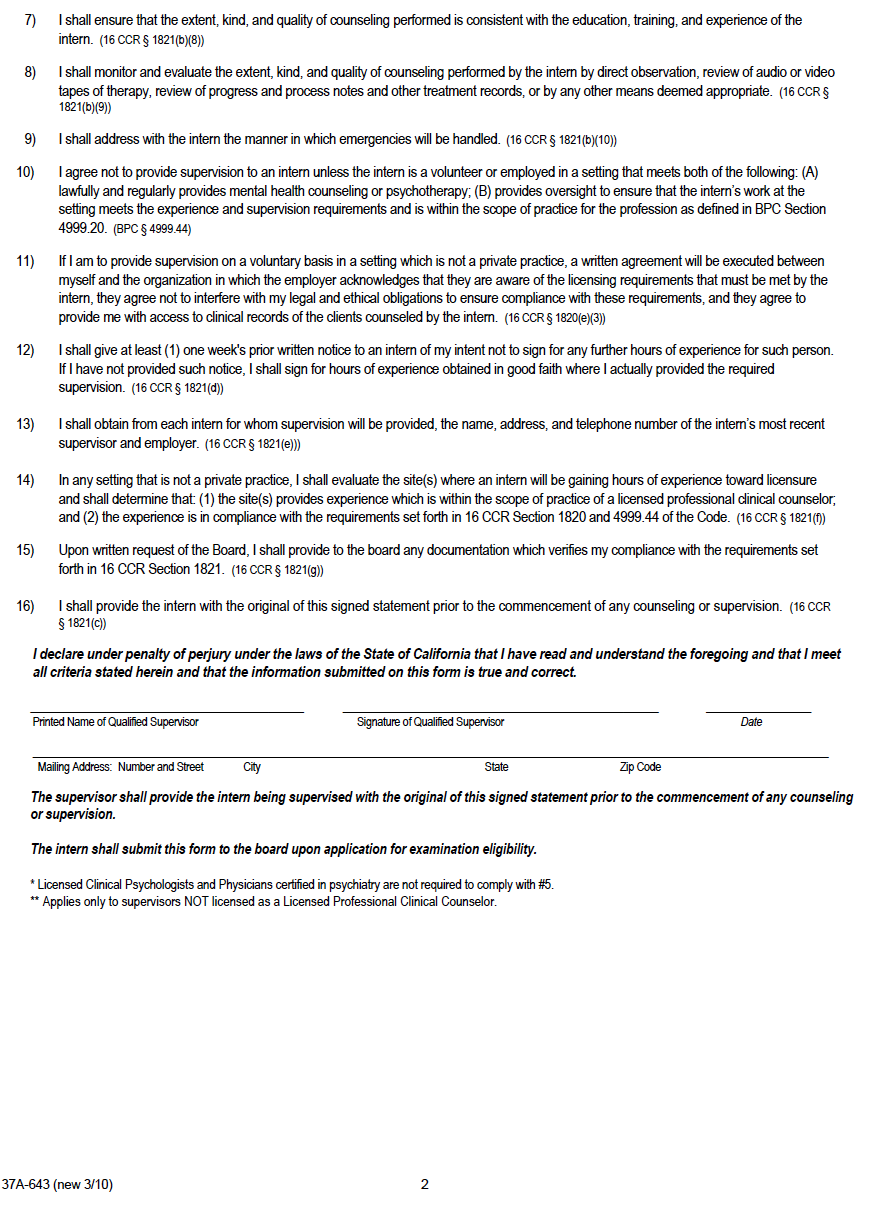
This PDF is provided as a print-only reference document and may not be fully accessible to users of assistive technology. For more information, please visit Title II Rule on Digital Accessibility page.