The Building Coherence Seminar Series

The Building Coherence Seminar Series…
provides principals and lead teachers with the knowledge, skills protocols and support needed to grow school cultures characterized by effective teacher leadership, common focus, collaborative teams and dedication to teaching and learning for all. The strategies and protocols shared throughout the seminars build high levels of teacher collaboration and leadership which research has shown to have the greatest impact on student achievement.
The Building Coherence Seminar Series’ Goals
- To overcome the traditional barrier of poverty and promote the highest levels of student achievement.
- To enable principals to transform the culture of their schools building teacher leadership, strong instructional coherence and high student learning outcomes.
- To develop teachers’ leadership capacity and techniques.
- Deepen the capacity of teacher teams – PLCs, task force groups and school committees—to value shared learning, work in highly collaborative groups, pursue instructional improvement, and enact shared decisions to better student learning outcomes.
- Enable principal and teacher leaders to sustain the emerging school culture and ensure the continuous improvement of student learning outcomes.
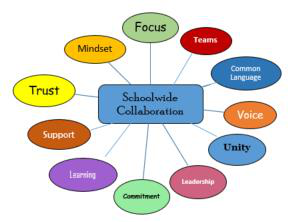
Improvement is a challenge of learning, not implementation.
The Building Coherence Seminar Series focuses on a developmental approach, one that prioritizes creating the conditions for powerful teaching and learning over time.
Building Coherence Seminar Series: Year One
Establishing Schoolwide Trust, Voice & Capacity
In the first year of this three-year program, principals and teachers learn about the value and impact of highly collaborative school cultures, practice new ways of growing trust across the faculty, begin to have teachers assume leadership roles in faculty meetings and learn about each other’s work style.
Each school’s Leadership Team – the principal and a team of lead teachers - attend the seminars to learn about new concepts and practices. Following each session, the Leadership Team deepens their understanding with the help of a coach and presents the new concepts and practices to the faculty.
| Session | Topic |
|---|---|
| Orientation | Pre-Meetings for The Principals and Representative Lead Teachers |
| Session One | Building A School Culture of High Collaboration, Strong Teacher Leadership, And A Singular Focus on Student Learning. |
| Session Two | Establishing Trust and Voice for All Teachers. |
| Session Three | Creating A Unifying Focus and “Learning for All” Mindset. |
| Session Four | How to Make Good Teams Great |
We believe that learning to improve is critical to advancing equity and learning opportunities for all students.

Building Coherence Seminar Series: Year Two
Developing Teacher Leadership & a Schoolwide Culture of Collaboration
In the second year of this three-year program, principals take actions empowering teachers to take the lead in making instructional decisions. Teacher leaders have the skills and confidence to lead the development of strong collaboration, a guiding instructional focus, a common language or instruction and more effective professional learning communities.
Leadership Teams – the principal and a team of lead teachers continue to learn and adopt new ideas to be shared at faculty meetings by the lead teachers. The Leadership Team coach helps them plan the expansion of the work across the school.
| Session | Topic |
|---|---|
| Session Five | Uniting Schoolwide Efforts Around an Instructional Focus |
| Session Six | Establishing a Common Language of Instruction |
| Session Seven | Using Gap Analysis to Advance Our Work |
| Session Eight | How Teams Bring Rigor to the Classroom |
| Session Nine | Assessing Our Coherence to Continue Our Journey |
Building Coherence Seminar Series: Year Three
Developing Teacher Leadership & a Schoolwide Culture of Collaboration
In the third year, the principals and teachers have developed trust, voice and a common focus across all grade levels. Teachers rotate through formal and informal leadership roles. To deepen their collaboration the faculty engages in peer observations.
Leadership Teams – the principal and a team of lead teachers continue to refine new ideas to be shared at faculty meetings by lead teachers. The Leadership Team coach helps plan the expansion of the work across the school. Peer observation becomes an integral part of the school’s instructional improvement strategy.
| Session | Topic |
|---|---|
| Session Ten | Peer Observation Protocols |
| Peer Observations | On campus peer observation protocol: Three rounds per site |
| Session Eleven | Deepening Collaboration |
| Session Twelve | Sustaining Collaborative School Cultures |
The Building Coherence Seminar Series is a three-year project originally designed by Harvard University’s Richard Elmore and launched in partnership with Fresno State University’s Welty Center to develop supportive conditions and systems for student and adult learning.
Historically education has been an isolated profession with teachers working alone or in pockets of cooperation. Research now shows that high levels of teacher collaboration have the greatest impact on student achievement. The Welty Center’s Building Coherence Seminar Series is unique as it provides principals and lead teachers with the knowledge, protocols and support they need to transform their school culture into one of common focus, effective teams, high coherence, and dedication to teaching and learning for all.
Learn more about
Building Coherence Seminar Series (BCII)
at the Welty Center Website
https://kremen.fresnostate.edu/centers-projects/weltycenter/services/bcii.html
For more information contact
Virginia “Ginny” Boris
BCII Project Coordinator
John Welty Center
For Educational Policy & Leadership
vboris@mail.fresnostate.edu
559 – 278 - 0265
Mabel Franks
Director
John Welty Center
For Educational Policy & Leadership
mafranks@mail.fresnostate.edu
559 – 278 - 0265
This HTML version was generated with AI assistance and may contain errors or omissions. The original approved PDF remains the official document of record. An alternative accessible format is available upon request from the document creator in accordance with Title II of the ADA.